B2B SEO for 2026: The 90 Day Brand First SEO Roadmap
If you are leading B2B marketing in 2026, you are stuck in a familiar squeeze:
→ Pipeline targets keep rising
→ CAC is under constant review
→ Boards and CEOs keep asking, “What is actually working?”
→ AI search is changing how buyers research and choose vendors in real time

Paul Slack, CEO of Vende Digital
“The biggest challenge for B2B marketers in 2026 is proving ROI in a world where buyers click less, fill out fewer forms, and make decisions long before they show up in your CRM. To keep up, marketers need connected systems and a story strong enough to stand out in a buyer-enabled world.”
In this environment, B2B SEO for 2026 cannot just mean “publish more blogs and hope something ranks.”
You need a brand first SEO roadmap that:
→ Shows up in classic search results
→ Dominates local and geographic intent (GEO)
→ Gets quoted and cited inside AI answers (AEO and LMO)
→ Owns the key spots in Google Maps and local packs
→ And most importantly, turns all that visibility into real revenue and pipeline
This post gives you a 90 day B2B SEO + GEO roadmap built specifically for marketing leaders who care about pipeline, revenue, and brand strength more than vanity metrics. It is intentionally simple to scan: clear sections, direct bullets, and practical steps you can run with immediately.
If you’d rather hand this off to a partner, you can see how we run this inside our own B2B SEO services.
Table of Contents Show
A B2B SEO Partner is MORE Affordable than you think.
Discover how Our Customers Grow Their Brands, Outshine Competitors, and Attract New Business

Quick Definitions: SEO, GEO, LMO, AEO
Before we walk through the 90 day roadmap, let’s align on terms so you can bring this straight to your leadership and sales teams.
SEO (Search Engine Optimization)
Everything you do to help search engines discover, understand, and rank your content in organic results.
In this roadmap, SEO is not just “more traffic.”
SEO = demand capture + brand credibility.
GEO (Generative Engine Optimization)
GEO is the practice of creating and structuring online content so that AI powered search engines and chatbots (like ChatGPT, Google’s AI Overviews, and Perplexity) can easily:
Discover your brand and content
Understand what you do and who you serve
Use your pages as sources when generating direct answers
LMO (Language Model Optimization)
LMO is the practice of creating and structuring online content so that AI powered search engines and chatbots can:
Discover your content
Correctly understand your entities, context, and relationships
Reuse your content to explain concepts, answer questions, and recommend vendors
GEO is about how generative engines find and use you.
LMO is about how language models interpret and trust you.
AEO (Answer Engine Optimization)
AEO is the game of making your brand the quoted source when answer engines and AI systems respond to your buyer’s questions.
It is still SEO, but tuned for:
Clear, direct answers
Strong and consistent entities
Real expertise and brand trust
You do not need four competing strategies.
You need one brand first strategy that intentionally covers SEO + GEO + LMO + AEO.

“If SEO is a black box, GEO (AEO) is a black box inside ten others. You’re not going to crack it or trick AI. This isn’t about gaming algorithms anymore, it’s about brand. AI is intelligence, and it’s trying to surface the best answer. Your job is to actually be that answer. The real challenge is understanding what AI cares about. The opportunity is that AI rewards clarity, authenticity, and genuinely great products. In many ways, that makes the job easier. Technology can handle the heavy lifting, like identifying content gaps and reducing AI hallucinations, so companies can focus on building something real and communicating it in a way that resonates.”
Why B2B SEO for 2026 Is Different
If you ran SEO five years ago, the playbook looked like this:
Keywords → content → backlinks → rankings
In 2026, the real stack looks more like:
Brand → Entity → Trust Signals → Visibility Everywhere
1. AI Answers and Assistants Are the New Front Door
Your prospects are now:
Asking ChatGPT, Gemini, and Perplexity for vendor recommendations
Seeing Google AI Overviews answer their question before the first blue link
Skimming direct answers instead of scanning ten organic results
Only brands with clear expertise and strong entities consistently show up.
This is where AEO and LMO matter most: your brand has to be a safe, obvious “source of truth” for the problems you solve.
2. Geographic and Local Relevance Still Matters in B2B
Your ICP might be national or global, but:
Deals still cluster in specific regions or metros
Trust is shaped by local proof, local partners, and regional case studies
Search engines weigh proximity, prominence, and relevance even for B2B queries
Your GEO and LMO work creates the bridge between brand, geography, and real world proof. For deeper local playbooks, see posts like How to Generate 5‑Star Google Reviews.
3. Branded Search Is the New Power Metric
Watch these queries closely:
“{your brand} reviews”
“{your brand} pricing”
“{your brand} + {service or category}”
When branded search volume increases, entity demand for your company is going up.
That is evidence your brand, content, PR, and revenue activities are working together. You can see how we think about this inside our own SEO pricing and plans.
4. Consistency Is the Real “Secret Hack”
Random SEO tactics do not win anymore. Coherent and consistent brand signals do:
Website and landing pages
Google Business Profile (GBP) and citations
Social profiles and content
PR, podcasts, and partnerships
Reviews and testimonials
Schema and structured data
All of these must agree on who you are, what you do, and who you serve.
The 90 day roadmap below is designed to enforce that alignment.
“If 2025 is about AI visibility, 2026 is about taking action to actually show up in AI search. I tell founders to skate to where the puck is going, not where it’s been. AI search is growing incredibly fast, and it’s a massive opportunity, especially in B2B. Tools like ChatGPT are already where people go to do real work, and that’s naturally where they’re discovering and evaluating software, solutions,
and vendors.”
The 90 Day B2B SEO Roadmap for 2026
(High Level)
Think of this as your 12 week sprint.
If you are a CMO or Head of Marketing, this is the slide you put in front of your CEO and CRO.
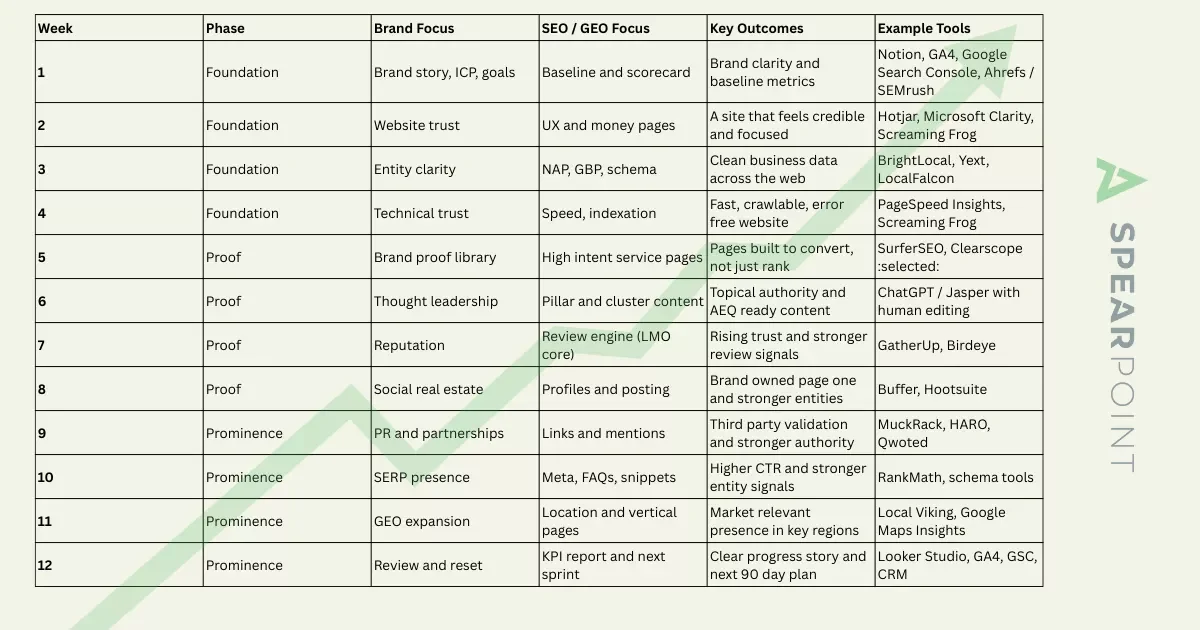
90 Day SEO and GEO Roadmap Overview

Jesse McFarland, Founder at SpearPoint Marketing
“A real B2B SEO roadmap is not about chasing more keywords. It is a 90 day plan to prove your brand belongs on the short list in search, in AI answers, and in your buyer’s mind when it is time to choose.”
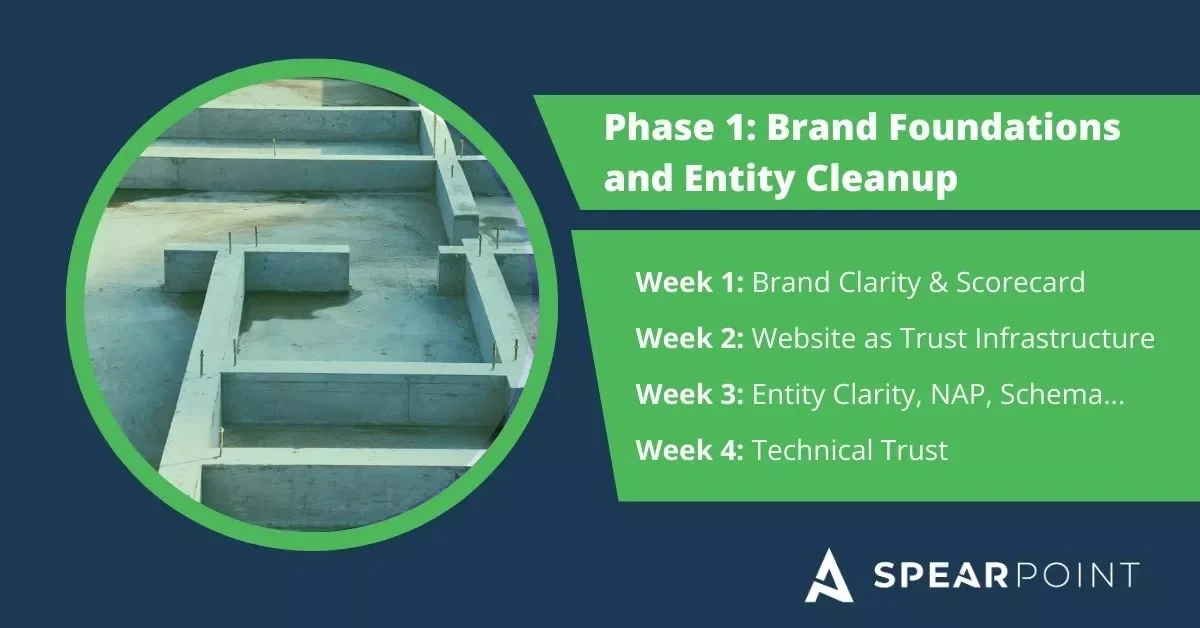
Phase 1: Brand Foundations and Entity Cleanup (Weeks 1–4)
This is where you move from “doing SEO tasks” to operating like a brand that search engines and buyers can trust.
Week 1: Brand Clarity and Scorecard
As a marketing leader, you do not need more dashboards. You need a focused set of metrics that connect directly to revenue and brand strength.
Context for leaders
If you cannot clearly state who you serve, why you win, and what you are optimizing for, every SEO and GEO initiative turns into noise.
This week is about alignment with leadership, sales, and RevOps.
What to do
Clarify your ICP and buying committee:
Industries and company size
Key triggers and pain points
Primary roles involved in the deal
Define your brand position on one page:
“We help [ICP] achieve [outcome] by [unique angle or method].”
Build your Brand for SEO Scorecard baseline:
Local visibility: map pack and GBP views
Reviews: volume, rating, and recency
Authority: number and quality of referring domains and mentions
Entity health: schema coverage, sameAs links, knowledge panel (yes or no)
Demand: branded search volume and trend
Content quality: organic traffic that turns into opportunities in your CRM
Example of a Scoring Scale for a SEO Scorecard
5 – Strong
Clear positive trend; meaningful visibility and trust gains.4 – Improving
Trending upward; momentum building.3 – Stable
No growth but no decline.2 – Weak
Inconsistent or declining signals.1 – Critical
Major gaps that limit visibility, trust, and AI discoverability.
Pro Mode tip:
Turn this scorecard into a recurring monthly slide. Over time, you can show how SEO, PR, and content work together to drive pipeline, similar to the way we show progress in our B2B SEO engagements.
Tools
Documentation: Notion, Miro
Data: Google Analytics 4, Google Search Console, Ahrefs / SEMrush
Week 2: Website as Trust Infrastructure
Every visitor and every algorithm is asking the same question:
“Does this look and feel like a real, competent, trustworthy brand?”
If the answer is “maybe,” no SEO tactic can fix that.
Context for leaders
An unclear or generic website makes every campaign less effective.
This week is about tightening your story and reducing friction for buyers.
What to do
Audit your home page and core offer pages:
Can an ideal buyer understand what you do in 5–7 seconds?
Do they see credible proof (logos, testimonials, case studies) without endless scrolling?
Is there a clear main CTA and a low friction micro CTA (like a demo, roadmap, or audit)?
Split services and solutions into focused pages:
Avoid dumping everything onto one “Services” page.
Create one page per core offer, mapped to specific intent and future GEO or AEO angles. For inspiration, look at how your own service pages are structured.
Tighten the copy:
Speak to outcomes, not just features.
Mirror the language your ICP uses on calls, not internal buzzwords.
Pro Mode tip:
Use a CTA library like the ideas in 25 Call‑To‑Actions for B2B Websites to test and rotate stronger offers on your key pages.
Tools
UX insights: Hotjar, Microsoft Clarity
Structure and on page SEO: Screaming Frog
Design collaboration: Figma or similar
Week 3: Entity Clarity, NAP, Local Search, Schema, and Maps
This is the foundation of your SEO roadmap and Local Maps presence.
Context for leaders
Search engines do not trust brands that cannot keep their own name, address, and phone number consistent.
Cleaning up entity data is one of the highest leverage projects you can complete in one to two weeks.
What to do
Overhaul your Google Business Profile (GBP):
Complete categories, services, description, photos, FAQs, booking or contact links.
Add UTM tags to URLs so you can measure GBP driven pipeline.
Fix citations and NAP consistency:
Audit key directories such as Google, Bing, Apple Maps, Yelp, and industry specific sites.
Correct name, address, phone, hours, URLs, and categories.
Implement Organization or LocalBusiness schema:
Add sameAs links for LinkedIn, X, YouTube, and other primary profiles.
Make sure contact details match your GBP and your site footer.
Pro Mode tip:
If local SEO is a major lever for you, pair this with a focused review strategy like the one in How To Generate 5‑Star Google Reviews.
Tools
Citations and local data: BrightLocal, Yext
Local rank and local search monitoring monitoring: LocalFalcon, Local Viking
Schema implementation: RankMath or manual schema markup
Week 4: Technical Trust (Just Enough To Not Be Broken)
You do not need perfect technical SEO. You do need to avoid breaking the basics.
Context for leaders
Technical issues silently kill performance:
Pages that are not indexed
Slow page loads
Broken links and redirect chains
This week is about removing roadblocks so your brand, content, and authority signals can actually work.
What to do
Run a site crawl and Core Web Vitals check:
Identify 404 errors, redirect chains, duplicate content, and noindex issues.
Flag slow pages, especially money pages and pillar content.
Prioritize P0 and P1 fixes:
Anything that breaks a user journey.
Major performance issues on high value pages.
Robots.txt or meta tag issues that block crawlers.
Align with engineering or your dev partner:
Put technical SEO items into the sprint backlog with a clear statement of business impact.
Tools
Crawling: Screaming Frog, Sitebulb
Performance: PageSpeed Insights
Edge caching and speed: Cloudflare
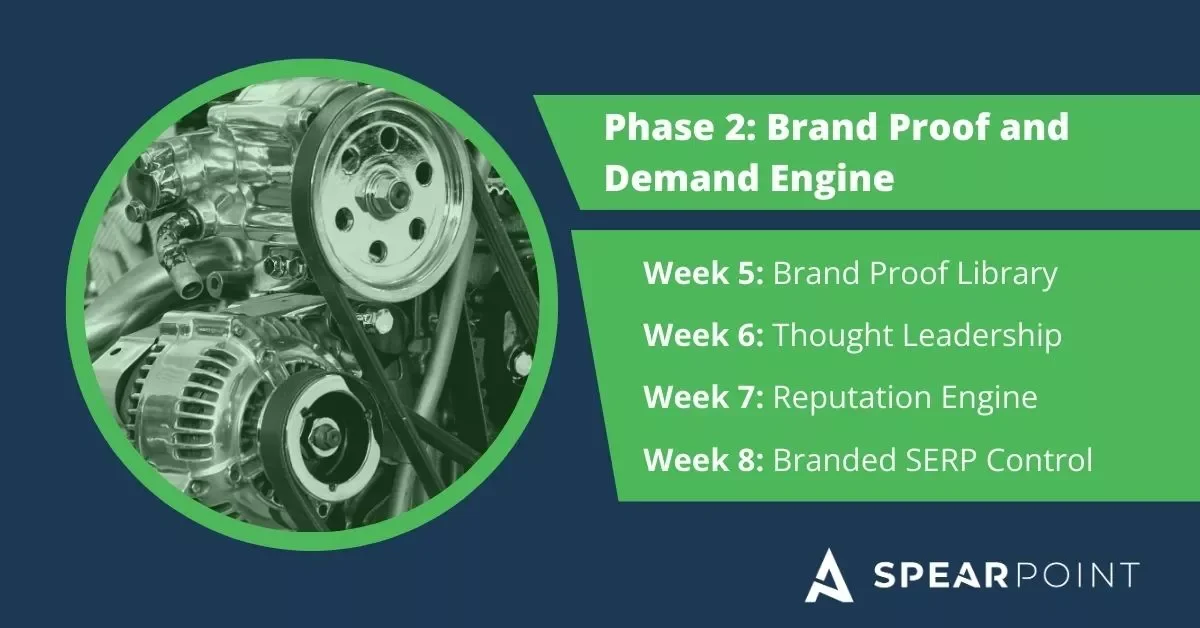
Phase 2: Brand Proof and Demand Engine
(Weeks 5–8)
Now you prove to the market and to algorithms that you are the obvious choice.
Week 5: Brand Proof Library and High Intent Pages
Most B2B SEO programs fail here: plenty of content, but weak money pages. You want the opposite.
What to do
Identify 3–5 revenue critical offers:
Services, packages, or core product lines.
For each, create or overhaul a dedicated page:
Clear, ICP specific headline.
Simple problem → solution → outcome narrative.
Process explained in 3–5 steps.
Social proof: logos, quotes, mini case studies.
Primary CTA (book a call) and secondary CTA (download, demo, or guide).
Add at least one comparison or evaluation asset:
“[Your brand] vs [Competitor]”
“Best [category] platforms for [ICP] in 2026”
Make it honest and genuinely useful.
How this supports AEO, GEO, and LMO
These pages become canonical sources that answer engines can reference when people ask “Who should I use for X?”
They’re also where you send traffic from thought leadership content.
Pro Mode tip:
Review how you talk about offers on your B2B SEO services page and mirror that clarity and proof across all your high intent pages.
Tools
Content optimization: SurferSEO, Clearscope
On page analysis: SERanking, Search Atlas
Conversion tracking: GA4 events and simple before/after comparisons
Week 6: Thought Leadership at Scale (Fuel for AEO and LMO)
This is where you start winning answer engines and building branded demand.
Context for leaders
LLMs and AI overviews tend to favor:
Clear explanations
Strong topical coverage
Original frameworks and points of view
Demonstrated experience and proof
What to do
Pick one strategic topic cluster that is central to your GTM, such as:
“Revenue operations for PLG SaaS”
“Multi location healthcare marketing”
“Cybersecurity readiness for mid market manufacturers”
Create:
One pillar guide that serves as your definitive take on the topic
Three to seven supporting articles such as FAQs, how‑tos, comparisons, and checklists
Structure content for AEO and LMO:
Include short, direct answers near the top.
Use clear H2 and H3 headings around specific sub questions.
Write definitions that are easy for answer engines to copy and reuse.
Include original frameworks, diagrams, or processes that only your brand owns.
Pro Mode tip:
Tie this cluster into existing content like your B2B SEO trends and ranking factors or your unconventional B2B SEO strategies so you build one strong topical graph instead of dozens of isolated posts.
Tools
Drafting assistance: ChatGPT or Jasper
Editing quality: Grammarly
Planning: Notion, Asana, or your content calendar tool
Week 7: Reputation Engine (Reviews, Testimonials, Proof)
Your reputation layer is core to LMO, GEO, and traditional SEO.
Context for leaders
Buyers trust reviews more than your claims.
Algorithms treat reviews and ratings as a proxy for real world trust.
What to do
Decide where reviews matter most:
GBP for local visibility
Review platforms like G2, Capterra, Clutch
Industry directories and partner marketplaces
Design a review playbook:
When do you ask? (launch, renewal, successful QBR, major milestone)
Who asks? (CSM, AE, founder, or account lead)
How do you ask? (personal email, in‑app prompt, automation)
Respond to every review:
Thank positive reviews with specifics.
Address negative reviews honestly and calmly.
Pro Mode tip:
Pair this program with the approach in How To Generate 5‑Star Google Reviews for Your Business Profile so your team is not guessing how to ask.
Tools
Review request and management: GatherUp, Birdeye, BrightLocal
Internal tracking: HubSpot or Salesforce tasks and workflows
Week 8: Own Your Social Real Estate (Branded SERP Control)
Social signals themselves are not direct ranking factors, but they strongly influence brand perception, GEO relevance, entity strength, and AEO credibility.
Context for leaders
When someone Googles your brand, they should see:
Your website
Your Google Business Profile (GBP)
Your key social profiles
Your YouTube channel or podcast
Your Reddit presence (owned profiles + relevant subreddit participation)
All of it should look aligned, professional, credible, and active.
What to do
Clean up LinkedIn, X, YouTube, Reddit, and other priority channels:
Consistent bios, logos, brand visuals, and messaging
Clear articulation of who you serve and how you help
Strong links back to key pages on your website
On Reddit: maintain a branded profile, answer industry questions, and participate in category subreddits without being salesy
Reddit is one of the strongest third-party authority signals for AEO — LLMs trust Reddit threads heavily.
Set up a lightweight publishing cadence:
Two to three posts per week on LinkedIn, X, and YouTube
One to two meaningful engagements per week on Reddit (comments > posts)
A mix of:
Proof (wins, testimonials, results)
POV (thought leadership, frameworks, insights)
Helpful micro content pulled from your pillar content
Activate leadership and SMEs:
Turn subject-matter experts into visible, on-brand thought leaders
Encourage them to contribute to:
LinkedIn conversations
Industry threads on Reddit
Niche community spaces (subreddits, Slack groups, forums)
Tools
Scheduling: Buffer, Hootsuite, or ContentStudio
Reddit monitoring: Reddit search, Later, or manual subreddit tracking
Asset library: Notion, Google Drive
Clip creation: Descript, Riverside
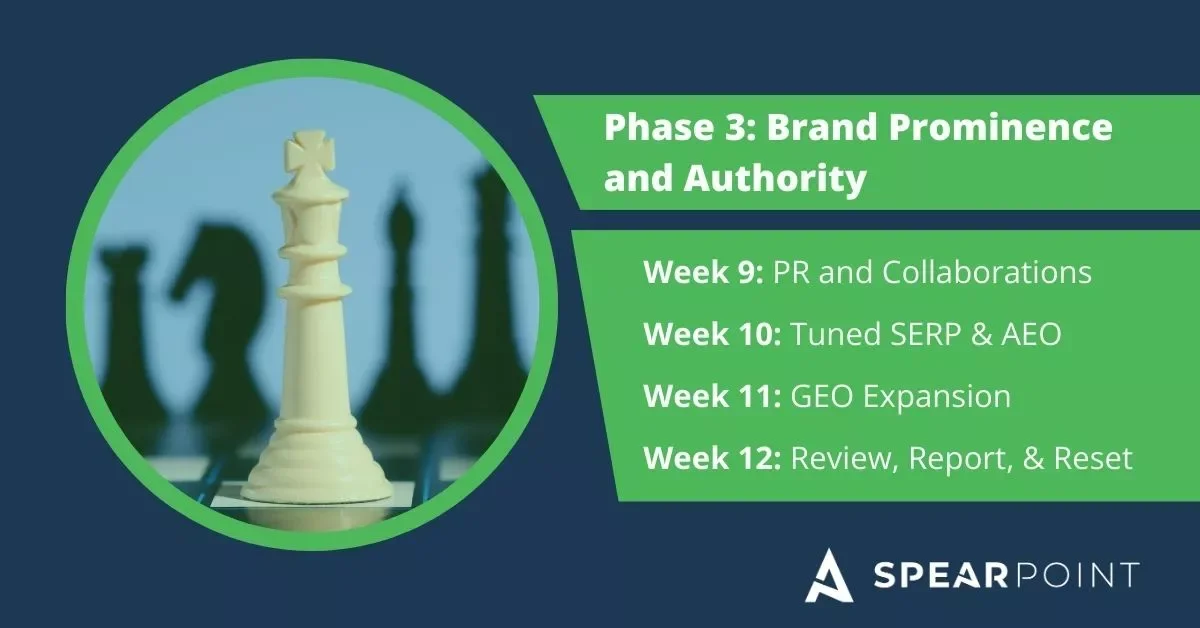
Phase 3: Brand Prominence and Authority (Weeks 9–12)
Now you scale brand prominence so that SEO, GEO, AEO, and LMO all compound.
Week 9: PR, Partnerships, and Collaborations
This is where your authority stops being self reported and starts being validated by others.
Context for leaders
Third party validation changes how sales conversations feel.
PR and partnerships also create the type of links and mentions that search engines treat as real authority.
What to do
Build a target list of:
Industry podcasts
Niche newsletters
Events and webinars
Partner blogs and integration pages
Local or trade press
Pitch stories that actually matter:
Unique data from your product or client base.
Category level points of view.
Founder or transformation stories.
Turn each win into multi channel presence:
Add logos to your site.
Link from a PR or “In the News” page.
Share clips and quotes on social.
Reference the coverage in sales sequences.
Tools
Outreach: MuckRack, Prowly
Source requests: HARO, Qwoted
Coordination: Asana, ClickUp
Week 10: Brand Tuned SERP and AEO Optimization
Now you refine how your brand appears in search results and answer surfaces.
Context for leaders
This is often low hanging fruit that improves CTR, trust, and answer engine performance without requiring new content.
What to do
Rewrite titles and meta descriptions for:
Core money pages
Pillar content
About and key brand pages
Focus on clarity, outcomes, and your brand name.
Add and refine FAQ sections:
Base questions on sales and customer conversations.
Make answers short, direct, and skimmable.
This is perfect material for AEO and GEO.
Tighten internal linking:
Treat pillars and money pages as hubs.
Point supporting content toward those hubs with descriptive anchor text.
Pro Mode tip:
Use FAQs to connect into core topics you already rank for, like SEO for lead generation,B2B keyword research, or B2B link building strategies.
Tools
Structured data and quick edits: RankMath or Yoast
SERP analysis: SERanking, Search Atlas
Performance and CTR: Google Search Console
Week 11: GEO Expansion Without Doorway Spam
This is the strategic side of your GEO roadmap.
Context for leaders
Do not spin up 50 copy paste location pages.
Instead, build real, differentiated pages for markets and industries that truly matter.
What to do
Choose strategic GEO or vertical bets:
Regions your sales team is focusing on.
Industries where you already have strong proof.
For each, create a specific landing page:
“{Service} for {Industry} in {Region}”
Integrate localized proof, case studies, testimonials, and context.
Explain how your approach fits that market’s regulations, buying cycles, and tech stack.
Align with LMO and GEO work:
Link to relevant GBP profiles where applicable.
Ensure NAP details match across site and citations.
Use local elements such as maps, partner logos, or local references.
Tools
Local visibility: Local Viking, LocalFalcon
Performance by region: GA4 and GSC segmented by region or landing page
Week 12: Review, Report, and Reset
Do not end the 90 days by asking, “So did it work?”
End it with a clear, leader level story.
What to do
Rescore your Brand for SEO Scorecard:
Local visibility trend
Reviews: volume, rating, and recency
Authority: meaningful links and mentions
Entity health: schema, citations, knowledge panel
Demand: branded search trend
Pipeline: organic sourced or influenced opportunities and revenue
Highlight your biggest wins:
Which content influenced opportunities?
Which channels or plays created the fastest lift?
Where did AEO, GEO, or LMO clearly improve results?
Build your next 90 day roadmap:
Double down on what moved the needle.
Pause or stop what did not.
Add one or two new experiments, not ten.
Tools
Reporting: Looker Studio, Power BI
Collaboration and storytelling: Notion, Google Slides
Data: GA4, GSC, CRM
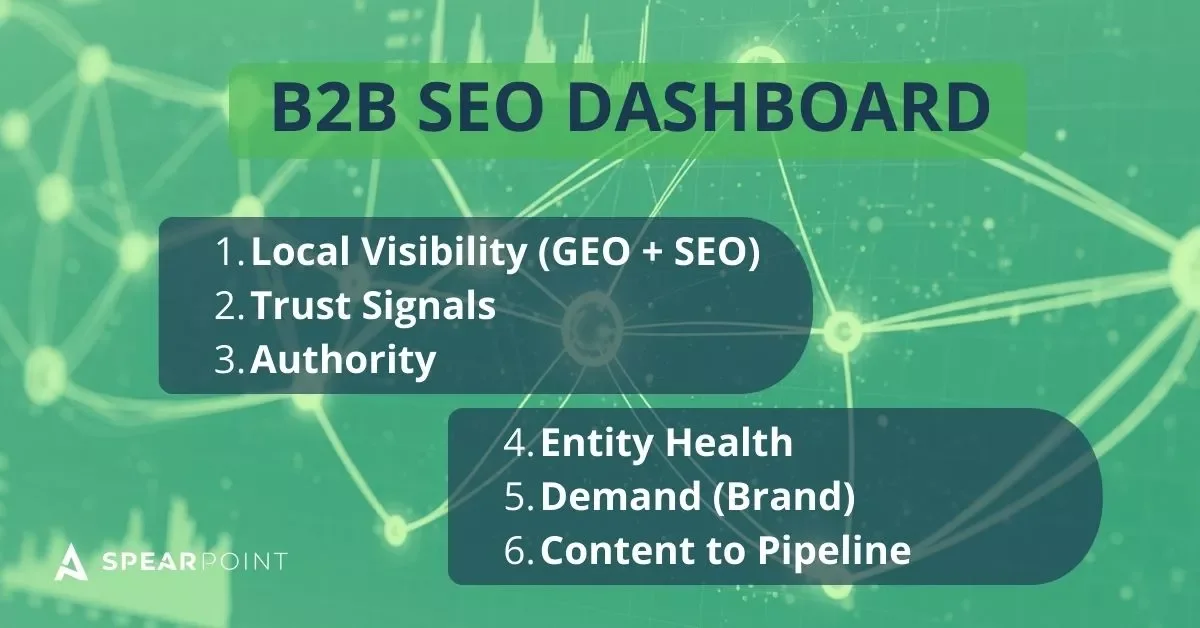
The Brand for SEO (At a Glance)
For B2B marketing leaders, this is your core dashboard.
Track monthly:
Local Visibility (GEO + SEO)
Map Pack impressions
GBP profile views and actions
Trust Signals
New reviews per month
Average rating
Response rate
Authority
New referring domains from credible sites
Press mentions, podcasts, partner features
Entity Health
Schema coverage and errors
NAP consistency score
Knowledge panel presence
Demand (Brand)
Branded search volume and trend
Brand + “pricing,” “reviews,” “case studies”
Content to Pipeline
Opportunities sourced or influenced by organic
Key pages appearing in closed won journeys
If these trend upward, you are winning the only game that matters: Brand strength in the eyes of both customers and algorithms.
Final Word: Brand First B2B SEO for 2026
In 2026, the winners are not the companies doing the most SEO activity.
They are the brands that look undeniably real, trusted, and present everywhere:
In classic search (SEO)
In local and Maps (Local SEO and GEO)
Inside AI answers and overviews (AEO, GEO, and LMO)
In the minds of your ICP when they build their short list
You do not need 50 competing projects.
You need one focused 90 day SEO roadmap you can execute, measure, and repeat.
If you want a partner who lives and breathes this, you can:
Explore B2B SEO services from SpearPoint
Book a free SEO audit and demo
Or talk with us about conversion based SEO (SEO + CRO)
Struggling with B2B SEO?
Discover How SpearPoint Grows Brands and Drives Conversions
About the Author

Jesse McFarland is the founder of SpearPoint Marketing, a conversion-focused SEO agency helping B2B, professional services, and SaaS brands turn search visibility into a measurable pipeline. With over 17 years of digital marketing experience spanning agency and in-house leadership, Jesse specializes in technical SEO, content strategy, CRO, and Digital PR. Since early 2024, his team has tracked hundreds of weekly queries across ChatGPT, Perplexity, Google AI Overviews, and Gemini, documenting measurable gains in AI citation rates for clients.
Jesse is a thought leader and speaker on B2B SEO, helping brands adapt their strategies for the next era of AI-powered search.
About Jesse. LinkedIn