How to Get More Gym Members: A Digital Marketing Guide for Gym Owners

Figuring out how to get more gym members remains the single biggest challenge for most fitness business owners. The industry is not just growing, it is hitting record highs. According to the Health & Fitness Association’s 2026 U.S. Consumer Report, 81 million Americans held gym memberships in 2025, a 5.2% increase from 2024 and the highest number ever recorded.
That momentum continues into 2026, with more than 100 million Americans using fitness facilities when you include non-members through day passes and guest access.
On the surface, that growth sounds like good news, and it is. But it also means the market is more competitive than ever. With participation rising across every demographic and more facilities entering the space, gyms are no longer just competing on location or price. The businesses consistently winning new members are the ones investing in strategic digital marketing, strong branding, and conversion-focused websites to stand out in an increasingly crowded market.
If your gym relies on word of mouth, a few social media posts, and a prayer, you are leaving money on the table. At SpearPoint Marketing, we specialize in gym and fitness SEO that puts local facilities in front of the people searching for them right now. This guide walks you through the digital marketing strategies that actually fill membership rosters, from local SEO and Google Business Profile optimization to review generation, content marketing, and retention tactics that keep your revenue predictable.
Summary: How to Get More Gym Members
Getting more gym members in 2026 comes down to being findable, credible, and worth talking about. Local SEO and a well-optimized Google Business Profile put your gym at the top of search results when people look for a fitness center nearby. Strong reviews and a steady stream of fresh content build trust before a prospect ever walks through your door. Paid ads can accelerate growth, but the gyms that sustain it long-term are the ones that also invest in retaining the members they already have, because keeping a current member costs a fraction of acquiring a new one. The best gym marketing strategy is not one tactic in isolation; it is a system where every channel reinforces the others.
Table of Contents Show
Key Points
Local SEO drives the highest-intent traffic. 46% of all Google searches have local intent, and "gym near me" generates over 1.8 million searches per month. Ranking in the local map pack puts your facility directly in front of people ready to sign up.
Your Google Business Profile is your digital storefront. It is free, it controls what prospects see first, and gyms that optimize it consistently see measurable increases in calls, direction requests, and website visits.
Reviews are your most powerful trust signal. According to BrightLocal's 2026 Local Consumer Review Survey, 68% of consumers will only use a business rated four stars or higher, and 41% always read reviews before choosing a local business.
Content marketing compounds over time. Blog posts and location pages that target specific keywords continue generating organic traffic months and years after publication, reducing your cost per lead with every passing quarter.
Paid ads fill gaps, not foundations. Google Ads and Meta Ads can generate quick leads, but without a strong organic presence, you are renting attention instead of owning it. The most efficient gyms use paid campaigns to supplement, not replace, their SEO strategy.
Retention is the highest-ROI marketing strategy. Acquiring a new gym member costs five to seven times more than retaining an existing one. Gyms that reduce annual churn by even 10% can recover tens of thousands of dollars in revenue.
A referral program turns members into your sales team. Referral acquisition costs range from $10 to $30 per member, compared to $60 to $120 through traditional marketing channels. Happy members who feel part of a community naturally recruit others.
Find Out Where Your Gym Stands Online
Not sure how your gym's digital presence stacks up? SpearPoint offers a free SEO guide built specifically for gym owners. Download the free gym SEO guide and see where the biggest opportunities are.
How Local SEO Helps You Get More Gym Members
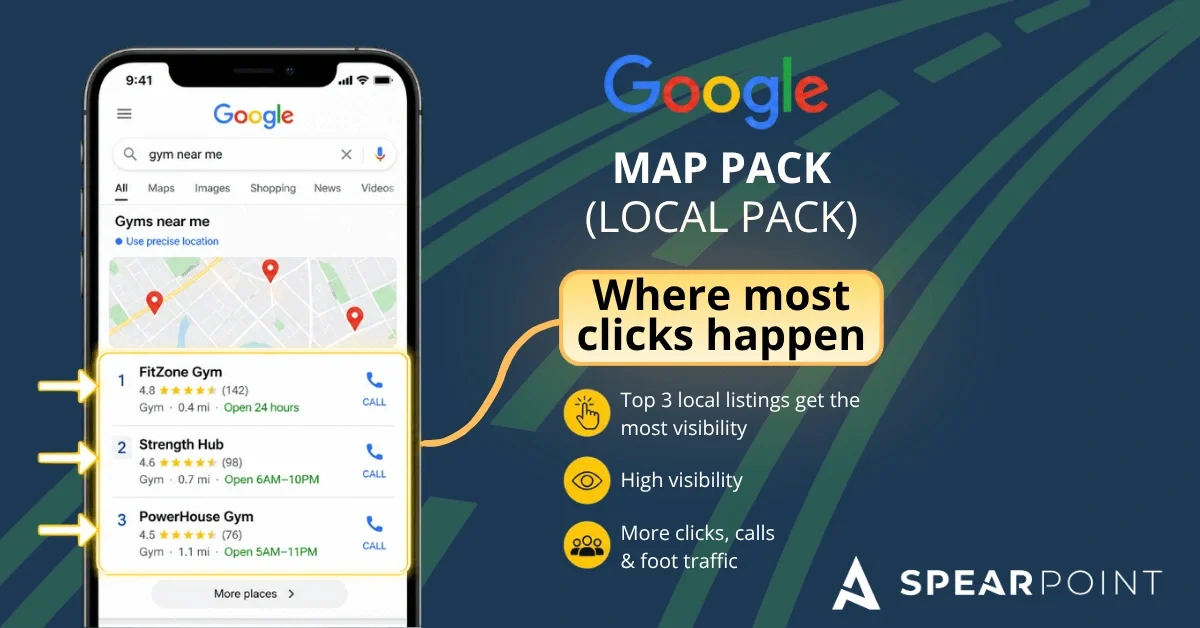
When someone searches "gym near me" or "fitness center in [city]," Google serves a local map pack at the top of the results. That map pack is where the vast majority of clicks go, and ranking there requires a deliberate local SEO strategy. According to Google's own data, 46% of all searches carry local intent, and 76% of people who search for something local on their smartphone visit a related business within 24 hours.
Local SEO for gyms starts with three fundamentals: a fully completed Google Business Profile with accurate name, address, phone number, and hours; consistent citations across directories like Yelp, Apple Maps, and Facebook; and location-specific content on your website that signals relevance to Google's algorithm. Getting these basics right is not glamorous, but it is the foundation that every other marketing channel builds on.
Google Business Profile Optimization
Your Google Business Profile is often the first impression a prospective member gets. It shows your photos, reviews, hours, and a link to your website directly in search results and Google Maps. Gyms that treat their profile as an afterthought miss the easiest win in digital marketing.
Optimization means more than filling in every field. Post weekly updates showing classes, promotions, or member achievements. Add high-quality photos of your facility, equipment, and community events. Respond to every review, positive or negative, within 48 hours. These actions signal to Google that your business is active and trustworthy, which directly influences your ranking in the local map pack.
Location Pages and Local Content
If your gym serves multiple neighborhoods or cities, each area deserves its own landing page. A page titled "CrossFit Gym in South Denver" targets a different search query than your homepage, and it gives Google a clear signal about where you operate. Each page should include the neighborhood name, nearby landmarks, driving directions, and unique details about that location.
Local blog content amplifies this strategy. Writing about community events, local fitness challenges, or neighborhood-specific health trends creates additional pages that rank for long-tail keywords. Over time, this content library becomes a lead generation engine that works around the clock.
Why Reviews Are the Key to Gym Growth
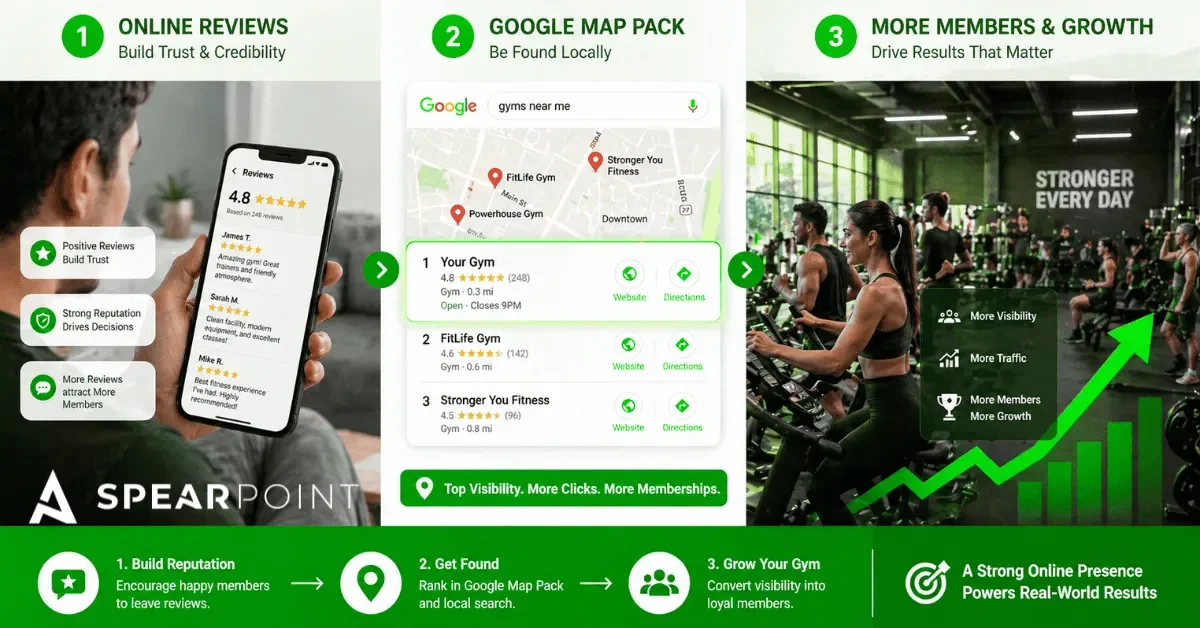
Online reviews have become the deciding factor for most gym shoppers. BrightLocal's 2026 Local Consumer Review Survey found that 41% of consumers always read reviews when considering a local business, a sharp increase from 29% just one year earlier. Even more striking, 68% of consumers now refuse to use a business rated below four stars, and 31% require at least 4.5 stars.
For gym owners, this means a steady stream of positive, recent reviews is not optional. Reviews serve double duty: they build trust with prospective members and they function as a ranking signal that Google uses to determine your position in local search results. A gym with 200 recent, high-rated reviews will consistently outrank a competitor with 30 reviews from two years ago, even if the competitor's website is technically better optimized.
Building a Review Generation System
The gyms that collect the most reviews are the ones that make it easy and make it habitual. Train your front desk staff to ask for a review after every positive interaction. Send an automated follow-up email or text 24 hours after a member's first visit, a personal training session, or a milestone achievement. Include a direct link to your Google review page so the member can leave feedback in under 60 seconds.
Responding to every review matters just as much as collecting them. A thoughtful response to a five-star review reinforces the positive experience, while a professional response to a negative review shows prospects that you take feedback seriously. SpearPoint has written extensively about this process in our guide to generating gym reviews, which breaks down the exact systems that high-performing gyms use.
Your Reviews Could Be Working Harder
Review strategy is one piece of a larger gym marketing system. If you want to see how SEO, reviews, and content work together for your specific market.
Content Marketing That Attracts Gym Members
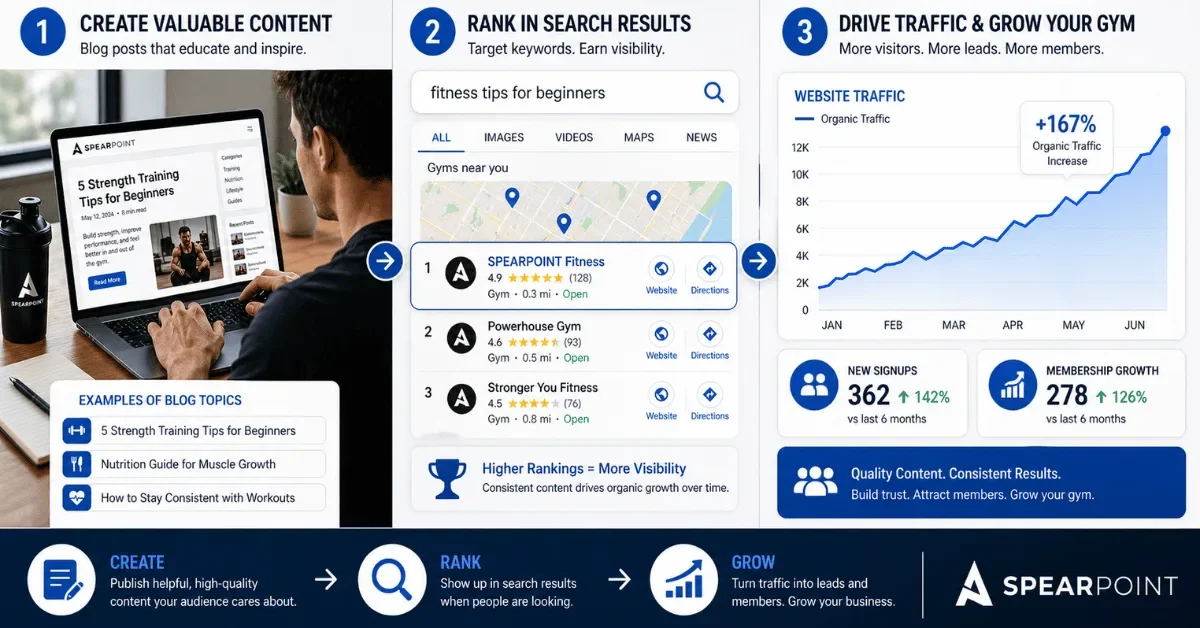
Content marketing is the long game, and it is one of the most cost-effective gym marketing strategies available. Every blog post, landing page, or resource you publish creates a new entry point for organic search traffic. Unlike paid ads, which stop generating leads the moment you stop paying, a well-written blog post can rank for years and continue bringing in visitors at no incremental cost.
The key is targeting the right keywords. Broad terms like "gym" or "fitness" are too competitive for most local facilities. Instead, focus on specific, high-intent phrases like "best gym for beginners in [city]," "CrossFit classes near [neighborhood]," or "personal training for weight loss [city]." SpearPoint's gym keyword research guide walks through how to identify the terms your ideal members are actually searching for.
Blog Topics That Drive Traffic and Trust
The best gym blog content answers real questions that prospective members are typing into Google. Topics like "what to expect at your first gym visit," "how to choose between a big box gym and a boutique studio," and "how often should a beginner work out" attract people in the research phase of their buying decision. By the time they finish reading your article, they already trust your expertise and your brand is top of mind.
Consistency matters more than volume. Publishing two well-researched, keyword-targeted posts per month will outperform a burst of ten generic articles. Each post should be at least 1,500 words, include internal links to your service pages and location pages, and incorporate external links to authoritative sources that support your claims.
Using Paid Ads to Accelerate Gym Membership Growth
Paid advertising on Google and Meta (Facebook and Instagram) can deliver leads faster than any organic strategy. Google Ads puts your gym at the top of search results for high-intent keywords immediately, while Meta Ads let you target specific demographics, interests, and geographic areas with visual creative that showcases your facility and community.
The most effective gym ad campaigns are tightly targeted. On Google, bid on keywords like "gym membership [city]" and "personal training near me" rather than broad terms that waste budget. On Meta, use radius targeting around your location and create separate ad sets for different audiences: new movers, fitness enthusiasts, parents looking for family-friendly options, and lapsed gym members who canceled elsewhere.
Where most gym owners go wrong with paid ads is treating them as their entire marketing strategy. Ads are a supplement, not a substitute. A prospect who clicks your Google ad still checks your reviews, browses your website, and evaluates your content before deciding. If those elements are weak, your ad spend converts at a fraction of its potential. That is why SpearPoint Marketing builds gym marketing systems where SEO, content, and paid media reinforce each other rather than operating in silos.
Stop Guessing, Start Growing
Whether you are running ads, investing in SEO, or just getting started with digital marketing, SpearPoint can build a plan tailored to your gym's goals and budget. See our gym marketing services and learn what a focused strategy looks like.

Member Retention: The Most Overlooked Gym Marketing Strategy
Most gym marketing conversations focus on acquisition, but retention is where the real money is. Acquiring a new member costs five to seven times more than keeping one you already have, according to industry research published by IHRSA (now the Health & Fitness Association). The average gym sees roughly 28.6% annual member churn, which means nearly three in ten members leave every year. For a 1,000-member facility charging $50 per month, that churn represents $171,600 in lost annual revenue.
Retention is a marketing strategy because every member who stays is a member you do not need to replace. And every retained member is a potential source of referrals, positive reviews, and social media content that fuels your acquisition efforts. The two sides of the equation are inseparable.
The First 90 Days Are Critical
Research consistently shows that members who stay engaged during their first 90 days are far more likely to remain long-term. This window is where gyms should concentrate their onboarding energy. Schedule a welcome call or meeting within the first week. Offer a complimentary personal training session to help new members build a routine. Send check-in emails at the two-week, 30-day, and 60-day marks.
Technology can help automate this process. Gym management platforms can trigger email sequences, track visit frequency, and flag members who have not checked in recently. When a member goes dark for two weeks, an automated text saying "We miss you, here is a free guest pass for a friend" costs almost nothing and can re-engage someone before they cancel.
Community as a Retention Engine
Gyms that build a genuine community retain members at significantly higher rates than those that simply provide equipment and space. According to a Glofox fitness industry survey, 73% of fitness consumers say that being part of a community helps them stay motivated, and 57% cite social interaction as the top reason they join a fitness community.
Community is not a vague aspiration; it is a set of deliberate actions. Host monthly member events. Create accountability groups or challenge programs. Feature member spotlights on social media. Train your coaches and staff to learn names, celebrate milestones, and check in personally. These investments in culture pay for themselves many times over through reduced churn and increased referrals.
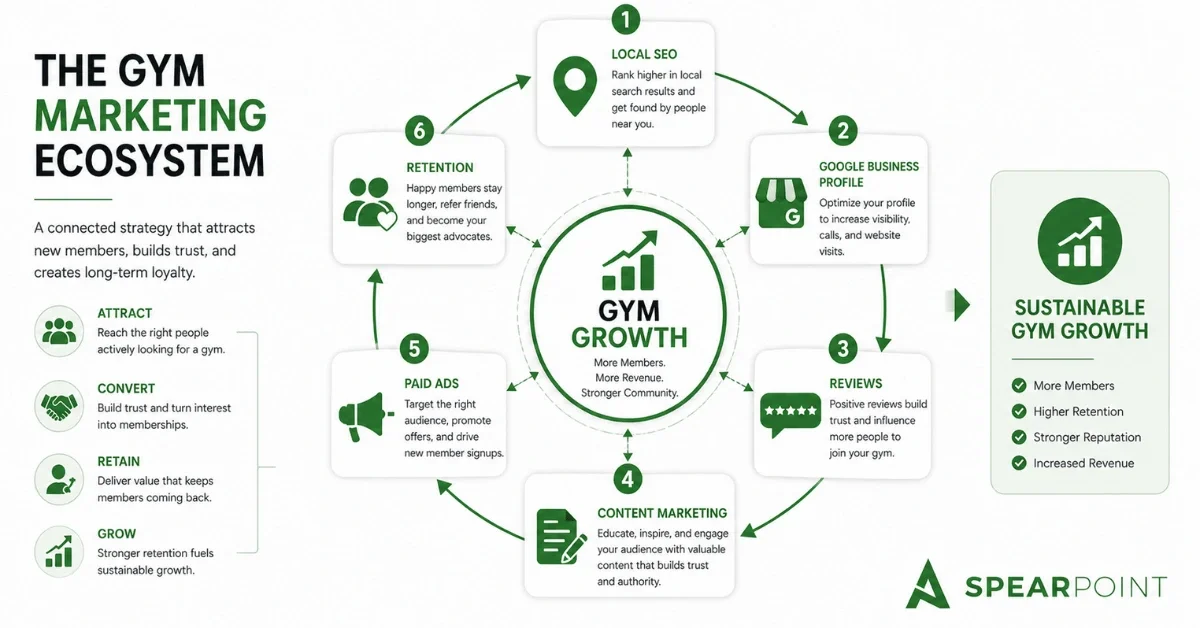
Building a Complete Gym Marketing System
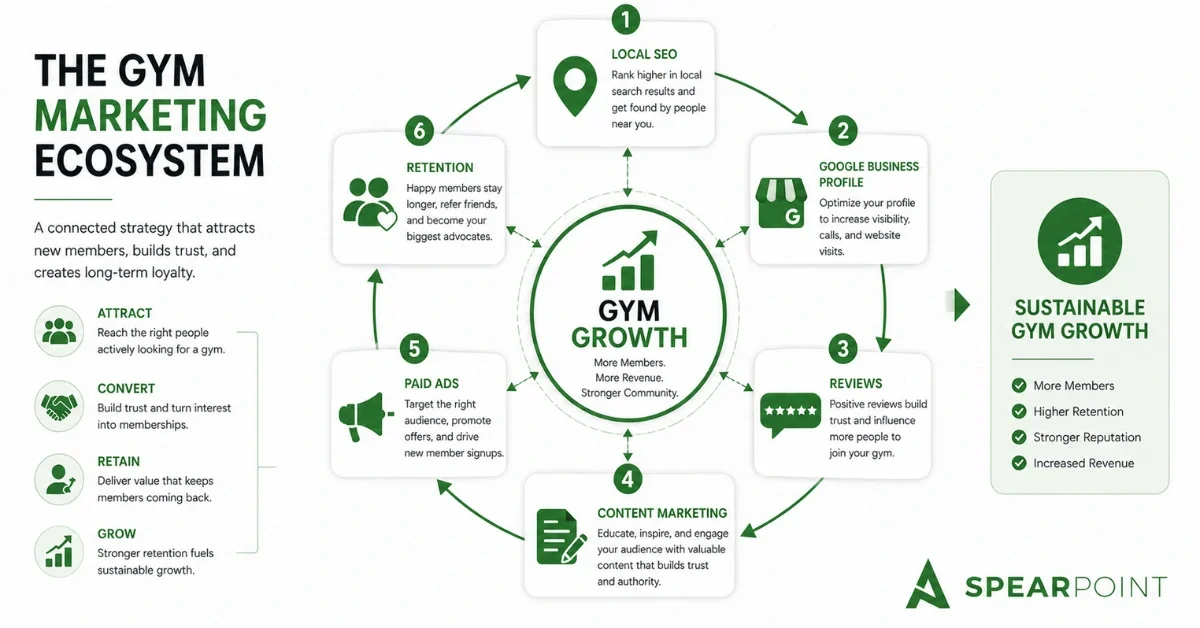
The gyms that grow consistently are not the ones doing one thing exceptionally well. They are the ones where every marketing channel supports the others. Local SEO drives organic visibility. A strong Google Business Profile converts that visibility into calls and website visits. Reviews build the trust that turns a curious browser into a facility tour. Content marketing keeps your gym top of mind throughout the research process. Paid ads fill seasonal gaps and target specific demographics. And retention ensures that the members you worked so hard to acquire stay, refer others, and increase their lifetime value.
This is exactly how SpearPoint Marketing approaches gym marketing. Founded by Jesse McFarland, a former personal trainer, health club manager, and fitness business owner with an MBA and over 17 years in digital marketing, SpearPoint understands the fitness industry from the inside. We do not apply generic marketing templates to gym businesses. We build custom SEO and digital marketing strategies rooted in how gym members actually search, decide, and sign up.

7 Gym Marketing Strategies Every Fitness Business Owner Should Know
Keep these fundamentals in your back pocket as you build your marketing plan for the year ahead.
Claim and optimize your Google Business Profile. It is free, it is the first thing prospects see, and it directly influences whether they call or keep scrolling.
Target "near me" and city-specific keywords. Generic fitness content will not outrank national brands. Local specificity is your competitive advantage.
Build a review generation system. Ask after every positive interaction, automate follow-up requests, and respond to every review within 48 hours.
Publish at least two blog posts per month. Each post is a new opportunity to rank for a keyword and attract a prospect you would never have reached otherwise.
Use paid ads strategically, not desperately. Set clear cost-per-lead targets, track conversions, and let organic efforts carry the long-term load.
Invest in your first 90 days of onboarding. A welcome call, a complimentary session, and regular check-ins dramatically reduce early cancellations.
Build community on purpose. Events, challenges, social media spotlights, and staff who know members by name create the kind of loyalty that no discount can buy.
The gyms that win are not necessarily the biggest or the cheapest. They are the ones that show up consistently in search, earn trust through reviews and content, and create an experience worth talking about.
Conclusion
Getting more gym members is not about finding a single magic tactic. It is about building a marketing system where visibility, credibility, and community reinforce each other at every stage of the member journey. Local SEO puts your gym in front of the right people at the right time. Reviews and content convert that attention into trust. A strong onboarding and retention process ensures that every new member becomes a long-term revenue source and a natural advocate for your brand.
SpearPoint Marketing was built for exactly this kind of work. Jesse McFarland founded SpearPoint after spending years on the gym floor, behind the front desk, and in the owner's office, so our team understands the pressures and opportunities that fitness businesses face every day. We combine that industry knowledge with deep expertise in SEO, content strategy, and digital marketing to help gyms grow sustainably. No BS, just results.
Ready to Fill Your Membership Roster?
SpearPoint works with gym owners who are serious about long-term growth. Get in touch to start a conversation about your gym's marketing strategy, or explore our fitness and gym SEO services to see how we can help.