SEO for Podcast Websites & Websites That Contain a Podcast
Most podcasters think “podcast SEO” means ranking inside Apple Podcasts or Spotify.
It doesn’t.
In 2026, your podcast is a content engine and your website is the part search engines can actually crawl, understand, and rank. Audio files alone don’t explain themselves. But episode pages + transcripts + schema + internal linking do.
This guide is for two scenarios:
A dedicated podcast website (the whole site is the show)
A company/brand website that contains a podcast (the show lives inside your main site)
The strategy is slightly different but the system is the same.
Also Read:
Table of Contents Show
A SEO Agency Partner is
MORE Affordable than you think.
Discover how Our Customers Grow Their Brands, Outshine Competitors, and Attract New Business
The shareable checklist: “Podcast Website SEO in 15 minutes”
If you only do one thing, do this:
Every episode has its own indexable page (not just a Spotify embed)
Each episode page includes a clean transcript (edited for readability)
Use PodcastSeries + PodcastEpisode schema
Schema references: PodcastSeries + PodcastEpisode
The episode page has:
A keyword-led H1
A short summary
Timestamps / chapters
Links to people/tools/resources mentioned
3–5 internal links to related episodes
Your RSS feed is valid and meets platform requirements
Start with RSS basics: RSS 2.0 specification
Validate quickly: W3C Feed Validation Service
You track indexing and clicks in Google Search Console
That single checklist is responsible for the majority of “why are we not getting organic traffic from our podcast?” fixes.
Podcast website vs. “website with a podcast” (what changes?)
If you have a dedicated podcast website…
You’re building topical authority around the show topic. SEO wins come from:
Content depth (episode library + supporting posts)
Clean episode architecture
Internal linking between episodes and topic hubs
If your company website contains a podcast…
You’re building business outcomes: leads, demos, pipeline, subscribers. SEO wins come from:
Aligning episodes to product/service pages and BOFU topics
Turning episodes into supporting SEO assets (blog posts, landing pages, comparison pages)
Making the podcast a cluster that strengthens your core revenue pages
Either way: the podcast becomes crawlable content, not just embedded audio.
Step 1: Build a podcast SEO site structure that scales
You want a structure that’s obvious to humans and search engines:
Recommended structure
/podcast/ (main show hub)
/podcast/episode-name/ (episode pages)
/podcast/topics/topic-name/ (topic hubs that link to episodes)
Optional: /podcast/guests/guest-name/ (guest pages if you have enough volume)
If your podcast sits inside a bigger brand site, keep the podcast under a single folder (/podcast/) so the section builds authority cohesively.
Bonus: submit a sitemap
If you publish episodes often, don’t make Google guess. Build and submit a sitemap:
Step 2: Make every episode page “rankable” (not just listenable)
Here’s what a high-performing episode page should include.
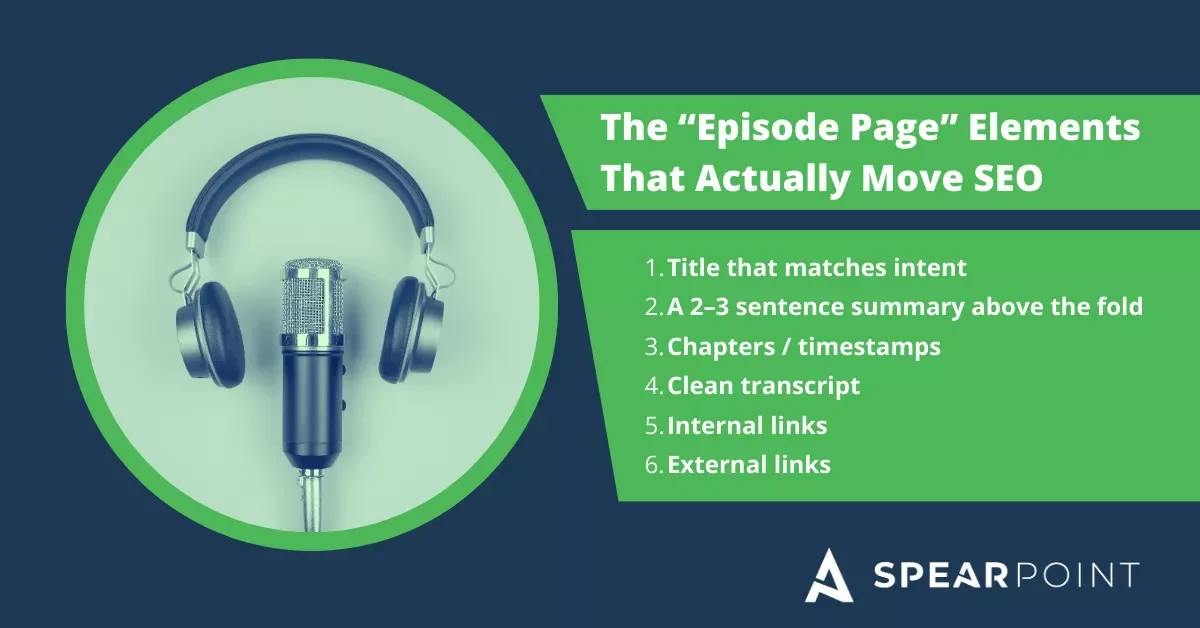
The “episode page” elements that actually move SEO
1) Title that matches intent
Bad: “Episode 47: Interview with Alex”
Better: “How to Build a B2B Podcast Growth Flywheel (Alex ___)”
2) A 2–3 sentence summary above the fold
This is your “organic search hook.” It helps the page work even when the user doesn’t press play.
3) Chapters / timestamps
Chapters increase scannability and reduce bounce.
4) Clean transcript
Transcripts are the SEO unlock. If you want the fastest workflow:
Export transcript files from Riverside: Download transcript / SRT (Riverside Help)
5) Internal links
Add a “Related episodes” block every time.
6) External links
Link to tools, people, and resources mentioned. It improves user experience and encourages sharing.
Step 3: Add podcast schema (so Google understands your show)
Structured data helps search engines interpret the page correctly and can improve eligibility for enhanced results.
Start here:
Minimum schema types to use
PodcastSeries on the main show hub page
PodcastEpisode on each episode page
Test it
Validate eligibility and errors with Google’s tool: Rich Results Test
Copy/paste JSON-LD starter (PodcastEpisode)
{
"@context": "https://schema.org",
"@type": "PodcastEpisode",
"name": "Episode Title Here",
"description": "Short episode summary here.",
"datePublished": "2026-01-23",
"timeRequired": "PT42M",
"associatedMedia": {
"@type": "MediaObject",
"contentUrl": "https://example.com/audio/episode.mp3",
"encodingFormat": "audio/mpeg"
},
"partOfSeries": {
"@type": "PodcastSeries",
"name": "Your Podcast Name"
}
}
Step 4: Get RSS right (because platforms still run on it)
Even if your website is perfect, broken feeds cause discovery issues across Apple/Spotify/directories.
Use the platform requirements:
And validate:
Pro tip
If you care about open podcast ecosystems and broader directory visibility, consider submitting/confirming your listing in:
Step 5: Speed + mobile performance (your silent rankings killer)
Podcast pages often get bloated with embeds, players, scripts, and heavy images.
Test performance and fix the basics:
Quick wins:
Lazy-load embeds
Compress images
Keep the audio player lightweight
Reduce plugin/script clutter on episode templates
Step 6: Keyword research for podcast websites (the simple way)
Don’t overcomplicate this. You need:
Show-level keywords (what the show is about)
Episode-level keywords (what this episode solves)
Topic hub keywords (clusters you want to own)
Tools that work well:
Free baseline: Google Trends
Keyword planning: Keyword Planner (Google Ads Help)
Question mining: AnswerThePublic
Competitive + clustering:Ahrefs Keywords Explorer and/orSemrush keyword research toolkit
Step 7: Measure what matters (and fix indexing fast)
If you don’t measure, you’ll end up “doing podcast SEO” forever without knowing what’s working.
The minimum setup
Track search impressions/clicks with: Google Search Console
Use URL-level debugging when an episode page doesn’t index:
If you publish video podcasts
Use platform analytics to identify topics that earn watch time and retention:
Common mistakes that kill “podcast website SEO”
Publishing episodes only on platforms (no indexable episode pages)
No transcript (or an unedited wall of text)
No schema, or schema that doesn’t match the page content
Embedding Spotify/Apple but not adding content around it
Thin show notes (“In this episode we talk about…”)
Episode titles that are meaningless outside your existing audience
No internal linking between episodes and core business pages
Slow pages (especially on mobile)
A simple 30–60–90 day podcast website SEO plan
Days 1–30: Foundation
Fix episode URL structure
Create episode page template
Add transcripts workflow
Add schema + test it
Days 31–60: Authority
Build 3–5 topic hubs that link to episodes
Turn 2–4 best episodes into blog posts
Add guest pages if relevant
Days 61–90: Growth loops
Internal-link episodes → service/product pages (if you’re a business)
Pitch guest appearances and PR for backlinks
Optimize top pages based on Search Console queries
Tools & resources (external links)
Technical & indexing
Schema
RSS
Transcripts
If you upload captions for video: Add subtitles/captions (YouTube Help)
Keyword research
Technical audits
Struggling with SEO & AEO?
Discover How SpearPoint Grows Brands—and Drives Conversions
About the Author

Jesse McFarland is the founder of SpearPoint Marketing, a conversion-focused SEO agency that helps B2B, professional services, and SaaS brands turn search visibility into a measurable pipeline. With over 17 years of digital marketing experience spanning agency and in-house leadership roles, Jesse specializes in technical SEO, content strategy, conversion rate optimization, and Digital PR.
Jesse is also the owner and host of the Brands and Brews Marketing Podcast, where he interviews marketers, founders, and operators about real-world growth strategies, SEO, and modern brand building.
He is a frequent speaker and thought leader on emerging SEO topics, including Answer Engine Optimization (AEO), helping brands adapt their strategies for the next era of AI-powered search.
About Jesse. LinkedIn Brands and Brews Marketing Podcast