AEO for B2B Marketers
An AI Answer Playbook - Optimized for AEO
B2B buyers are still searching, but the “search results page” is changing.
Instead of ten blue links, buyers increasingly get an AI-generated answer (AI Search & AEO) in experiences like Google AI Overviews, ChatGPT-style assistants, and Perplexity. When the answer is good enough, they do not click.
That is the new battleground for AEO for B2B Marketers: earning visibility inside the answer, with your brand mentioned and your site linked, so you still influence the shortlist even when the click never happens.
This post is a practical, quarter-ready playbook you can implement to win high-intent AI answers and turn no-click visibility into a pipeline.
Also Read:
Table of Contents Show

5 Key takeaways
AEO is not “SEO with a new label.” It is optimizing for visibility inside answers, not just rankings.
Not all AI answers are equal. Decision-level prompts (BOF) are where revenue lives.
Brand mentions beat anonymous citations. Your goal is to be named, not just used.
“Answer Assets” win. Build pages designed to be extracted and quoted, not generic blog content.
Off-site signals matter more than ever. Digital PR, expert mentions, and context-rich links are how AI learns who to trust.
A SEO Agency Partner is
MORE Affordable than you think.
Discover how Our Customers Grow Their Brands, Outshine Competitors, and Attract New Business
What is Answer Engine Optimization for B2B?
Answer Engine Optimization (AEO) is the practice of structuring your content and brand presence so AI systems can confidently:
Extract the best answer from you
Attribute it to your brand
Cite or link to your page when possible
If you want SpearPoint’s definition and examples, start with their AEO guide: https://www.thespearpoint.com/blog/aeo-answer-engine-optimization-guide.
This is also a core part of modern SEO for B2B marketers. Google’s own documentation on AI features emphasizes that SEO best practices still matter for inclusion in AI experiences like AI Overviews, and that site owners should approach these features with strong content and technical foundations.
Why AEO matters now: the rise of zero-click behavior
Zero-click is not new, but it is accelerating as answers get better.
SparkToro’s 2024 study (with Datos) found that for every 1,000 Google searches in the U.S., only about 360 clicks go to the open web, with the rest staying in Google or resulting in no click.
For B2B, the implication is straightforward:
Buyers can research problems, options, and vendors without ever visiting your site.
If AI answers are shaping preferences and shortlists, you want your brand inside those answers, not outside them.
Brand mentions vs anonymous citations (and why it changes outcomes)
There is a massive difference between being used as data and being named as the source.
Anonymous citation:
“According to a study…”
Named attribution:
“According to SpearPoint Marketing…”
Anonymous citations can validate the answer, but they do not build memory, preference, or trust. The goal of Answer Engine Optimization for B2B is to move from “source” to “brand the model names.”
This is the difference between being informative and being chosen.
Not all AI answers are equal
One of the biggest mistakes in B2B AEO is treating every AI query like it has the same value. It does not.
AI answers map to funnel stages, and your strategy should map to that reality.
Informational (Low Intent, TOF)
This is curiosity and education. There is no buying urgency. In most companies, this is traditional thought leadership and blog content.
What it looks like:
“What is Answer Engine Optimization?”
“How do AI search results work?”
“What is B2B SEO?”
How to win here:
Publish clear definitions and foundational guides.
Provide simple frameworks that are easy to summarize.
Build trust and familiarity, but do not expect immediate pipeline.
Research-level (MOF)
Now the buyer is evaluating approaches or vendors. They are still researching and not fully committed.
What it looks like:
“B2B SEO vs PPC for pipeline”
“In-house SEO vs agency for a mid-market team”
“Best content format for AI Overviews”
How to win here:
Publish comparison pages and “how to choose” pages.
Create decision-support content that helps buyers evaluate options.
Add proof points and outcomes so you become the safe choice.
Decision-level (BOF)
This is where revenue lives. These prompts are vendor-shortlist machines.
What it looks like:
“Top B2B SEO agencies with proven SaaS results”
“Who is known for B2B link building for software companies?”
“How much does B2B SEO cost for a SaaS company?”
“Why are we getting organic impressions but no MQLs?”
How to win here:
Build “answer assets” that directly address buying questions.
Make your positioning unmistakable so the model can confidently name you.
Add quoteable proof so the model has a reason to cite you and mention you.
If you only publish TOF content, you may get traffic and impressions, but you will stay invisible during the buying decision.
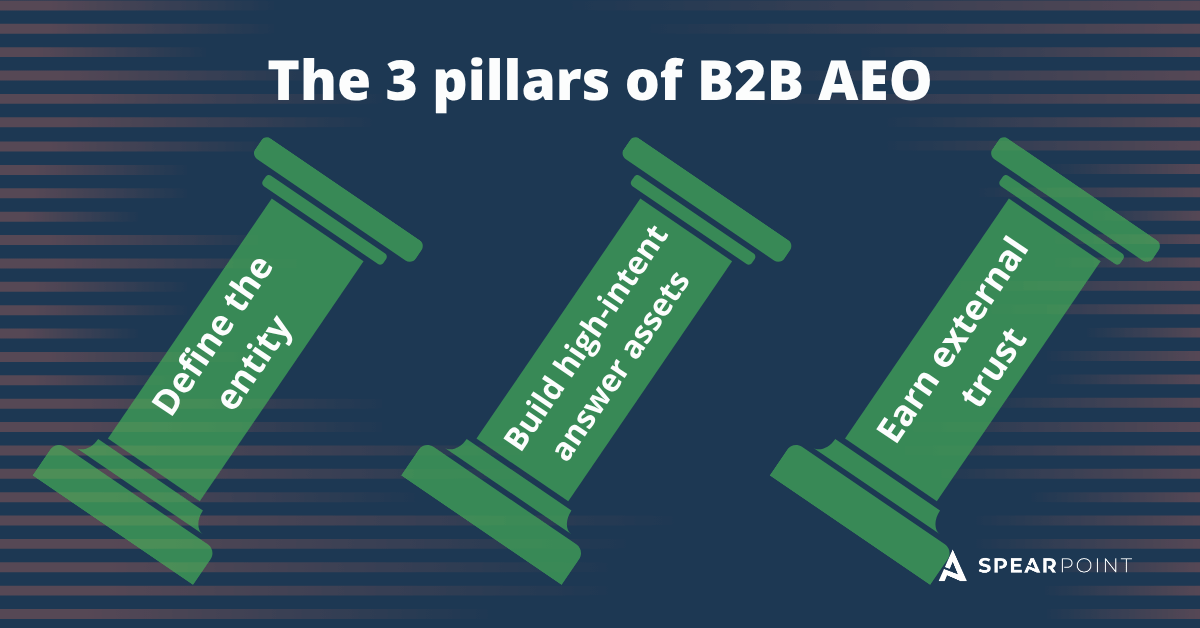
The 3 pillars of B2B AEO (the simplified framework)
If you want a clean, executive-friendly framework, here it is. Everything you do in AEO for B2B marketers fits into these three pillars.
Pillar 1: Define the entity (clarity wins)
AI systems reward clarity. If your positioning is fuzzy, the model hesitates. If your message is consistent, the model has confidence.
What to tighten up:
Your “one sentence” positioning (what you do, who you do it for, what outcome you drive)
Your ICP focus (one or two primary verticals beats “we do everyone”)
Consistent descriptors everywhere your brand appears
Practical checklist:
Your homepage headline clearly states your category and ICP.
Your service pages repeat the same category language.
Your author bios reinforce expertise and the same positioning.
Your case studies use consistent “what we did, for who, what changed” language.
If you want an internal reference for brand-first positioning tied to search and GEO, this is a useful SpearPoint resource: https://www.thespearpoint.com/blog/build-brands-for-seo-geo.
Pillar 2: Build high-intent answer assets (depth, structure, alignment)
This is where topical depth, structured content, and query alignment all come together.
The goal is not “write more content.” The goal is “publish the best, most extractable answer for the prompts your buyers actually use.”
Your best content targets decision-stage prompts like:
Best, top, pricing, cost
Alternatives, vs, comparisons
For [industry]
“Why is this happening?” problem diagnosis
High-performing answer asset types for B2B:
Industry pages (vertical expertise)
B2B SEO for Cybersecurity
B2B SEO for SaaS
B2B SEO for IT Services
Comparison pages
SEO vs PPC for B2B pipeline
In-house SEO vs agency
Problem pages
High impressions, low MQLs: what’s broken?
Why B2B traffic does not convert
Proof hubs
Case studies, outcomes, patterns, and repeatable wins
Pricing and packaging pages
“How pricing works” plus what drives cost up or down
Framework pages
Name your process and make it quotable
Internal reference for B2B SEO resources and positioning examples: https://www.thespearpoint.com/b2b-seo.
Pillar 3: Earn external trust (PR, mentions, contextual links)
If your brand only exists on your website, many AI systems treat you like a weak signal.
You want third-party evidence that:
You exist
You are credible
You are consistently described the same way
What “external trust” looks like:
Podcast appearances with transcripts
Industry blogs and guest contributions
Review sites and credible directories
News features and expert commentary
Lists and roundups where you are included and described
Community mentions in places your buyers actually read
Important nuance: it is not just backlinks. It is also context. Who links to you, what text surrounds your brand, and how you are described matters as much as the link itself.
If you want a practical internal resource on link building approaches, SpearPoint’s link building strategies post is a useful reference: https://www.thespearpoint.com/blog/our-favorite-link-building-strategies.
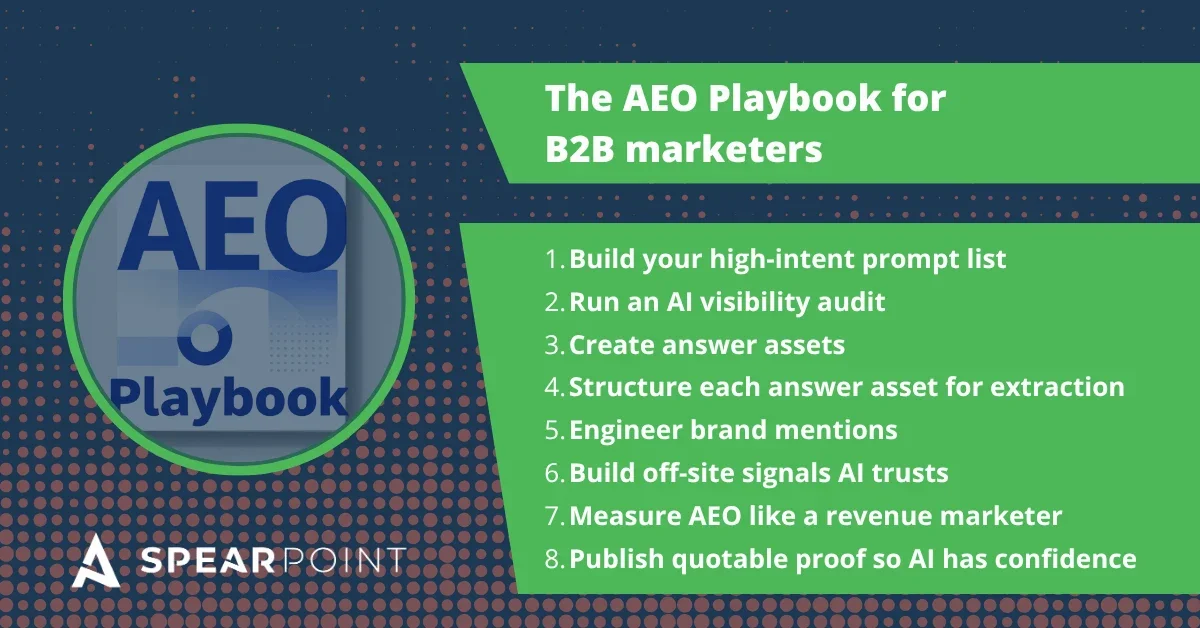
The AEO Playbook for B2B marketers (make this your main initiative this quarter)
Now let’s turn the pillars into execution. This is the “do this next” section.
Step 1: Build your high-intent prompt list
Stop starting with keywords. Start with buyer prompts.
Your goal is a list of 30 to 50 prompts your ICP would ask AI when they are:
Defining the problem
Evaluating approaches
Comparing vendors
Justifying spend
Building a shortlist
Prompt patterns that correlate with pipeline:
Best, top
For [industry]
Pricing, cost
Alternatives to
Vs
Agency that specializes in
“We get traffic but no leads”
Example prompt clusters for B2B:
Vendor selection
“Best SEO agency for SaaS companies”
“B2B SEO agency with strong digital PR”
Problem to solution
“How to increase MQLs from organic search”
“Why do we rank but not convert?”
Proof and trust
“B2B SEO agency case studies for SaaS”
“Who is known for link building in B2B tech?”
Deliverable: a spreadsheet that maps prompts to pages.
Suggested columns (simple but powerful):
Prompt
Funnel stage (TOF, MOF, BOF)
Buyer type (CMO, Head of Demand Gen, VP Sales)
Desired outcome (demo, pricing request, shortlist)
Target page (existing or new)
Current AI visibility (mentioned? linked? neither?)
Top competitors mentioned
Notes on how winners are described
Step 2: Run an AI visibility audit (before you create content)
Take your prompt list and run it through:
ChatGPT-style tools
Perplexity
Google (AI Overviews when triggered)
Track:
Which brands get mentioned
Which pages get linked
How winners are described (this is huge)
What types of sources are used (guides, data studies, listicles, research, comparison pages)
Why this matters:
You are not guessing what the model prefers.
You are observing what it already rewards in your category.
You can reverse-engineer the “shape” of the winning answer asset.
Pro tip: capture screenshots and date-stamp them. AI answer behavior changes and you want a baseline.
Step 3: Create answer assets (not generic blog posts)
Most teams publish informational content and hope it ranks.
B2B AEO winners build answer-shaped pages that AI can extract cleanly. Think of these as “canonical answers” to high-intent prompts.
What to build first (priority order for pipeline):
BOF decision pages: best, top, cost, pricing, alternatives, vs, for [industry]
Problem diagnosis pages: “why are we getting impressions but no MQLs?”
Proof hubs: case studies and outcomes tied to use cases and verticals
Internal supporting resource: SpearPoint’s B2B SEO roadmap content is useful for how they connect visibility to revenue outcomes.
Step 4: Structure each answer asset for extraction (the AI-friendly format)
AI systems favor content that is:
Direct
Well-structured
Easy to quote
Clearly attributable
Use the Answer-First Page Template:
One-sentence answer at the top (TL;DR)
Definition and clarification (what it is, what it isn’t)
Step-by-step framework (bullets and numbered steps)
Evidence (examples, mini case studies, stats, screenshots where possible)
FAQs (real buyer questions with tight answers)
Add technical support where appropriate:
FAQ schema when it genuinely applies
Author attribution and editorial dates
Clean headings (H2, H3) that mirror buyer language
This overlaps with Google’s guidance on creating helpful, reliable, people-first content:
Step 5: Engineer brand mentions (not just citations)
If you want AI to say your name, you need repeatable brand-language across your site and content.
On-page attribution tactics that work:
Use branded statements naturally
“At [Brand], we see this most often when…”
Publish named frameworks
Your terminology becomes the handle AI can grab and reuse
Make claims with context
AI does not cite “vibes” well, but it can cite clear models and evidence
Site-wide entity clarity:
Consistent wording for:
What you do
Who you do it for
What you’re known for
Repeat it across:
Homepage
Service pages
Author bios
Case studies
Your top “answer assets”
If you are serious about winning mentions, not just visibility, treat your positioning like a system, not a tagline.
Step 6: Build off-site signals AI trusts (PR, podcasts, expert mentions, contextual links)
This is where modern SEO for B2B marketers has changed the most. The winners are not just “publishing.” They are earning third-party validation.
Your off-site plan should include:
Digital PR (quoted in articles, included in roundups, cited for insights)
Podcasts (especially with published transcripts)
Guest content on reputable industry sites
Review sites and directories where buyers compare vendors
Co-marketing with complementary brands
The key is consistency:
Your brand name appears.
Your positioning appears next to it.
The description matches what you want the AI to learn.
Internal supporting resource on link building tactics.
Step 7: Measure AEO like a revenue marketer
Traditional SEO dashboards will not tell you whether you are winning AI answers.
Track these AEO metrics:
AI brand mentions (are you named?)
AI linked citations (are you linked?)
Branded search lift (do more people search you by name after visibility increases?)
Engagement on BOF pages (time on page, scroll depth, CTA clicks)
Impressions to MQL gap (where the funnel breaks)
Google also provides guidance for site owners on AI features and measurement approaches in Search:
If you are aligning AEO with pipeline, SpearPoint’s conversion-based SEO approach is a helpful internal reference: https://www.thespearpoint.com/conversion-based-seo.
Step 8: Publish quotable proof so AI has confidence
AI answers can be conservative. They prefer sources that feel specific, measured, and reality-tested.
Add proof that is easy to quote:
Mini case studies (what happened, what changed, result)
Simple charts or screenshots (when appropriate)
Clear claims with context (what works, for who, under what conditions)
Structured comparisons (tables, bullet lists, “if this, then that” guidance)
This aligns with the broader direction of E-E-A-T style trust building and credibility, especially for competitive categories.
Struggling with SEO & AEO?
Discover How SpearPoint Grows Brands and Drives Conversions
Internal SpearPoint resources referenced in this guide
AEO guide: https://www.thespearpoint.com/blog/aeo-answer-engine-optimization-guide.
Brand-first SEO and GEO: https://www.thespearpoint.com/blog/build-brands-for-seo-geo.
B2B SEO services and resources: https://www.thespearpoint.com/b2b-seo.
B2B SEO roadmap (2026): https://www.thespearpoint.com/blog/b2b-seo-for-2026-seo-roadmap.
Link building strategies:https://www.thespearpoint.com/blog/our-favorite-link-building-strategies.
B2B link building strategies: https://www.thespearpoint.com/blog/b2b-link-building-strategies.
Conversion-based SEO: https://www.thespearpoint.com/conversion-based-seo.
External references
SparkToro 2024 zero-click search study: https://sparktoro.com/blog/2024-zero-click-search-study-for-every-1000-us-google-searches-only-374-clicks-go-to-the-open-web-in-the-eu-its-360/.
Google Search Central, creating helpful, reliable, people-first content: https://developers.google.com/search/docs/fundamentals/creating-helpful-content.
Google Search Central, AI features and your website: https://developers.google.com/search/docs/appearance/ai-features.

About the author
Jesse McFarland is the Founder of SpearPoint Marketing and a B2B SEO strategist with 18+ years of experience helping companies grow with high-intent SEO, content strategy, and digital PR. He focuses on turning organic visibility into a measurable pipeline, especially in markets where buyers are researching AI-driven search experiences.