The Real Numbers, the Pricing Models, and What Each Budget Actually Buys You in 2026
Ask three agencies what B2B SEO costs and you'll get three numbers, sometimes thousands of dollars apart. None of them is lying.
One quotes you $1,200 a month. One quotes $5,000. One says $15,000 and won't get out of bed for less. They're describing completely different products with the same two-letter label slapped on the front.
So before you sign anything, you need two things: the honest range, and a way to tell which number is real for your company. This post gives you both.
Here's the short version up top: most B2B companies in the $1M–$10M revenue range spend between $2,500 and $10,000 a month on SEO in 2026. The floor for anything worth calling a growth program is around $1,000. Below that, you're buying a monthly report and some hope.
TL;DR for the CFO Who Wants the Numbers

The honest range is $1,000 to $10,000+ per month. Most serious B2B programs for a $1M–$10M company land between $2,500 and $5,000, and competitive verticals push past $10,000.
The "average" is a trap. Blended survey averages mix freelancers, local shops, and enterprise retainers into one meaningless number. What matters is whether the scope fits your competitive reality.
You're paying for skilled labor, not software. Price tracks how much expert work your market demands: content, links, technical fixes, and now AEO.
Cheap SEO is the expensive option. A $300 plan burns twelve months and produces nothing you can take to a pipeline review. The opportunity cost dwarfs the invoice.
Agencies usually beat in-house on cost. One senior hire runs $110,000–$180,000 fully loaded; a strong retainer buys a whole team for a fraction of that.
Judge it by pipeline, not rankings. B2B SEO breaks even around month seven and compounds for years. If your provider can't tie the work to leads and revenue, the price is irrelevant.
Table of Contents Show
The Short Answer: What B2B SEO Costs in 2026
Let's put the benchmark data on the table before we interpret it, because the spread is the whole story.
Ahrefs' 2026 survey of 439 SEO providers put the average agency retainer at roughly $3,209 a month, with freelancers averaging closer to $1,350. Backlinko's survey of 300-plus SEO professionals landed lower, with a typical retainer of $1,000 to $2,500. Clutch, looking only at agencies, came in at about $3,199 a month, with one-off projects averaging a steep $37,158.
So which is right? All of them. They're measuring different slices of the same market.
For B2B specifically, the picture tightens up. Small B2B teams cluster in the $1,500 to $5,000 band. Mid-market B2B SaaS engagements typically run $5,000 to $10,000. Regulated and high-value verticals like finance, healthcare, legal, and enterprise software frequently start at $5,000 and climb, according to GoodFirms' pricing research, because they combine intense competition with content that demands real subject-matter expertise.
That's the range. Now here's why the average won't help you budget.
Six Factors That Change B2B SEO Pricing
A blended average tells you what a freelancer in one market and an enterprise agency in another charge on average. That's about as useful for your budget as the average temperature of the planet is for deciding what to wear today.
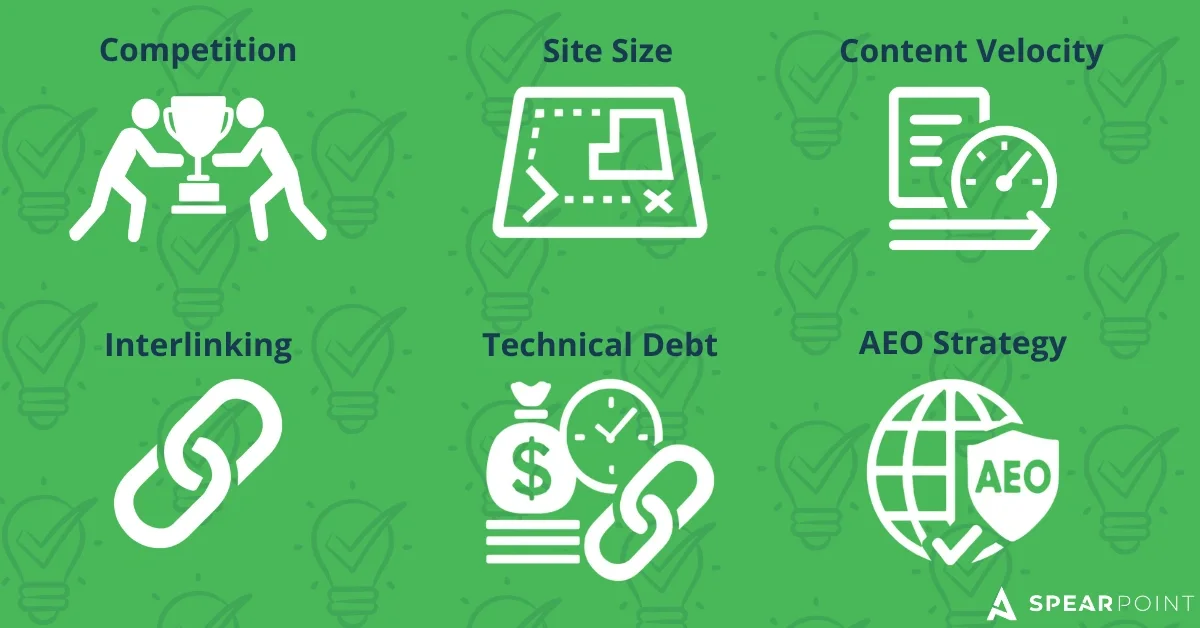
Your real price comes down to six things:
Competition. A local B2B services firm and a national SaaS platform fighting fifty funded competitors need completely different budgets. The harder the landscape, the more skilled work it takes to break through.
Site size. A clean 40-page site is a far smaller job than a 4,000-page platform. More pages mean more to audit, optimize, internally link, and maintain, and the budget scales with the surface area.
Content velocity. Ranking for buyer-intent terms takes genuinely expert content, and that's where a lot of the money goes. Pieces that perform tend to cost more to produce because they take strategy, research, and editing.
Links. Digital PR and authority building are labor-heavy, and they're often the difference between page two and the money positions.
Technical debt. A decade of rendering problems, redirect chains, and accumulated cruft has to be cleaned up before anything else ranks. The deeper the debt, the more of your budget goes to repairing the foundation.
AEO strategy. Answer Engine Optimization for ChatGPT, Perplexity, Gemini, Google AI Overviews, Microsoft Copilot, and Claude is increasingly its own workstream, and it's frequently priced on top of traditional SEO.
Two providers quoting wildly different numbers may both be fair. They're scoping different amounts of work against different competitive realities. Your job isn't to find the cheapest quote. It's to find the one whose scope matches what it'll actually take to win your searches.
The Four Pricing Models, and When Each One Makes Sense
Almost every quote you'll see fits one of four structures, and the structure matters as much as the number.
1. Monthly retainer
The default, and it isn't close: about 78% of providers use it. You pay a flat recurring fee for ongoing work. It fits SEO because rankings don't hold still, so the work can't either. Retainer clients also tend to stay engaged far longer, which tracks with how SEO compounds.
2. Project-based
A fixed fee for a defined deliverable, like a technical audit, a migration, or a penalty recovery. It's the right call when you have a specific one-time fix rather than an ongoing growth goal.
3. Hourly
Useful mainly as a sanity check on the other two. Common rates run $100 to $150 an hour, and higher for senior consultants. If an agency quotes $5,000 a month for an estimated 20 hours, that's $250 an hour, and that rate should reflect the specialization you're getting.
4. Performance-based
Payment tied to outcomes. Appealing on paper, and occasionally the right fit, though the honest version aligns incentives around pipeline while the dishonest version games easy-to-hit vanity metrics. Read the fine print on what "performance" is being measured.
For most B2B companies chasing sustained organic growth, the retainer model fits best. Project work supplements it when something specific breaks.
Numbers on a pricing page are easy. Here's what a right-sized budget actually produced for a B2B client.
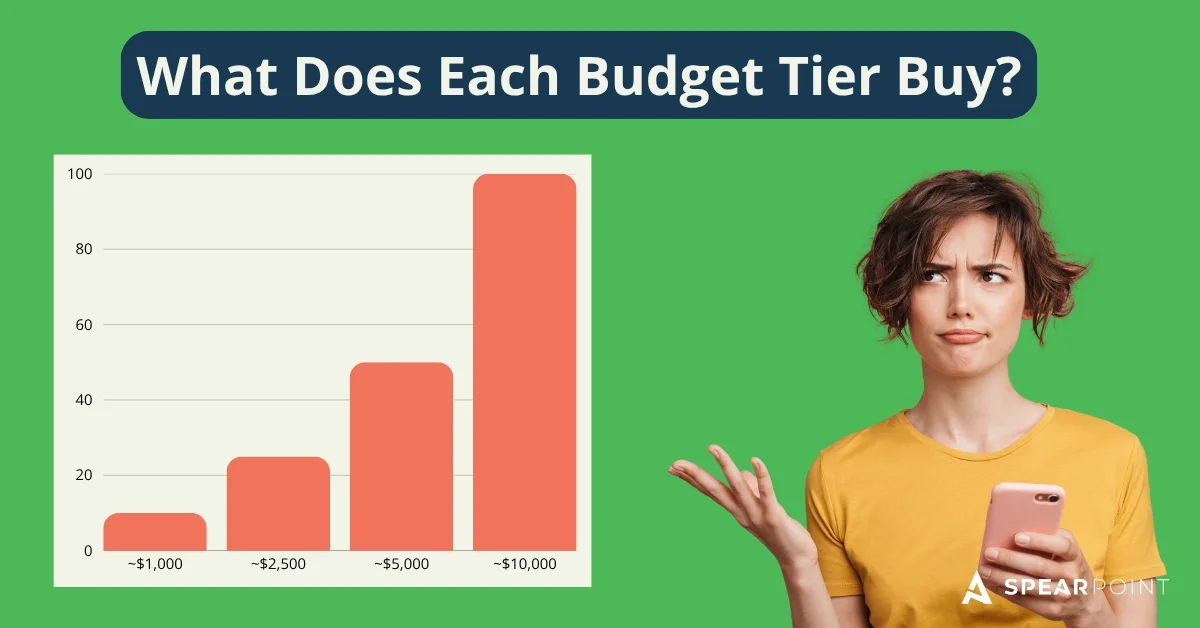
That's the return a real budget buys. Here's what each tier of budget gets you.
What Each Budget Tier Actually Buys You
This is the part the pricing pages won't give you straight. Here's what your money buys at each level of a B2B program in 2026.
| Monthly budget | What it realistically buys | Best fit for: |
|---|---|---|
| ~$1,000 | Maintenance-level work: basic on-page fixes, light content, minimal reporting. One or two hands, part-time. | A very small B2B in a low-competition niche, or a supplement to in-house work. |
| ~$2,500 | The foundation program: technical cleanup, keyword and intent strategy, a few optimized pages a month, on-page work, real reporting. | A small B2B establishing organic search as a channel for the first time. |
| ~$5,000 | The mid-market workhorse: steady content velocity, link building, technical depth, conversion-focused service and comparison pages, and an AEO layer. | A $1M–$10M B2B that's serious about pipeline from search. |
| ~$10,000+ | Aggressive execution: high content volume, digital PR, full technical and AEO coverage, CRO alignment, and dedicated senior strategists. | Competitive B2B SaaS, regulated industries, or national campaigns. |
Notice what climbs as the budget rises. It isn't the number of keywords in a spreadsheet. It's the amount of skilled, conversion-focused work aimed at the searches your buyers actually make before they buy.
A $6,000 retainer that includes technical audits, content production, internal linking, schema, digital PR, analytics, and CRO alignment is a different species from a $900 plan covering light edits and a monthly report. Both get called SEO. Only one moves your pipeline.
In-House vs. Agency vs. Freelancer: The Real Math
"We'll just hire someone" sounds cheaper until you run the full numbers.
A single senior in-house SEO hire costs $80,000 to $120,000 in salary alone. Load in benefits at roughly 30%, professional tools at $6,000 to $12,000 a year, recruiting, and training, and the fully loaded cost lands around $110,000 to $180,000 a year for one person with one skill set. A full in-house team of three or four runs $300,000 to $500,000-plus.
That's the catch with a single hire: SEO in 2026 spans technical work, content strategy, link building, structured data, and AEO. Finding one person who's genuinely strong at all of them is rare, and when you find them, they've usually started their own agency.
An agency retainer at $2,500 to $10,000 a month ($30,000 to $120,000 a year) buys a whole bench: a technical specialist, content strategists, a link team, and someone who lives in AEO, all at once. For most B2B companies under a large internal marketing team, that math favors the agency.
Freelancers sit in between. Genuinely cost-effective for a defined slice of work like a technical audit or a content sprint, and a good fit when your scope is narrow. Broader campaigns tend to outgrow a single freelancer's bandwidth fast.
The strongest setup for a scaling B2B is often a hybrid: one internal owner who holds strategy and context, paired with an agency that brings the specialist depth and execution muscle.
The $300-a-Month Trap: Why Cheap SEO Is the Expensive Option
Do the arithmetic on a $300 "full-service SEO" plan. At an entry-level rate, that buys two or three hours a month. Two or three hours cannot audit a site, build authority, produce expert content, and optimize for AI search. So it doesn't. It produces a report.
Meanwhile, the meter that really matters keeps running. Ahrefs found that only 1.74% of newly published pages rank in the top ten within a year, down from 5.7% in 2017. Ranking takes longer than it used to, which means every month of fake progress is a month of real ground lost to competitors who are putting in the work.
Watch for these red flags:
Guaranteed #1 rankings. Nobody controls Google's algorithm. Anyone promising the top spot is selling you something.
Suspiciously round, suspiciously low pricing. A flat $300 for "everything" means nothing gets enough hours to work.
No conversion talk. If the whole pitch is traffic and rankings with no mention of leads or revenue, they're selling vanity metrics.
AI-generated content at scale with no expert oversight. Google's own guidance is clear that mass-produced content without genuine expertise doesn't meet the E-E-A-T bar it rewards.
Cheap SEO doesn't save money. It defers the real spend by a year and adds the cost of the ground you lost while you waited.
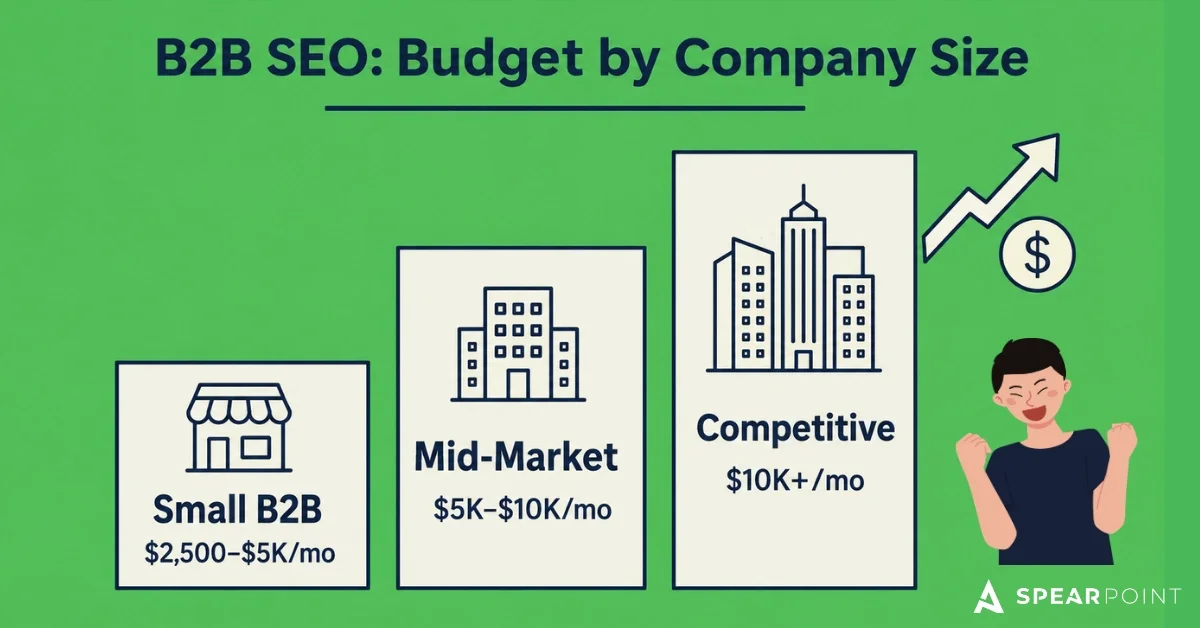
How to Budget by Company Size, and What the Return Looks Like
A practical way to set the number: for a $1M–$10M B2B company, budgeting $2,500 to $5,000 funds a real growth program, with competitive verticals justifying more. General marketing-spend guidance from the Small Business Administration lands around 7% to 9% of revenue, and SEO is one line inside that.
Now the part that makes the budget defensible: the return.
First Page Sage's 2026 analysis found a three-year ROI of 702% for B2B SaaS companies investing in SEO, with an average breakeven around month seven. The same research pegs a typical B2B SEO campaign at roughly +$385K in organic revenue in Year 1, +$1.2M in Year 2, and +$3.3M in Year 3 when content quality holds and customer lifetime value sits at $10,000 or more. On a cost-per-lead basis, B2B SaaS organic leads run about $147 to $164, well under the $250 to $310 typical of paid search.
Payback is honest, though, so budget for it: expect six to nine months for mid-market B2B, nine to twelve for smaller companies, and up to eighteen for competitive regulated verticals. Anyone promising 90-day ROI on competitive queries is overpromising.
One more reason the return is climbing rather than shrinking, despite the "SEO is dead" crowd. SparkToro's 2026 research puts roughly 60% of Google searches at zero-click, and Forrester found that about 84% of B2B buyers now consult AI assistants before they ever talk to a vendor. Your buyers are researching in Google and in AI answers before they fill out a form. Cut search, and you go invisible on both surfaces at once. That's why we treat SEO and AEO as one system, and why the budget that covers both is the one worth setting.
Numbers on a pricing page are easy. Here's what a right-sized budget actually produced for a B2B client.
No pitch, no obligation. Just a clear read on what winning your searches would take.
FAQ
-
Most companies in that range should plan for $2,500 to $5,000 a month for a genuine growth program, with competitive or regulated verticals justifying $5,000 to $10,000-plus. Below roughly $1,000 a month, you're funding maintenance and reporting rather than growth.
-
Rarely, and almost never for B2B. A $300 plan buys two or three hours of work a month, which can't move a competitive market. The real cost isn't the invoice; it's the year of lost ground while a bargain provider produces reports instead of results.
-
Breakeven typically lands around month seven for B2B SaaS, with mid-market companies seeing payback in six to nine months and competitive regulated verticals taking twelve to eighteen. The returns compound, with the strongest results usually arriving in years two and three.
-
For most B2B companies without a large marketing team, an agency wins on cost and breadth. One senior hire runs $110,000 to $180,000 a year fully loaded and gives you a single skill set. A retainer buys a full specialist team for a fraction of that. A hybrid, with one internal owner plus an agency, is often the strongest setup as you scale.
-
Sometimes, and you should ask directly. Many providers now price Answer Engine Optimization for ChatGPT, Perplexity, Gemini, Google AI Overviews, Microsoft Copilot, and Claude as a separate line. We build it into the same program because it draws on the same content and authority signals as traditional search.
Suggested External Links Used in This Post
Ahrefs, 2026 SEO pricing survey: https://ahrefs.com/
Backlinko, SEO pricing and statistics: https://backlinko.com/
Clutch, SEO agency pricing data: https://clutch.co/
GoodFirms, SEO pricing plans: https://www.goodfirms.co/resources/seo-pricing-plans
First Page Sage, SEO ROI Statistics 2026: https://firstpagesage.com/
SparkToro, 2026 zero-click search research: https://sparktoro.com/
Forrester, 2026 B2B buyer journey research: https://www.forrester.com/
About the Author

Jesse McFarland is the founder of SpearPoint Marketing, a conversion-focused SEO and AI search agency based in Centennial, Colorado. Jesse has more than 17 years of digital marketing experience across B2B, SaaS, healthcare, legal, fitness, ecommerce, and startup organizations.
He specializes in helping companies turn organic search into qualified demand through modern SEO, AEO, GEO, AI Visibility, content strategy, technical SEO, and brand-first search marketing. Jesse helps business owners and marketing leaders understand how search is changing without losing their minds every time someone on LinkedIn announces SEO is dead again.