How Answer Engine Optimization Gets Your Gym Into the AI Answer, and Into More Memberships

Someone just moved to your town. They want a gym. In 2026, a growing share of those people don't open Google Maps and scroll. They open ChatGPT and type "good gym near me for a beginner."
ChatGPT gives them a name. Maybe two. Then it stops.
That's the whole game now, and here's how brutal it is: SOCi's 2026 Local Visibility Index looked at more than 350,000 business locations and found ChatGPT recommends only about 1.2% of them when asked for a local option. Meanwhile, BrightLocal's 2026 Local Consumer Review Survey found 45% of consumers used AI tools like ChatGPT, Gemini, and Perplexity to find a local business in the past year, up from 6% the year before.
Put those two numbers together, and you have the local-discovery story of the year. A fast-growing share of your future members are asking a machine which gym to join, and for almost every gym, the answer doesn't include them.
The old game was ranking in the map pack. This is a different game, and most gyms haven't noticed the rules changed. Good. That's your opening.
TL;DR for the Owner Who Just Got Asked: "Are We on ChatGPT?"

AI search is a real membership channel now. Nearly half of consumers have used AI to find a local business, and that share went up sevenfold in a year.
The answer names a few and stops. AI recommends a tiny fraction of local businesses, so being "on the list" isn't enough. You have to be one of the names it says.
This is a distinct channel from your Google profile. Your profile feeds it, but winning AI answers takes work your profile checklist doesn't cover.
Most of the work is off your website. AI builds its picture of you from reviews, directories, and mentions across the web far more than from your homepage.
Answer the real questions. Prospects ask AI about pricing, beginners, classes, and hours. Answer them clearly, and you become the extractable answer.
Check whether you're actually recommended. Ask ChatGPT, Gemini, Perplexity, and Google's AI Mode yourself. What you find will set your priorities.
Table of Contents Show
What AI Search Really Is for a Gym, and Why It's Its Own Channel
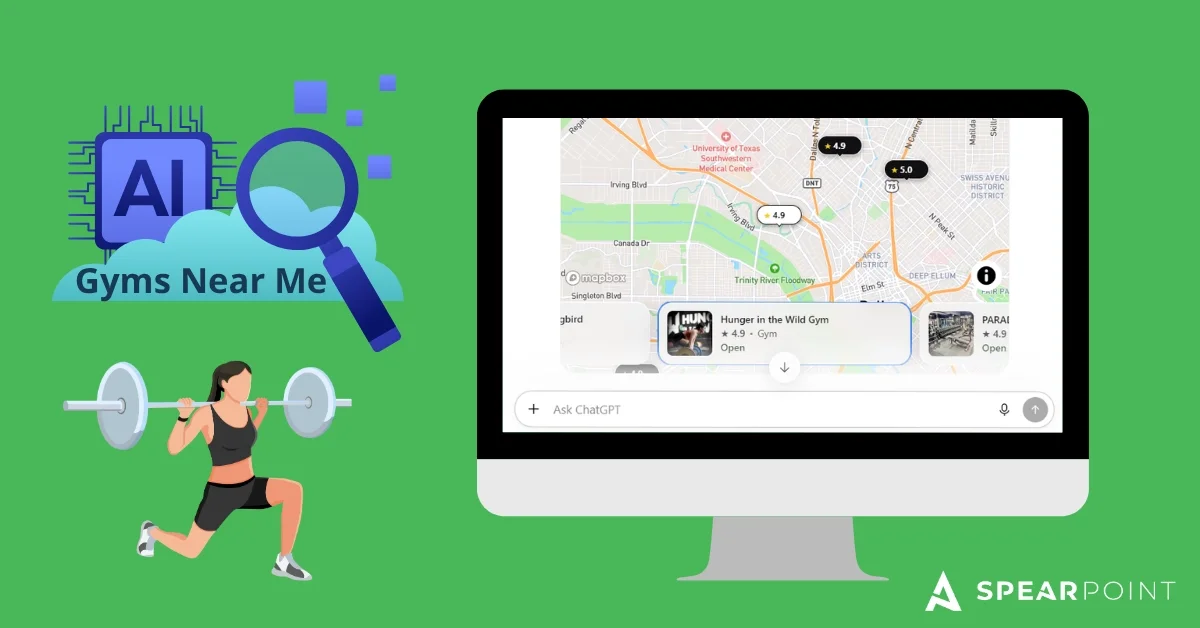
Let's be precise, because "AI search" gets thrown around loosely. For a gym, it means the moment a prospective member asks an answer engine (ChatGPT, Perplexity, Gemini, Google's AI Overviews and AI Mode, Microsoft Copilot, or Claude) to recommend a place to train, and the engine hands back a short, confident answer with a name on it.
Answer Engine Optimization is the work of being that name.
Here's the trap owners fall into: assuming this is just their Google Business Profile with extra steps. It's related, but it's not the same channel. Your profile is one input the engines read. Winning the answer is a broader job that depends on what the entire web says about you, how clearly your site answers real questions, and whether the machine can assemble a coherent, trustworthy picture of your gym from all of it.
We broke down the profile side of this, field by field, in the complete Google Business Profile checklist for gyms. Get that done first; it's the foundation. This post is about everything built on top of it that actually earns the AI recommendation.
And the payoff is memberships. A person who asked an assistant "which gym should I join" and got your name arrives pre-sold, already told by a source they trust that you're the answer. That's a warmer lead than almost anything the map pack sends you.
How Answer Engines Decide Which Gym to Name
AI engines don't rank ten options and let the user choose. They synthesize an answer from everything they can find and commit to a short list. Three things decide whether you make it.
Consensus across sources. The engine is looking for agreement. When your name, location, services, and reputation line up consistently across your site, your profile, directories, and reviews, you become a safe, corroborated answer. When the web tells contradictory stories about you, you're a risk the engine routes around.
Entity clarity. The machine needs to understand, unambiguously, what you are and who you serve. "A 24-hour strength-and-conditioning gym for beginners in [city]" is a clear entity. "Fitness solutions for your best self" is noise a machine can't use. Marketing fluff doesn't just bore humans; it starves the algorithm.
Freshness and specificity. Ahrefs' 2026 analysis of 17 million citations found that AI-cited content is on average 25.7% fresher than the content ranking in classic Google results, with ChatGPT showing the strongest preference for recency. Recent, specific, accurate information beats a stale "about" page every time.
The uncomfortable part for the sloppy: AI engines are less forgiving than Google. SOCi found that inaccuracies in details like name, address, and hours are punished more harshly in ChatGPT and Perplexity than in the Google 3-pack. The map pack might still show you with a wrong phone number. The answer engine just leaves you out.
Getting found where people actually search is the whole job. Here's what that looked like for a real local fitness business.
Same principle, new surface. Now the recommendation engine is a machine, and the work is getting it to say your name.
Make Your Website AI-Readable
Your website is where you control the message, so make it trivially easy for a machine to lift the right answer.
Answer real questions directly. Structure pages around the actual questions a prospect asks, and answer each one cleanly and early. A section headed "How much does membership cost?" with a straight answer underneath is extractable. The same information buried in a paragraph of brand poetry is not.
Use FAQ blocks and clear headings. Give the engine clean, self-contained chunks it can pull. Question-shaped headings with concise answers are close to ideal for how these systems read a page.
Nail entity accuracy. State plainly what you are, where you are, who you're for, and what you offer. Consistency between your site and everywhere else you appear is what earns the machine's trust.
Now the honest part, because this is where a lot of "AEO advice" oversells. Schema markup helps Google understand your pages and can win you rich results, so keep it. But don't expect it to be your AI lever: Ahrefs tested 1,885 pages and found that adding JSON-LD schema produced no measurable change in AI citations, and that none of the major AI systems even read JSON-LD when fetching a page live. For AI specifically, clear content and accurate entity information do the heavy lifting. Markup is table stakes for search, but it isn't what gets you named by the machine.
For the deeper mechanics of the AI layer across every engine, we go further in how brands get found in AI search and the full AEO guide.
What AI Uses to Recommend a Gym
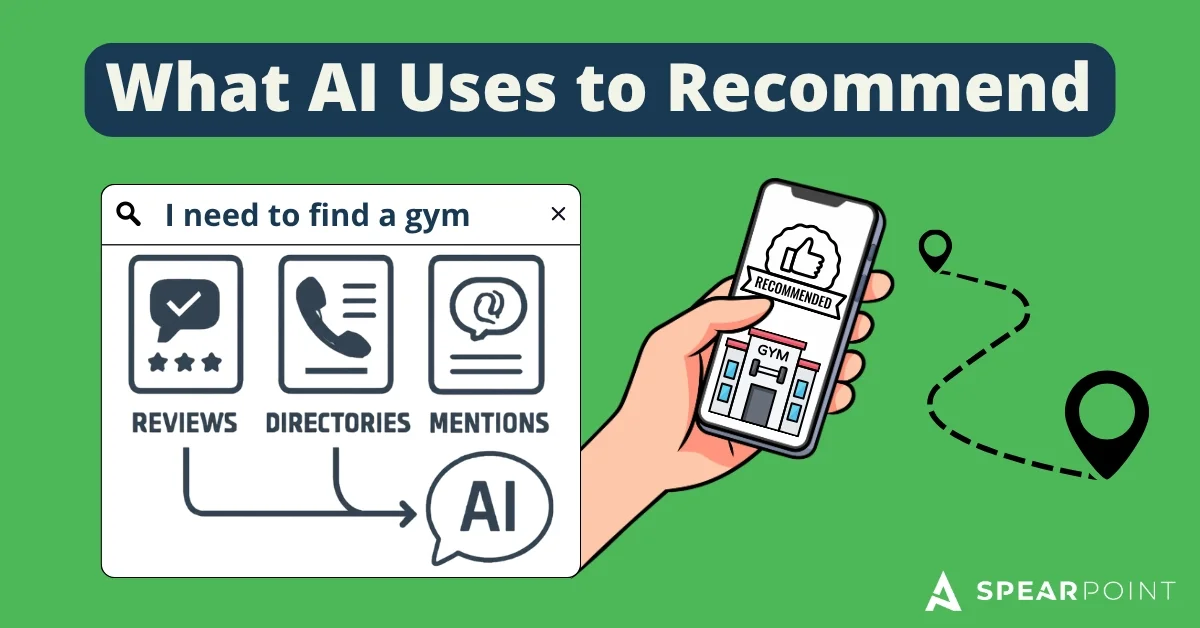
Here's the finding that reorders your whole to-do list: most of what an AI engine says about you doesn't come from your website at all. An Omniscient Digital analysis of more than 23,000 citations found that roughly 77% of the sources cited in AI answers about a brand are off-page — directories, reviews, forums, and video, rather than the brand's own site.
For a gym, that means your highest-leverage AEO work lives out in the world:
Reviews, in volume and freshness. Reviews are prime AI fuel, and recency matters. Prospects and machines both weigh recent sentiment heavily, so a steady flow beats a one-time push. Our guide on how to generate gym reviews details the system for that.
Directory presence and consistency. The more places your accurate, consistent information appears, the more corroboration the engine has to confidently name you. Inconsistent listings do the opposite.
Mentions and coverage. Local press, class-listing sites, community pages, and partner mentions all feed the picture. Being talked about accurately, in more places, makes you a safer answer.
The through-line: AEO isn't a tweak you make on your homepage. It's the accumulated evidence, spread across the web, that you're the gym worth recommending. That's slower than flipping a setting, and that's exactly why most of your competitors won't do it.
Answer the Questions Real Prospects Actually Ask AI
People don't ask machines vague questions. They ask specific, high-intent ones, and each is a chance to be the answer:
"How much is a membership at a gym near me?"
"Best gym for beginners in [city]"
"Which gyms near me have early morning classes?"
"Is there a 24-hour gym in [neighborhood]?"
"Good gym for someone nervous about starting?"
Every one of those maps to content you can own. Put clear pricing on your site instead of hiding it behind a form. Write honestly for the beginner who's intimidated. Spell out your class schedule, your hours, and who you're the right fit for. When your site plainly answers the exact question a prospect types, you hand the engine a clean answer to lift, with your name on it.
This is where the beginners win, ironically. The gyms that describe themselves in plain, specific, human terms are the easiest for a machine to understand and recommend. Specificity is a competitive advantage now.
Check Whether AI Recommends You
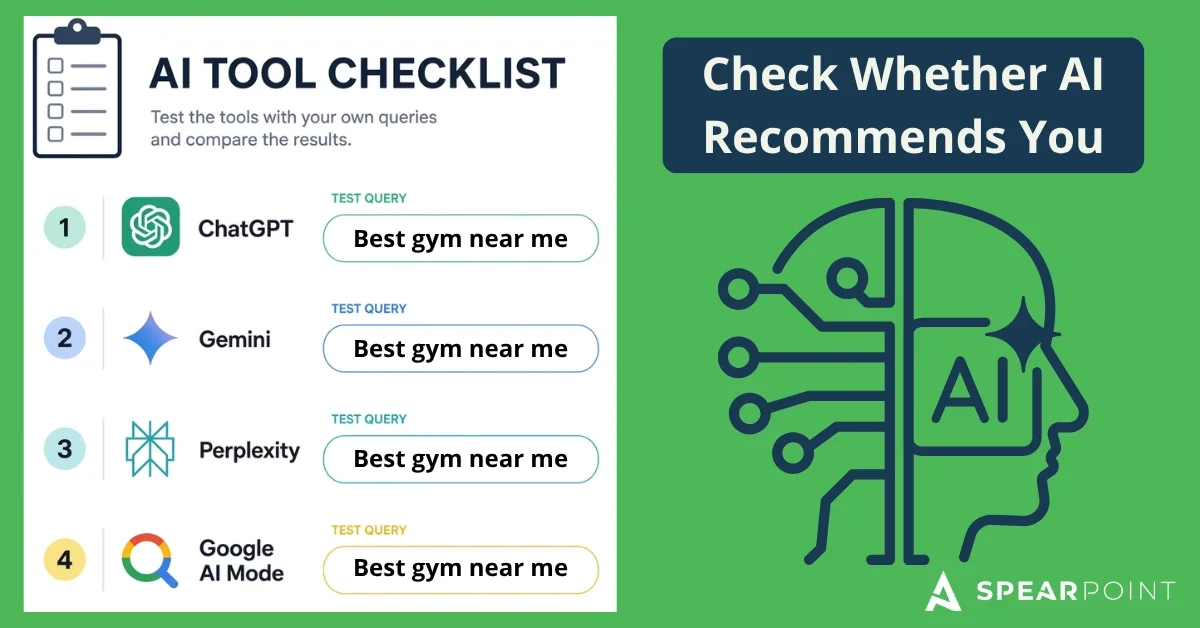
You can stop guessing in about ten minutes. Open each engine and ask it, as a prospect would, to recommend a gym in your area.
Test at least four, because each reads different sources and a clean result in one tells you nothing about the others:
ChatGPT is the volume leader; BrightLocal found 31% of consumers asked it for a business recommendation in the past year. It leans heavily on Bing's index, so your Bing presence suddenly matters.
Google's AI Mode and AI Overviews sit inside the search results your prospects already use and draw on Google's local data. AI Mode was used by 23% of consumers for recommendations.
Gemini reads Google's ecosystem, including your Business Profile, so it doubles as a check on your profile data.
Perplexity pulls its own mix of sources and citations.
Run the searches your prospects run. If you're not named, note which sources the engine did cite; that's your roadmap for where to build presence next. What you find in these ten minutes should set your AEO priorities more than any generic checklist.
Where This Meets Your Local SEO and Your Profile
AEO doesn't replace your local SEO; it's the same visibility system pointed at a new surface. BrightLocal's data shows Google's share as the top review-discovery platform slipped from 83% to 71% in a single year as AI discovery climbed. Both channels run in parallel now, and they feed on the same fuel: accurate data, real reviews, and clear information about who you are.
So do the foundation first. Your Google Business Profile is the single most important input, and we walk through it field by field in the complete GBP checklist for gyms. Then build the off-site evidence, sharpen your site's answers, and check your AI results on a schedule. Do that, and you show up whether your next member searches Google, opens Maps, or asks a chatbot.
That's the whole point of treating search as one connected system, which is exactly what our fitness and gym SEO work and our AEO and AI search services are built to do.
Want to know whether ChatGPT and Gemini already recommend your gym, and which competitor they name instead?
We'll show you exactly where you're invisible in AI answers, and what it'll take to be the name they say.
FAQ
-
AI search is when a prospective member asks a tool like ChatGPT, Gemini, Perplexity, or Google's AI Mode to recommend a gym, and the tool answers with a short list of names. It generates members because the person arrives pre-sold: a source they trust just told them you're the right choice. With 45% of consumers now using AI to find local businesses, being one of the names the machine recommends is a real, growing membership channel.
-
By becoming the clearest, most corroborated answer. That means accurate, consistent information about your gym everywhere it appears. You want a steady flow of recent reviews, presence across the directories and sources ChatGPT pulls from, and a website that answers real prospect questions directly. ChatGPT leans heavily on Bing's index and off-site sources, so the work extends well beyond your own site.
-
Structure pages around the actual questions prospects ask, and answer each one clearly and early. Use question-shaped headings, and FAQ blocks the engine can lift, state plainly what you are and who you serve, and keep your information current. Schema markup still helps traditional search, but for AI citation specifically, clear content and accurate entity information matter more than markup.
-
Yes, a lot. Your profile is one of the primary sources engines like Gemini and Google's AI Overviews read when recommending a local business. It's the foundation AEO builds on, which is why we recommend completing the full profile checklist first, then layering the off-site and on-site AEO work on top.
-
Ask it. Open ChatGPT, Gemini, Perplexity, and Google's AI Mode and run the searches a prospect would, like "best gym near me for beginners." Check several engines, because each reads different sources. If you're not named, look at which sources the engine cited instead; that tells you where to build presence next.
Suggested External Links Used in This Post
BrightLocal, Local Consumer Review Survey 2026: https://www.brightlocal.com/research/local-consumer-review-survey/
SOCi, 2026 Local Visibility Index: https://www.soci.ai/
Ahrefs, 2026 AI citations analysis: https://ahrefs.com/
Omniscient Digital, analysis of AI answer citations: https://beomniscient.com/
About the Author

Jesse McFarland is the founder of SpearPoint Marketing, a conversion-focused SEO and AI search agency based in Centennial, Colorado. Jesse has more than 17 years of digital marketing experience across B2B, SaaS, healthcare, legal, fitness, ecommerce, and startup organizations.
He specializes in helping companies turn organic search into qualified demand through modern SEO, AEO, GEO, AI Visibility, content strategy, technical SEO, and brand-first search marketing. Jesse helps business owners and marketing leaders understand how search is changing without losing their minds every time someone on LinkedIn announces SEO is dead again.