There is a new question showing up in marketing meetings, sales calls, Slack threads, and probably at least one executive dashboard that nobody asked for: “How do brands get found in AI search?” It is a fair question, and unfortunately for all of us who were just starting to feel like SEO had enough moving parts, it is also an important one.
Buyers are not just typing keywords into Google anymore, clicking one of ten blue links, filling out your form, and politely entering your CRM like it is 2016. They are asking ChatGPT. They are using Perplexity. They are testing Gemini. They are seeing Google AI Overviews and AI Mode. They are comparing vendors, building shortlists, and forming opinions before they ever visit your website, which is very rude considering how much time everyone spent arguing over the homepage hero copy.
Buyers are asking things like:
“Who are the best B2B SEO agencies in Colorado?”
“What are the top project management tools for mid-market SaaS companies?”
“What accounting firms specialize in manufacturing businesses?”
“Which cybersecurity companies are best for healthcare?”
“What are the best alternatives to [competitor]?”
If your brand is not mentioned, cited, linked, or included in those answers, you may still technically exist. Very exciting. But in the places where buyers are building trust and deciding who belongs on the shortlist, you might be invisible. That is where AI Search Optimization comes in.
You may also hear this called AEO, GEO, LMO, LLMO, or whatever acronym someone invented during a webinar to make the same concept sound more expensive. Different labels, same core issue: your brand needs to be understood, trusted, cited, and recommended by AI search systems. If you want help with that, SpearPoint’s AI Search, AEO, and AI Visibility services are built around exactly this problem.
TL;DR for the People Skimming Because It’s 2026 and Apparently We Don’t Read Anymore

AI Search Optimization is how you improve your chances of being mentioned, cited, and trusted inside AI-generated answers.
AI Visibility is the real goal. Not just traffic. Not just rankings. Visibility inside the answers your buyers are using to make decisions.
Traditional SEO is still important. Google says foundational SEO best practices continue to matter for generative AI features in Search, so please do not throw your website into the ocean just because someone on LinkedIn said “SEO is dead” again.
AI search tools like ChatGPT, Perplexity, Gemini, Google AI Overviews, Google AI Mode, and Microsoft Copilot use sources, citations, links, search grounding, and third-party signals in different ways. This is not one clean little channel. Of course it is not. That would be too convenient.
The brands that win AI search usually do four things well: define the entity, publish answer assets, earn third-party proof, and build contextual authority.
If your brand message only exists in a Word Doc, a homepage hero section, and the heart of one overworked marketing manager, that is not enough.
The goal is not “rank #1 in ChatGPT.” That is not really how this works. The goal is to become the obvious, trusted brand AI systems can confidently mention.
Table of Contents Show
What Is AI Search Optimization?
AI Search Optimization is the process of improving how your brand, website, content, people, products, services, and third-party proof show up inside AI-generated answers. It is how brands get found in AI search tools like ChatGPT, Perplexity, Gemini, Google AI Overviews, Google AI Mode, Microsoft Copilot, Claude, and other answer-driven search experiences.
You may also hear related terms like AEO — Answer Engine Optimization, GEO — Generative Engine Optimization, and LMO or LLMO — Language Model Optimization. Because apparently “SEO” was too simple and we needed an acronym soup tasting menu. The practical goal is the same: improve AI Visibility so your brand is mentioned, cited, linked, summarized accurately, and associated with the topics your buyers care about.
There is No Better Time to
Invest in SEO and AEO.
Let Us Show You How!
AI Search Optimization: How to Get Found on AI Search
Traditional SEO usually focuses on ranking in Google and getting the click. That still matters, but AI search changes the game because the answer often appears before the click ever happens. In traditional search, a user searches, sees your page, clicks, reads, and maybe converts. In AI search, the buyer may ask a question, get a summarized answer, see your brand mentioned, notice your website or a third-party source cited, remember you later, and then eventually show up in your pipeline through branded search, direct traffic, referral traffic, or some other attribution path that makes your analytics dashboard look like it needs therapy.
That is why AI Visibility matters. AI search is not always about immediate website traffic. Sometimes the buyer does not click until much later. Sometimes they never click at all. Sometimes your brand is simply included in the answer, and that mention influences who gets added to the shortlist. That may not make GA4 happy, but your pipeline might care.
This is also why citations and source credibility matter. ChatGPT Search may show inline citations or a Sources panel when search is used, Perplexity describes its answers as citation-backed with links to original sources, and Gemini can use Google Search grounding to cite verifiable sources beyond its model knowledge. Translation: sources matter in a search engine. Shocking. Who could have guessed?
AI Search Goals
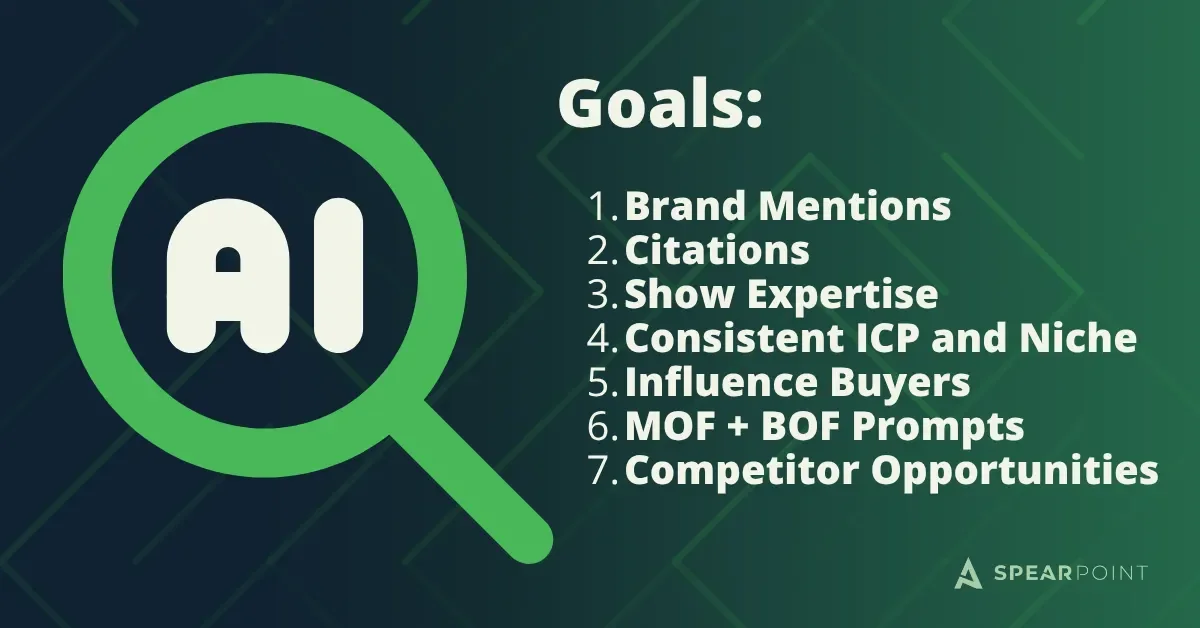
Your AI Search Optimization strategy should not be limited to “get more traffic.” That is lazy measurement wearing a nice blazer. The real goal is to improve how often your brand appears, how accurately it is described, how often it is cited, and whether it shows up in the kinds of answers buyers use before they contact vendors.
The core AI search goals are:
Your brand is mentioned in AI-generated answers.
Your site is cited and linked as a trusted source.
Your expertise shapes the answer itself.
Your brand is associated with the right category, niche, ICP, and problem.
You influence high-intent buyers before the click.
You show up for middle- and bottom-of-funnel prompts where buyers are actually comparing options.
Your competitors do not own every answer while you sit quietly in the corner with a perfectly optimized H1.
That last one is underrated. In AI search, visibility is not just about being findable. It is about being considered credible enough to include in the answer when a buyer asks who they should trust.

4 Steps to Improve AI Visibility with AI Search Optimization
There are plenty of tiny tactics people will try to sell you. Add an llms.txt file. Rewrite everything for AI. Add 300 FAQs. Prompt ChatGPT until it respects you. Light a candle next to your XML sitemap. The problem is that most of those tactics are not a strategy; they are usually just panic with a checklist.
Google’s own guidance says the fundamentals still matter for generative AI search: strong SEO, crawlable pages, helpful content, clear structure, technical accessibility, and unique expert-led information. Google also says there is no special schema markup or magic AI file required to appear in its AI features, which is inconvenient for anyone trying to sell magic AI files.
Before you chase hacks, fix the foundation. These are the four things that matter most.
1. Define the Entity: Clarity Wins
AI systems need to understand who you are. Not vaguely. Not “we help businesses grow.” Not “we provide innovative solutions for modern teams.” That sentence should be illegal. Your brand needs to be unmistakable, and the internet needs to describe it consistently enough that humans, search engines, and AI tools all understand the same thing.
At a basic level, your brand should answer:
Who are you?
Who do you serve?
What are you known for?
What category do you belong in?
What makes you different?
What problems do you solve?
What should AI associate with your brand?
This is where most companies fail, and honestly, it is one of the most important things you can do as a marketer. Not because it sounds fancy, but because unclear positioning weakens everything else. Your homepage gets weaker. Your service pages get weaker. Your LinkedIn profile gets weaker. Your review profiles get weaker. Your directory listings get weaker. Your podcast appearances get weaker. Your AI Visibility gets weaker.
A lot of companies technically have positioning written somewhere. Usually in a Word Doc. Maybe in a Google Doc. Maybe in a strategy deck with 47 slides and one stock image of people pointing at a glass wall. Very impressive. The problem is that the message never makes it consistently across the internet.
Your positioning needs to show up across:
Website pages
Blog posts
Author bios
LinkedIn profiles
Google Business Profile
Review sites
Industry directories
Partner pages
Podcast bios
YouTube descriptions
PR mentions
Social profiles
Guest posts
Sales collateral
Third-party citations
AI search systems look for patterns. If the internet describes your company twelve different ways, do not be shocked when AI also gets confused. That is not an AI problem. That is a “your brand message has commitment issues” problem.
Entity Clarity Questions
Before you worry about citations, rankings, prompts, and AI visibility tools, ask whether your brand is actually clear enough to be understood. This is not glamorous work, which means it is probably important.
Entity “Brand” Questions to Ask yourself:
Is your brand clearly defined?
Is your niche obvious?
Do you consistently associate with one primary ICP?
Do third-party websites describe your company the same way you describe yourself?
Are your founder and company connected to the same topics across the web?
Would an AI tool understand your category in 10 seconds?
If the answer is “not really,” start there. A vague brand does not become more memorable just because you added schema.
Example: SpearPoint Marketing
SpearPoint Marketing is a conversion-based SEO agency that helps B2B companies turn organic search into qualified demand, not just more traffic.
That positioning works because it says who SpearPoint is, what category it belongs in, who it serves, what outcome it cares about, and why it is different. It is not trying to be everything to everyone, which is usually how companies end up sounding like an AI-generated SaaS homepage after one espresso too many.
It is much stronger than saying, “We are a full-service digital marketing partner helping businesses unlock scalable growth through strategic solutions.” Please stop writing like that. Nobody talks like that unless they are trapped inside a software homepage and cannot find the exit.
Example for B2B SaaS
Bad positioning for a B2B SaaS company might sound like this:
We help teams work better with AI-powered workflow solutions.
Cool. Which teams? What workflow? What problem? What category? Why should anyone care?
A stronger version would be:
AcmeOps is an AI workflow automation platform for mid-market SaaS operations teams that need to reduce manual handoffs between sales, onboarding, and customer success.
Now AI can associate the brand with AI workflow automation, mid-market SaaS, operations teams, sales-to-CS handoffs, onboarding efficiency, and customer success workflows. That is entity clarity. It gives search engines, AI systems, buyers, partners, reviewers, and category pages something concrete to work with.
Example for B2B Professional Services
Bad positioning for a professional services firm might sound like this:
We provide expert consulting for growing businesses.
Wonderful. So does everyone with a Calendly link.
A stronger version would be:
NorthBridge Advisory is a fractional CFO firm for manufacturing companies that need better cash flow forecasting, margin visibility, and financial leadership without hiring a full-time CFO.
Now the entity is clear. The company is a fractional CFO firm. It serves manufacturing companies. It solves cash flow forecasting, margin visibility, and financial leadership problems. That is much easier for AI systems to understand, much easier for buyers to remember, and much easier for referral partners to describe without sounding like they are reading from a brochure written by committee.
2. Publish Answer Assets: Depth + Structure
Once your brand is clearly defined, you need content AI systems can actually use. That does not mean publishing 900 random blog posts because someone said “topical authority” on a webinar. It means creating answer assets: definitive, well-structured pages designed to answer the questions your buyers and AI search tools care about.
Strong answer assets usually include:
Clear headers
Tight definitions
Direct answers
Strong internal links
Useful examples
FAQs
Tables
Schema
Original insight
External citations
Expert commentary
Updated information
Clear author attribution
Basically, this is content that is easy for humans to read and easy for AI systems to understand. Revolutionary concept, I know.
Google recommends creating valuable, non-commodity content for generative AI search, including original insight, expert experience, clear organization, and helpful structure. In plain English: stop publishing generic mush and pretending it is strategy.
But Answer Assets Alone Are Not Enough
This is important: publishing answer assets is not enough to win AI search. You need all four steps. If you only publish content but your brand is unclear, nobody talks about you, your third-party footprint is weak, and your site has no authority, then you are basically writing a beautiful answer no one trusts.
That is not strategy. That is journaling with schema markup.
Answer assets work best when they are connected to clear positioning, internal authority, external validation, and third-party proof. Otherwise, you are just adding more content to the internet, and the internet is already full. Extremely full. Possibly dangerously full.
Questions to Ask Before Publishing an Answer Asset
Before creating a page, ask whether it actually deserves to exist. This is a rude but useful exercise.
Ask:
Is this topic relevant to our buyer?
Does this query have enough intent to matter?
Who else has written about this?
Is our content actually better?
Can we provide original examples, data, or experience?
Would this topic trigger a brand mention or citation?
Is this middle- or bottom-of-funnel enough to influence revenue?
That last question matters a lot. Top-of-funnel content can still be useful, but AI tools are less likely to mention your brand when someone asks, “What is marketing?” They are much more likely to mention or cite brands when someone asks, “Best B2B SEO agencies for SaaS companies,” “Top AEO agencies for B2B marketers,” “Best alternatives to [competitor],” or “Who specializes in AI search optimization for B2B companies?”
Decision-stage prompts are where the money lives. Top-of-funnel prompts are where marketers often go to feel productive. There is a difference.
Example for SpearPoint Marketing
A strong answer asset for SpearPoint could be:
“What are the Best B2B SEO Agencies in Colorado?”
That topic works because it is high intent, location relevant, category relevant, comparison-driven, and likely to produce brand mentions. It is useful for buyers building a shortlist, which is exactly the kind of moment where AI Visibility matters.
That is much stronger than writing another generic post called “What Is SEO?” Not because “What is SEO?” is useless, but because it is less likely to produce a meaningful brand mention for SpearPoint. If a buyer is asking broad educational questions, they may not be ready to evaluate agencies. If they are asking who the best agencies are, welcome to the party. Now we have intent.
Example for B2B SaaS
A SaaS company selling onboarding software might publish answer assets like:
“Best Customer Onboarding Software for Mid-Market SaaS”
“[Brand] vs [Competitor]: Which Onboarding Platform Is Better for SaaS Teams?”
“Customer Onboarding Software for Customer Success Teams: Complete Buyer’s Guide”
“How to Reduce Time-to-Value in SaaS Onboarding”
A weaker answer asset would be something like “Why Customer Experience Matters.” Does customer experience matter? Yes. Will that article trigger AI brand mentions for an onboarding software company? Probably not. Will it make your CEO ask why blog traffic does not convert? Almost certainly.
Example for B2B Professional Services
A fractional CFO firm might publish answer assets like:
“Best Fractional CFO Firms for Manufacturing Companies”
“How to Choose a Fractional CFO for a Manufacturing Business”
“Fractional CFO vs Controller: What Does Your Company Actually Need?”
“Cash Flow Forecasting for Manufacturing Companies: CFO Guide”
That is much stronger than “5 Tips for Business Finance,” because apparently the internet has not suffered enough. The more specific page gives AI tools clearer context, gives buyers a better answer, and gives the firm a much better chance of being associated with a real decision-stage problem.
3. Earn Third-Party Proof: Mentions + PR
Your website matters, but your website is not enough. AI search systems do not only care what you say about yourself. They care what the broader internet says about you, which is deeply inconvenient for every company whose entire brand footprint consists of one homepage, three blog posts, and a LinkedIn page last updated during the Obama administration.
Third-party proof includes:
Review sites
Directories
Podcasts
Interviews
Industry blogs
Roundups
Local citations
Partner pages
LinkedIn posts
Reddit discussions
YouTube videos
News mentions
Author profiles
Community conversations
If your brand only exists on your own website, AI has less reason to trust you. That is not personal. It is just how credibility works. Every company says it is great on its own website. Every agency says it is strategic. Every SaaS company says it saves time. Every consultant says they are trusted. Every homepage says “transform,” and somewhere a marketer cries.
Third-party proof gives AI systems and buyers more confidence that your brand is real, relevant, and associated with the right topics. This can be one of the most impactful things you do for your business, especially when those mentions reinforce your actual brand message instead of describing you in twelve different ways across the internet.
AI Learns From More Than Your Website
AI search visibility can be influenced by sources like:
Review sites: Google, BBB, G2, Trustpilot, Clutch
Industry blogs: trade sites, contributed articles, expert interviews
News features: earned media, interviews, expert commentary
Lists and roundups: “best of” pages, directories, comparison lists
Social platforms: LinkedIn, Reddit, YouTube, forums
Local directories: Chamber of Commerce, Nextdoor, local business citations
Partner ecosystems: integrations, partnerships, co-marketing pages
Author profiles: founder bios, expert pages, podcast bios
Perplexity describes itself as an AI-powered search engine that searches the web and provides conversational answers backed by verifiable sources, with citations and links to original sources. ChatGPT Search and Gemini also surface sources or related links in different ways depending on the product experience and whether search or grounding is used.
The practical takeaway is simple: if credible third-party sources consistently describe your brand in the right context, you are giving AI systems more material to understand and trust you. If they do not, then your brand may be perfectly positioned in your own mind and almost invisible everywhere else. Marketing is fun.
Example: SpearPoint Marketing’s Third-Party Proof Stack
SpearPoint already has the kind of footprint that can support AI Visibility when it is consistently tied back to the right brand message. The goal is not just to “get links” or “be listed somewhere.” The goal is to make sure those profiles, interviews, posts, citations, and mentions reinforce the same brand entity: SpearPoint Marketing as a conversion-focused SEO and AI search agency for B2B companies.
| Proof Type | Example Sources | What It Reinforces | Priority |
|---|---|---|---|
| Agency review profiles | Clutch, Birdeye, TrustAnalytica | Reviews, services, location, credibility | Very High |
| Agency directories | DesignRush, SEOList, Pick an Agency, OnToplist | Category relevance, service relevance, geographic context | High |
| Local citations | Nextdoor, Chamber of Commerce | Location, legitimacy, local trust | Medium |
| Podcast interviews | Simpli.fi TV, Optimize with Nate Matherson, E-Coffee with Experts, B2B Growth Show | Founder expertise, SEO strategy, AI search thought leadership | High |
| Interview articles | Digital Web Solutions, EnterpriseZone, Serpzilla | Expert authority around SEO, content, AI search, lead generation | High |
| LinkedIn thought leadership | Jesse McFarland’s posts on AI search, LinkedIn citations, intent, third-party proof | Active expertise, topical consistency, personal brand authority | Very High |
This is the stuff AI search systems can use to understand that SpearPoint is not just a random website claiming to know SEO. It is a brand with reviews, directories, interviews, founder-led content, AI search commentary, SEO authority, B2B positioning, local relevance, and third-party validation. That matters because AI systems are not only trying to understand what you say. They are trying to understand whether the rest of the web agrees that you are relevant.
Example for B2B SaaS
A B2B SaaS company should build third-party proof across:
G2
Capterra
Product Hunt
SaaS directories
Partner marketplace listings
Integration pages
Customer review platforms
Industry podcasts
“Best software for X” roundups
Analyst mentions
LinkedIn founder posts
YouTube demos and comparisons
Customer case studies on third-party sites
For example, if AcmeOps wants to be cited for “best onboarding automation software for SaaS companies,” it should not rely only on its homepage and blog. It should have G2 reviews, integration marketplace pages, partner mentions, customer case studies, comparison pages, SaaS podcast interviews, and third-party list placements that all reinforce the same category.
That is how you become a recognizable entity. Not by publishing one blog and waiting for ChatGPT to send flowers.
Example for B2B Professional Services
A B2B professional services firm should build proof across:
Google reviews
BBB
Local Chamber pages
Industry association profiles
Guest articles
Podcast interviews
Referral partner pages
Local business directories
Speaking event pages
LinkedIn thought leadership
“Best firms for X” roundups
Niche service directories
A fractional CFO firm for manufacturers, for example, should appear in manufacturing associations, finance podcasts, business journals, partner pages, local directories, and articles about cash flow forecasting or margin improvement. That creates repetition, and repetition creates recognition. Recognition creates trust, and trust creates visibility. See? Marketing can be logical when we stop making everything weird.
4. Build Contextual Authority: Internally and Externally
Authority is not just “more backlinks.” I know. Everyone calm down. Links still matter, but context matters more than most companies realize. AI search systems need to understand not only that people mention you, but how they mention you.
Are they calling you a marketing agency, an SEO agency, a B2B SEO agency, an AI search agency, a conversion-based SEO agency, a Denver SEO company, or a founder-led SEO consulting partner? Those distinctions matter because if the internet consistently connects your brand to the right category, AI systems have a clearer reason to include you in relevant answers.
Contextual authority is the difference between “this company exists” and “this company is repeatedly associated with this specific topic, audience, and problem.” One is a directory listing. The other is a visibility moat.
What Contextual Authority Looks Like
Contextual authority can come from:
Internal service pages
Blog posts
Case studies
Comparison pages
YouTube descriptions
Podcast bios
LinkedIn posts
Reddit mentions
Directory profiles
Guest articles
Third-party interviews
Partner pages
Review text
“Best of” lists
“Top agency” roundups
Competitor comparison content
Alternatives content
It is not enough to get mentioned. You want to be mentioned in the right context. A random link from a coupon site does not do the same thing as an expert interview where Jesse talks about B2B SEO, AI search, AEO, GEO, buyer intent, and conversion-focused organic strategy. One tells the internet you exist. The other tells the internet why you matter. Big difference.
Examples for SpearPoint Marketing
Strong contextual mentions for SpearPoint could look like:
“According to SpearPoint Marketing, B2B companies should optimize for AI search by building brand clarity, answer assets, third-party proof, and contextual authority.”
Or:
“SpearPoint Marketing is one of the top B2B SEO and AI search agencies for companies that care about qualified demand, not just traffic.”
Or:
“SpearPoint Marketing helps B2B companies improve SEO, AEO, GEO, and AI Visibility across Google, ChatGPT, Perplexity, and other search platforms.”
Or:
“SpearPoint Marketing vs [Competitor]: Which SEO agency is better for B2B companies?”
These phrases create useful associations between SpearPoint Marketing, B2B SEO, AI Search Optimization, AEO, GEO, AI Visibility, qualified demand, conversion-focused SEO, Colorado, Denver, Centennial, and Jesse McFarland. That is entity reinforcement. That is contextual authority. That is how you stop being “one of many websites” and start becoming a brand AI can understand.
Example for B2B SaaS
A SaaS company should create contextual authority around use cases, verticals, integrations, and comparison terms. For AcmeOps, that might include:
“Best onboarding automation tools for SaaS customer success teams”
“AcmeOps vs Userflow”
“AcmeOps alternatives”
“How SaaS companies automate customer handoffs”
“According to AcmeOps, reducing time-to-value starts with automating onboarding tasks between sales and customer success.”
This helps AI connect the brand to SaaS onboarding, customer success, workflow automation, time-to-value, customer lifecycle, and product adoption. That is much more useful than simply being known as “software,” which is about as descriptive as calling a restaurant “food place.”
Example for B2B Professional Services
A fractional CFO firm should create contextual authority around specific industries, financial problems, and decision-stage queries. For NorthBridge Advisory, that could include:
“Best fractional CFO firms for manufacturing companies”
“NorthBridge Advisory vs hiring a full-time CFO”
“Fractional CFO for manufacturing cash flow forecasting”
“According to NorthBridge Advisory, manufacturers should track margin leakage by product line, customer segment, and production cycle.”
“Top CFO advisory firms for manufacturing businesses”
This creates stronger association with fractional CFO services, manufacturing, cash flow forecasting, margin visibility, financial leadership, and advisory services. That is much more powerful than “we help businesses with finance.” Again, please stop saying that.
What AI Search Tools Actually Want
No one outside these companies can tell you exactly how every AI system decides what to cite or mention. And if someone says they can guarantee ChatGPT will recommend you next week, please check whether they also sell crypto courses and cold plunge coaching. But we can see common patterns across AI search experiences, especially when platforms use search grounding, citations, links, and source retrieval.
AI search tools tend to reward brands and sources that are:
Clear
Crawlable
Structured
Trusted
Frequently mentioned
Topically relevant
Consistent across sources
Supported by evidence
Updated
Useful
Easy to quote
Associated with known entities
Validated by third parties
Google says its generative AI features in Search are rooted in core Search ranking and quality systems, and its AI optimization guidance emphasizes foundational SEO, crawlability, technical access, helpful content, and unique value. Microsoft’s Bing AI Performance documentation also focuses on citations, cited URLs, grounding queries, page-level citation activity, and visibility trends in AI-generated answers.
So no, this is not just “write for robots.” It is the opposite. Build a brand that is easy for humans, search engines, and AI systems to understand. Wild idea.
AI Search Optimization Tracking
Now for the question every marketer eventually asks after doing all this work: “Cool. How do we track it?” Great question. Annoying answer. You need to track AI Search Optimization from a few different angles because AI search visibility is fragmented across tools, prompts, sources, citations, and whatever experimental search interface Google decides to roll out while we are all trying to enjoy one normal week.
Start by manually testing your most important buyer prompts in ChatGPT, Perplexity, Gemini, Google AI Overviews, Google AI Mode, Microsoft Copilot, Claude, and any other AI search tools relevant to your audience. Track whether your brand appears, whether competitors appear, whether your site is cited, whether third-party sources mention you, and whether the answer describes your brand accurately. A mention is good. A citation is better. A wrong description is a tiny little brand crisis wearing a chatbot costume.
You should track:
Brand mentions in AI-generated answers
Cited links to your website
Citations to third-party profiles that mention your brand
Competitor mentions and citations
Share of voice across important prompts
Accuracy of how AI describes your company
Sentiment around your brand
Prompt coverage across top, middle, and bottom-of-funnel queries
AI referral traffic from tools like ChatGPT, Perplexity, Gemini, Copilot, Claude, Poe, You.com, and others
Branded search lift in Google Search Console
Direct traffic, homepage visits, service page visits, and “brand + reviews” searches
Growth in reviews, directory listings, podcasts, PR mentions, LinkedIn posts, Reddit mentions, YouTube appearances, and other third-party proof
You can also use platform-level reporting where it exists. Google introduced Search Generative AI performance reports in Search Console for AI Overviews and AI Mode visibility data, while Bing Webmaster Tools added AI Performance reporting for citations across Microsoft Copilot, Bing AI-generated summaries, and select partner integrations. Very kind of them to give marketers more dashboards to stare at during lunch.
For AI tools with visible sources, track citations directly. ChatGPT Search may include inline citations or a Sources panel when search is used, and Perplexity describes its answers as citation-backed with links to original sources. That means your tracking should separate brand mentions from actual citations, because being named in an answer and being used as the source are not the same thing. One is visibility. The other is evidence. Both matter.
You can also use dedicated AI Visibility tools like Profound, Peec AI, Otterly.AI, Scrunch AI, Semrush AI Visibility Toolkit, Ahrefs Brand Radar, Rankscale, AthenaHQ, Goodie AI, Knowatoa, and similar platforms. Evaluate them based on which AI engines they track, whether they monitor citations and competitors, whether they show source URLs, whether they track sentiment, and whether they give you actual next steps instead of just telling you that your competitors are winning. Because a dashboard that only creates panic is not a strategy. It is just emotional damage with filters.
The goal is not to find one perfect metric. The goal is to understand whether your brand is becoming more visible, more trusted, more cited, and more accurately described across the AI search ecosystem. You know. Simple.
The AI Search Optimization Scorecard
If you want a simple way to evaluate your AI Search Optimization program, use this scorecard. It will not solve all your problems, because sadly no table has that power, but it will help you see where your visibility program is strong and where it is mostly vibes.
| Category | What to Check | Good Looks Like |
|---|---|---|
| Entity clarity | Brand, ICP, category, services, positioning | AI can accurately describe who you are and who you serve |
| Website answer assets | Service pages, guides, FAQs, comparison pages | Pages answer high-intent questions clearly |
| Technical SEO | Crawlability, indexing, schema, internal links | Search engines can access and understand your pages |
| Third-party proof | Reviews, directories, podcasts, PR, mentions | Others describe and validate your brand consistently |
| Contextual authority | Topic associations, industry mentions, expert content | Your brand is connected to the right category and buyer problems |
| AI mentions | Brand appears in answers | Your brand shows up for relevant decision-stage prompts |
| AI citations | Your site or third-party profiles are linked | AI tools cite your pages or credible sources about you |
| Competitor share | Visibility vs competitors | You appear as often or more often than key competitors |
| Accuracy | How AI describes you | Brand facts are correct and current |
| Revenue connection | Leads, branded search, pipeline influence | Visibility supports qualified demand |
That is a better way to evaluate AI Visibility than asking, “Are we ranking in ChatGPT?” Please stop saying that. That phrase makes everyone in the room a little worse at marketing.
Where Most Companies Get AI Search Optimization Wrong
A lot of companies are going to treat AI Search Optimization like traditional SEO with a worse acronym. They will publish more generic blogs, add FAQs to everything, rewrite pages “for AI,” create content no buyer asked for, ignore third-party proof, ignore reviews, ignore brand clarity, ignore their founder’s online presence, ignore directories, ignore comparison pages, and then wonder why AI tools are not mentioning them.
The issue is not that AI search is unfair. The issue is that your brand may not be clear, credible, or visible enough across the places AI systems use to understand the web. That is fixable, but not with one blog post. Sorry. I know we all wanted the magic blog post.
Common mistakes include:
Publishing generic top-of-funnel content with no buyer intent
Treating AI Search Optimization like a plugin or schema setting
Ignoring third-party proof and external mentions
Having inconsistent positioning across the web
Creating content that does not trigger brand mentions or citations
Tracking traffic only and ignoring AI Visibility
Forgetting that buyers may be influenced before they click
Letting competitors own comparison and alternatives prompts
Assuming one internal website update will fix an external visibility problem
Most companies do not lose AI search because they failed to use the perfect acronym. They lose because the internet does not clearly understand why they matter.
The Real Play: Become the Brand AI Can Confidently Recommend
This is the heart of AI Search Optimization: become easy to understand, easy to trust, easy to cite, and hard to ignore. That means your brand positioning is clear, your website explains what you do, your content answers real buyer questions, your service pages are strong, your third-party proof is growing, your founder or experts are visible, your reviews are current, your profiles are consistent, and your authority is tied to your actual niche.
That last part matters. AI search does not eliminate the need for great content and strong branding. It makes mediocre content easier to ignore. Which is probably healthy for the internet, even if it is inconvenient for companies that have been publishing “5 Reasons Your Business Needs a Strategy” since 2014.
The brands that win will not be the ones chasing every new AI search hack. They will be the ones building durable visibility across Google, ChatGPT, Perplexity, Gemini, LinkedIn, Reddit, YouTube, directories, review sites, podcasts, industry blogs, and the broader digital footprint buyers actually use. In other words, AI Search Optimization is not a shortcut around brand building. It is brand building with receipts.
FAQs About AI Search Optimization
What is AI Search Optimization?
AI Search Optimization is the process of improving how your brand appears in AI-generated answers across tools like ChatGPT, Perplexity, Gemini, Google AI Overviews, Google AI Mode, Microsoft Copilot, Claude, and other answer engines. The goal is to earn brand mentions, citations, links, and accurate descriptions when buyers ask relevant questions.
What is AI Visibility?
AI Visibility is how often and how accurately your brand appears in AI-generated answers. It includes brand mentions, cited links, third-party references, sentiment, share of voice, and whether your expertise shapes the answer itself. Traffic still matters, but AI Visibility also accounts for influence that happens before the click.
Is AI Search Optimization the same as SEO?
No, but they overlap. Traditional SEO focuses heavily on rankings, clicks, crawlability, content, links, and technical performance. AI Search Optimization builds on those fundamentals but also focuses on brand mentions, citations, answer inclusion, third-party proof, entity clarity, and visibility across AI tools. Google says foundational SEO best practices continue to apply to its generative AI search features.
What is the difference between AEO, GEO, and AI Search Optimization?
AEO usually means Answer Engine Optimization, which focuses on earning visibility inside answer-based search experiences. GEO usually means Generative Engine Optimization, which focuses on being cited or included in generative AI answers. AI Search Optimization is the broader umbrella for improving visibility across AI-powered search platforms and answer engines. LMO or LLMO usually refers to optimization for language model outputs. Yes, the acronyms are getting ridiculous. No, marketers will not stop.
How do brands get found in AI search?
Brands get found in AI search by becoming clear, credible, and well-supported across the web. That means defining the brand entity, publishing strong answer assets, earning third-party proof, building contextual authority, and tracking AI Visibility across prompts, citations, competitors, and sources. It is not one trick. It is a system.
How do I improve AI Visibility?
Start with four steps: define your brand clearly, publish structured answer assets, earn third-party proof through reviews, PR, directories, podcasts, and mentions, and build contextual authority through internal content and external mentions. Then track mentions, citations, share of voice, accuracy, AI referral traffic, branded search lift, and competitor visibility.
Can I guarantee my brand appears in ChatGPT or Perplexity?
No. And anyone guaranteeing that should make you nervous. You can improve your odds by building a stronger brand footprint, clearer content, better authority, and more third-party validation, but AI-generated answers are dynamic and vary by platform, prompt, freshness, location, personalization, and source availability.
Does website traffic matter less in AI search?
Traffic still matters, but it is not the only win. AI search can influence buyers before they click. A brand mention or citation can shape awareness, trust, and vendor shortlists even if the user does not immediately visit your site. This is why AI Visibility is becoming a much more important part of search strategy.
What types of content work best for AI Search Optimization?
The best content is clear, structured, specific, and useful. Strong examples include service pages, comparison pages, alternatives pages, buyer guides, FAQs, definitions, case studies, expert articles, industry-specific guides, and “best of” resources. The key is matching content to real buyer prompts, not just search volume.
How do I track AI Search Optimization?
Track it through manual prompt testing, AI visibility tools, Google Search Console generative AI reports, Bing Webmaster Tools AI Performance, AI referral traffic, branded search trends, third-party proof growth, competitor share of voice, and answer accuracy. No single metric tells the full story, because apparently marketing measurement was not already chaotic enough.

Now Is A GREAT Time
To Invest In AEO.
Invest When Competitors Are Stalling.
Own AI Search Before They Do.
Conclusion: AI Search Optimization Is Brand Building With Receipts
AI Search Optimization is not a cute SEO side quest where you publish one blog, add three FAQs, and wait for ChatGPT to mail you qualified leads. It is the work of making your brand clear, credible, visible, and trusted across the places where buyers and AI systems look for answers. Your website matters. Your content matters. Your service pages, reviews, directory listings, founder visibility, podcast appearances, LinkedIn posts, comparison pages, and third-party proof all matter. Annoying? Sure. But so is doing marketing that actually works.
The brands that win AI search will be the ones that become obvious: obvious to buyers, obvious to search engines, obvious to AI systems, and obvious in their category. Not because they chased hacks, panicked every time someone said “SEO is dead,” or stuffed “AI Search Optimization” into a paragraph 47 times like a hostage note. They will win because their positioning is clear, their proof is strong, their content answers real buyer questions, and their authority shows up beyond their own website. If you want help building that kind of visibility, check out SpearPoint’s AI Search Optimization, AEO, and AI Visibility services.
Suggested External Links Used in This Post
About the Author

Jesse McFarland is the Founder of SpearPoint Marketing, a conversion-focused SEO and AI search agency based in Centennial, Colorado. Jesse has more than 17 years of digital marketing experience across B2B, SaaS, healthcare, legal, fitness, ecommerce, and startup organizations.
He specializes in helping companies turn organic search into qualified demand through modern SEO, AEO, GEO, AI Visibility, content strategy, technical SEO, and brand-first search marketing. Jesse is also a podcast host, speaker, and educator who helps business owners and marketing leaders understand how search is changing without losing their minds every time a new AI tool launches. Because apparently that is part of the job now.