SEO for Manufacturers: Get Found by B2B Buyers, Distributors & Procurement Teams

A plant manager types a question into Google at 9:40 on a Tuesday:
"ISO 9001 CNC machine shop that can hold ±0.0005 and ship in three weeks."
Somebody's getting that quote request. The question is whether it's you, or the shop two states over with a worse floor and a better website.
That's the uncomfortable thing about manufacturing SEO. Your tolerances can be tighter, your lead times shorter, and your quality team sharper than anyone in your zip code—and none of it matters if a buyer can't find you at the exact moment they're ready to source. Being the best supplier and being the found supplier are two different competitions. You're probably winning one and losing the other.
So let's answer the question we get from manufacturers constantly: what SEO strategy actually works for a manufacturing company trying to generate B2B leads online? Not traffic. Leads. Quotes. Revenue you can put on a PO.
TL;DR

Manufacturing buyers do most of their research before they contact you, so your website has to do the selling your reps used to.
"We make quality products" ranks for nothing and sells to no one. Buyers search by capability, material, tolerance, certification, industry, and location—so build pages around those, not around your org chart.
High-intent pages (capabilities, "[process] for [industry]," "[material] supplier," and location pages) beat another generic blog post every time, because they catch buyers who are ready to request a quote.
SEO and AEO are one system now. The same structured, specific content that ranks in Google is what gets your shop named inside ChatGPT, Perplexity, and Google AI Overviews.
Measure quote requests and closed revenue, not keyword rankings. A #1 ranking you can't invoice is a trophy, not a result.
Table of Contents Show
"We Make Quality Products" Doesn't Rank—or Sell
Here's the homepage headline we see on roughly half of manufacturing sites:
"Quality Manufacturing Solutions You Can Trust."
Good luck. That sentence is doing nothing. No buyer searches for "quality solutions." No AI engine recommends a shop because it "can be trusted." And no procurement lead builds a shortlist out of adjectives.
The problem isn't that SEO stopped working for manufacturers. The problem is that most manufacturing sites are written for an awards banquet, not a buyer with a drawing in hand. Vague copy is a choice, and it's an expensive one.
Specificity is the whole game. A buyer sourcing a part doesn't want to know you're "innovative." They want to know you run Swiss-type lathes, hold tight tolerances on 316 stainless, carry AS9100 for their aerospace program, and can turn around a prototype in two weeks. Say that, and you've done more SEO than a year of "industry-leading" filler.
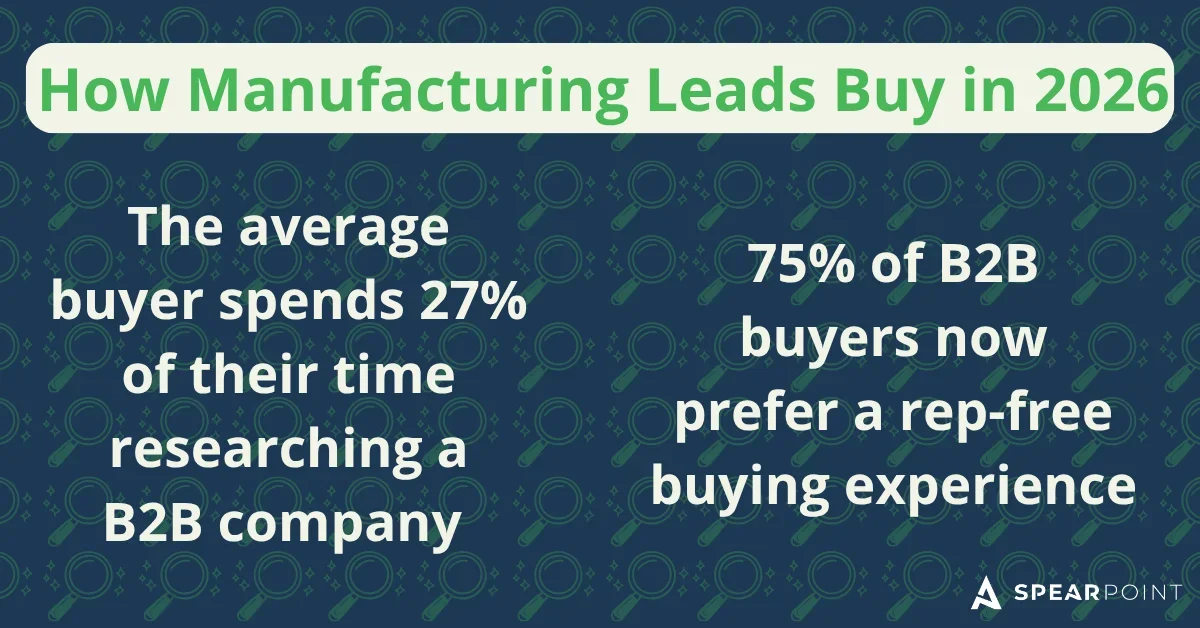
How Manufacturing Leads Buy in 2026
If you still picture the sale starting with a phone call, the data has bad news.
B2B buyers spend only 17% of their purchase journey meeting with potential suppliers—and just 5% to 6% with any single sales rep.
— Gartner, The B2B Buying Journey
The rest of that time, the buyer is researching—and 27% of it is spent researching independently online, long before your quoting team hears a word. Gartner also found that 75% of B2B buyers now prefer a rep-free buying experience. Translation: they'd rather read your capabilities page at 11 p.m. than take your call at 11 a.m.
This is even more true in industrial sourcing, where buyers arrive ready to move. On Thomasnet alone, 2.2 million registered buyers source industrial products, and 66% show up with a specific purchase in mind. These are people with a part number and a budget, not tire-kickers.
So your website isn't a brochure anymore.
It's your best sales rep, working the 83% of the journey your actual reps never see.
And if that rep can't clearly state what you make, who you make it for, and why you're qualified—you lose the shortlist before you ever knew you were on it.
Build Pages Around Capabilities and Intent, Not Your Org Chart
Most manufacturing sites have five pages: Home, About, Services, Capabilities (one page, 200 words), and Contact. That structure tells Google—and buyers—almost nothing.
High-intent buyers search in capability + qualifier + application language. Your site architecture should mirror exactly how they search.
The page types that actually pull quotes
Process pages—one dedicated page per process you want to win work for: CNC machining, injection molding, metal stamping, sheet metal fabrication. Not one buried list.
"[Process] for [industry]" pages—CNC machining for medical devices, injection molding for automotive. This is where high-intent buyers live, and where competitors are usually asleep.
Material and tolerance pages—if titanium, PEEK, or tight-tolerance work is your edge, it deserves its own page with real numbers.
Certification and compliance pages—ISO 9001, AS9100, ITAR, IATF 16949. Buyers filter by these before anything else; make them indexable, not a logo in the footer.
Location pages—CNC machine shop in [metro] still matters, because plenty of buyers want a supplier they can audit in person.
A weak page vs. a strong page

AEO: Getting Your Shop Recommended by ChatGPT, Perplexity, and Google AI Overviews
Here's the part most manufacturers haven't clocked yet. Your buyers aren't only searching Google—they're asking AI.
94% of B2B buyers now use large language models during their buying process.
— 6sense, 2025 B2B Buyer Experience Report
When a sourcing engineer types "best contract manufacturers for medical device enclosures with ISO 13485" into ChatGPT or Perplexity, or sees a Google AI Overview answer the question outright, a shortlist gets built in seconds—and your shop is either named in it or it isn't.
This is where SEO and AEO (answer engine optimization) stop being two projects and become one. The content that earns a citation inside an AI answer is the same content that ranks in classic search: specific, structured, and genuinely informative. There's no separate "AI content" to write. There's just content that's clear enough to be quoted, or vague enough to be skipped.
To get your manufacturing site recommended by AI engines:
Answer real sourcing questions in plain language. Add FAQ-style sections that state your tolerances, materials, minimums, lead times, and certifications as direct answers—the exact facts a buyer asks an AI to confirm.
Use structured data and clean headings. Mark up your capabilities, certifications, and locations so machines can read them without guessing.
Earn third-party mentions. AI engines lean on corroboration. Listings on industrial platforms, trade-press mentions, and real reviews make you a safer recommendation.
Keep specs current and consistent. Conflicting numbers across your site, your Thomasnet profile, and your directory listings make an engine distrust all of them.
Do this, and you show up in both places a modern buyer looks—the ten blue links and the one AI answer—without writing a single word twice.
One of our B2B clients came to us invisible in both Google and AI search.
A weak page vs. a strong page
Here's the difference in practice, on a single capabilities page:
| Element | Weak version | Strong version |
|---|---|---|
| Headline | "Precision Machining Solutions" | "CNC Machining for Medical & Aerospace—±0.0005" Tolerances, AS9100" |
| Capabilities | "State-of-the-art equipment" | "5-axis Swiss-type lathes, 316/17-4 stainless, titanium, PEEK; up to 12" turning diameter" |
| Proof | "Trusted by industry leaders" | "AS9100D and ISO 9001:2015 certified; first-article inspection reports on every run" |
| Logistics | (not mentioned) | "Prototype in 10–15 business days; production runs of 500–50,000" |
| Next step | "Contact us" | "Upload your print for a quote in 24 hours" |
See how we can turn search visibility into more booked revenue.
The Manufacturing SEO Action Plan
If you want a checklist to hand your marketing person (or your nephew who "does websites"), here it is:
Audit your capability coverage. List every process, material, and industry you want more work in. One indexable page each. No exceptions.
Rewrite for specificity. Replace every "quality," "innovative," and "solutions" with a number, a material, or a certification.
Build high-intent pages. "[Process] for [industry]," material pages, certification pages, and location pages—the ones ready buyers actually search.
Add the facts AI needs. Direct-answer FAQ sections, structured data, and consistent specs across every listing you own.
Claim and align your directory profiles. Thomasnet, Google Business Profile, and industry directories should match your site word for word.
Put an action on every page. Upload a print, request a quote, check capacity. Make saying yes effortless.
Track quotes, not rankings. Tie every form, call, and upload back to real pipeline. (More on that next.)
Measure Quote Requests and Revenue—Not Rankings
Let's land the plane where it belongs: on money.
Ranking #1 for "precision machining" feels great right up until you realize half that traffic is students, competitors, and people who'll never cut a PO. Rankings are a means. Quote requests and closed revenue are the point. Confuse the two, and you'll optimize yourself into a beautiful but broke website.
Manufacturers who win with SEO don't ask, "Where do we rank?" They ask:
How many quote requests came from organic search and AI referrals this month?
Which pages and search terms actually produced them?
What's the close rate and average order value on that work?
What did it cost us to earn each quote, and is that number going the right direction?
Answer those, and SEO stops being a marketing expense and starts being a lead channel you can forecast. That's the whole game—and it's the one we actually keep score on.
Not sure whether your site is pulling quotes or just collecting dust?
Get a free manufacturing SEO & AI-visibility audit—we'll show you exactly where buyers are finding your competitors instead of you.
Conclusion
SEO for manufacturers isn't dead, and it isn't optional. It's changed—from a brochure you put online into the sales rep that works the 83% of the buying journey your people never touch. The shops that lose aren't the ones with worse machines. They're the ones with vaguer websites.
Your next big account is searching right now—in Google, in Thomasnet, and inside an AI chat window. Specific, structured, conversion-focused pages put you on the shortlist. Adjectives put you nowhere.
Build the site a ready buyer is actually looking for, and you stop hoping they find you.
You make sure they do.
FAQ
-
Manufacturing SEO is the practice of optimizing an industrial or manufacturing company's website so B2B buyers, distributors, and procurement teams find it in search engines and AI tools when they're ready to source a supplier. For manufacturers, it centers on capability, material, certification, and location pages that match how buyers actually search—and on turning that visibility into quote requests, not just traffic.
-
Most manufacturers see meaningful movement in three to six months, with stronger compounding gains past the six-to-twelve-month mark. High-intent capability and "[process] for [industry]" pages often produce quote requests faster than broad informational content, because they catch buyers who are already near a decision.
-
Yes. Thomasnet and industry directories are valuable, but they put you in a crowded list alongside every competitor. Your own site is where you control the message, rank for specific capabilities, and get cited by AI engines. The two work best together—matching specs across both makes each more credible.
-
AI tools like ChatGPT, Perplexity, and Google AI Overviews now build supplier shortlists directly from web content. The same specific, structured pages that rank in Google are what get your shop named in an AI answer, so SEO and AEO are a single strategy—not two budgets.
-
Writing vague, award-speech copy ("quality solutions," "industry-leading") instead of the concrete specs buyers and AI engines need—and then measuring rankings instead of quote requests. Specificity and revenue tracking fix most of what's broken on a manufacturing site.
Suggested External Links Used in This Post
About the Author

Jesse McFarland is the founder of SpearPoint Marketing, a conversion-focused SEO and AI search agency based in Centennial, Colorado. Jesse has more than 17 years of digital marketing experience across B2B, SaaS, healthcare, legal, fitness, ecommerce, and startup organizations.
He specializes in helping companies turn organic search into qualified demand through modern SEO, AEO, GEO, AI Visibility, content strategy, technical SEO, and brand-first search marketing. Jesse helps business owners and marketing leaders understand how search is changing without losing their minds every time someone on LinkedIn announces SEO is dead again.