SEO for Consulting Firms: How Advisory & Strategy Firms Win Clients Through Search
The Client-Generation Playbook for Advisory & Strategy Firms
Ask most consulting founders where their clients come from, and you'll get some version of the same answer: "Referrals, mostly."
It's a great answer, right up until it isn't.
Referrals are the best lead you'll ever get. They're also the one channel you don't control, can't forecast, and can't scale on demand. When the pipeline gets thin in Q3, you can't exactly call a former client and say, "Could you refer me three more of those?"
And here's the uncomfortable part. In Consulting Success's survey of consultants, over half say 60% of their business comes via referral, while 70% get zero leads or calls per month from their website. That's not a website. That's a very expensive online business card.
This post is about closing that gap and turning search into a second engine that generates the kind of high-intent client your referral network already sends you, without waiting for someone else to make the introduction.
TL;DR for the Founders Who Bill by the Hour and Read by the Second

Referrals are a ceiling, not a strategy. They're your best channel and your least controllable one. Search is capacity you actually own.
Your buyer decides before they ever call you. If you're invisible during the anonymous research phase, you're not losing pitches; you're losing before the pitch.
AI search is now part of that research. SEO and AEO are one system, not two projects.
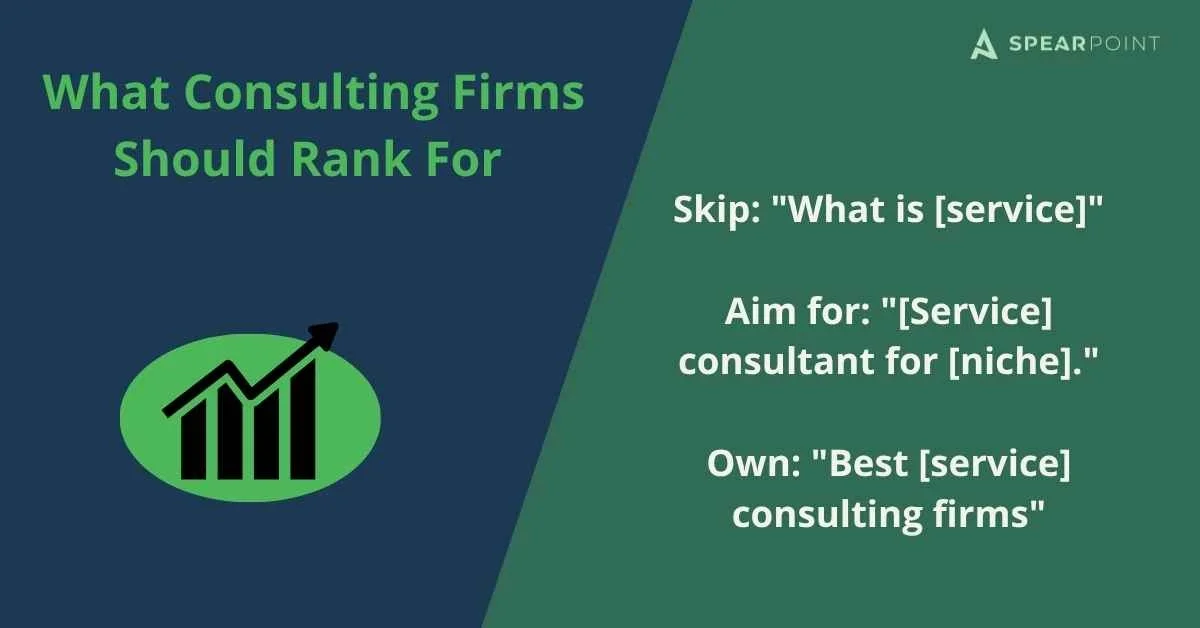
Chase “change management consultant for manufacturing,” not “what is change management”.
Your expertise is the unfair advantage. The job is getting it indexed, structured, and cited, not inventing it.
Measure booked calls, not clicks. Rankings that don't fill your calendar are just trophies.
Table of Contents Show
Your Competitors Aren't Better.
They're Just Easier to Find.
See how we took a professional-services firm from invisible to page one for the searches its buyers actually make.
Why Referral-Only Growth Is More Risk Than Flex
Let's be fair to referrals. They convert, they close faster, and they arrive pre-sold on trust. Which, for a business bought entirely on trust, is enormous.
But a referral-only firm has a structural problem: your growth is capped by other people's memory. You grow exactly as fast as your network happens to think of you, to the right person, at the right moment.
That's not a growth model. That's luck in a nice suit.
Now layer in what the data says about consultants and marketing. The same Consulting Success research on how consultants get clients found that only 25% of consultants market their business daily. The entire category is under-investing in the one thing that could de-risk the whole operation.
That's your opening.
Because when your competitors treat their websites like brochures, showing up in search isn't hard. It's just uncommon.
The Consulting Buyer Has Already Made Up Their Mind
Here's the shift that should reframe how you think about your website.
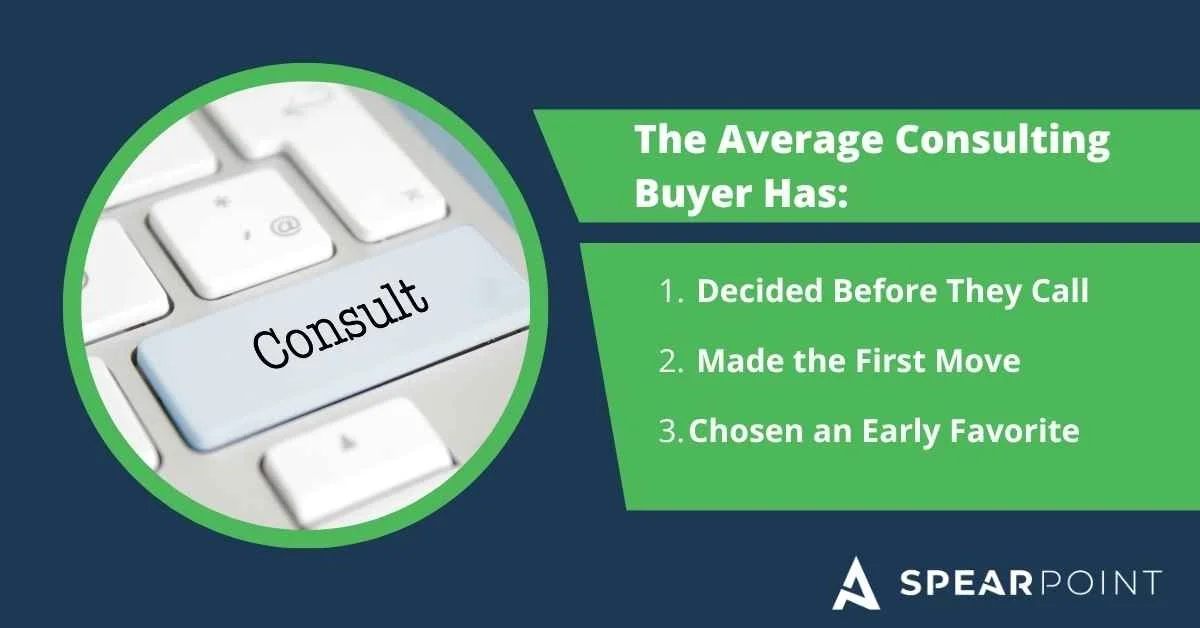
Your prospective client (the VP of Ops looking for a supply-chain consultant, or the founder hunting a change management consultant) does almost all of their evaluating before they ever fill out a form. According to 6sense's 2025 B2B Buyer Experience Report, buyers now reach first contact around 61% of the way through their journey, nearly 80% of seller conversations are still buyer-initiated, and the vendor they've already favored before that first call wins roughly 80% of the time.
Read that last line again.
The decision is basically made in a phase you can't see, on searches you're either present for or absent from.
So the question isn't "how do I generate leads?"
It's this: when a stakeholder is anonymously building their shortlist, does your name come up on Google and inside AI answers as one of the obvious options?
If it doesn't, you're losing before the pitch even happens.
SEO and AEO Are One System Now. Let’s Name the Machines
For years, "SEO" meant ranking blue links on Google. That's still part of it. But your buyer's research now runs through Google, Google AI Overviews, AI Mode, ChatGPT, Perplexity, Gemini, Microsoft Copilot, and Claude. Often that’s in the same afternoon.
The numbers backing this aren't fringe anymore. One analysis of 2025 B2B buying data, citing G2's Buyer Behavior Report, found that GenAI chatbots are now the single most influential source for B2B vendor shortlists at 17.1%, ahead of review sites and vendor websites. And on the classic-search side, research on AI-mediated buying, citing TrustRadius, reports that 72% of buyers now encounter Google AI Overviews during research, and 90% click through to the sources those answers cite.
So being "the best answer" now means being the answer a machine chooses to summarize and cite. We treat that as one connected discipline: SEO for the rankings, Answer Engine Optimization and Generative Engine Optimization for the AI layer. Your buyer doesn't experience them as separate. Neither should your strategy.
The good news for consultants: AI answers reward exactly what you sell. Depth, specificity, real frameworks, defensible points of view. The stuff a $12-an-hour content mill can't fake is the stuff these systems love to cite.
What Consulting Firms Should Actually Rank For (Hint: Not "Business Strategy")
Most consulting SEO fails for one boring reason: the firm targets words that sound impressive instead of words that signal a buyer with a budget.
High-intent over top-of-funnel. Always.
A ranking for "what is change management" brings you students and curious middle managers. A ranking for "change management consultant for manufacturing" brings you someone with a P&L problem and a purchase order.
Here's the difference in plain terms:
| Query Type | Example | Who's Searching | Its Worth |
|---|---|---|---|
| Informational (top-of-funnel) | "what is change management" | Researchers, students, DIY-ers | Traffic. Rarely revenue. |
| Commercial-intent | "change management consultant for manufacturing" | An exec with a budget | High. This is a lead. |
| Comparison | "change management consultant vs internal team" | A buyer weighing options | Very high. Late-stage. |
| "Best of" | "best change management consulting firms" | A committee narrowing options | Very high. Shortlist entry. |
| Service + geo | "change management consultant Denver" | A local buyer ready to talk | High. Warm. |
Your priority order writes itself: service pages, comparisons, and "best of" content first, then informational content second, as support. If you want the mechanics of finding these searches, we walked through it in B2B Keyword Research for a Winning SEO Strategy.
Weak Example vs. Strong Example
Here’s an example of a weak headliner. Unfortunately, it’s what most firms publish:
"We’re a full-service strategy consulting firm helping businesses unlock growth and drive transformation."
That sentence describes 40,000 firms. It ranks for nothing, gets cited by no AI, and convinces no one. "We help businesses grow" isn't positioning. It's what everyone says.
Strong, and what actually earns the click and the citation:
"We're a boutique strategy firm that helps Series A–B SaaS companies fix unit economics and hit break-even before their next raise. In the last two years, we've taken four portfolio companies from negative to positive contribution margin in under six months."
That’s specific. It has a named audience, a real outcome, and it’s provable. That's the version Google ranks and ChatGPT quotes.
The Consulting SEO & AEO Scorecard
Before you build anything, grade what you've got. Score each row honestly.
| Element | Missing (0) | Basic (1) | Dialed In (2) |
|---|---|---|---|
| Service pages | One "Services" page | A page per service | A page per service × named audience |
| Positioning | "We help businesses grow" | Clear niche | Niche + provable outcomes |
| Proof | None public | A logo wall | Named case studies with numbers |
| High-intent content | Only thought leadership | Some "best of" / "vs" | Full commercial-intent library |
| AI visibility (AEO) | Never checked | Aware of it | Structured, cited, monitored |
| Reviews and E-E-A-T | Sparse | Some Google reviews | Reviews + authored bios + credentials |
| Conversion paths | "Contact us" | A form | Clear CTAs to book a call |
7 or below: you're leaving pipeline on the table every month. 8 to 11: solid foundation, real upside. 12 to 14: you're the firm your competitors are worried about.
The Playbook: How Advisory & Strategy Firms Win Through Search
Here's the sequence we run for consulting clients. In order, because order matters.
Pick the niche you actually win in, and say it out loud. Broad firms are invisible; specific firms are magnetic. "Ops consultant" loses to "RevOps consultant for B2B SaaS" every time.
Build a service page per offer, per audience. Not one "Services" page. A page for each service crossed with each buyer type you serve. These are your highest-intent assets.
Publish proof, with numbers. Named case studies with real outcomes do double duty: they rank, and they close. Anonymized is fine when NDAs bite; just keep the metrics.
Own the comparison and "best of" searches. "[Category] consulting firms compared," "alternatives to [big firm]," "how to choose a [type] consultant." Late-stage buyers live here.
Structure content so AI can cite it. Use clear questions as headers, put direct answers up top, add schema markup, and keep language plain. This is the core of getting found in AI search.
Build E-E-A-T like your credibility depends on it, because it does. Authored bios, credentials, real expertise on the page. Consulting is a trust purchase, and Google and the AI engines both reward demonstrated expertise.
Stack reviews. Google reviews feed both local rankings and the trust signals AI engines weigh.
Convert on purpose. Every page should make booking a discovery call the obvious next move. If your best content ends in a limp "Contact us," see our 25 CTAs for B2B websites.
Measure calls, not clicks. Tie rankings to booked calls and closed engagements. Everything else is a vanity metric. More on that in how to boost SEO conversions.
"But Our Work Is Confidential and Too Bespoke to Productize"
Yes. We know. Consulting has the least publishable case studies and the most nuanced sales cycle of almost any B2B category.
Good.
That’s a very different game. And it's an easier one to win, because your competitors are using the same excuse to do nothing.
You don't need to expose a client's confidential turnaround to rank. You need to demonstrate how you think: the framework, the diagnostic questions, the pattern you see across engagements, the point of view most firms are too timid to state. That's rankable, it's citable, and (conveniently) it's the exact thing that makes a buyer trust you before the first call.
Referrals still matter. Nobody's telling you to abandon your best channel. We're telling you to stop making it your only channel. For the balanced version of this argument across the whole category, see SEO for Professional Service Firms.
Stop Waiting to Be Remembered
Referrals depend on someone else thinking of you at the exact right moment.
Search doesn't wait for anyone's memory. It puts your name in front of a buyer the moment they start looking, whether that's on Google or inside the AI answers where shortlists now form. Your expertise is real. Your point of view is defensible. The only thing missing is making both of them findable.
The firms that figure this out won't just get more leads. They'll get off the referral roller coaster entirely, and start building a pipeline they actually own.
Because the goal isn't just to get found.
The goal is to get chosen.

Struggling to Get
Clients From Search?
Discover how SpearPoint helps advisory and strategy firms turn search into booked calls and then grab a free SEO and AI-visibility audit.
FAQ
-
It works, and arguably works better for consulting, because your buyer runs a long, research-heavy, trust-driven evaluation that's practically built for search and AI visibility. The catch is that consulting SEO has to target high-intent commercial searches, not generic informational traffic. Rank for the searches a budget-holder makes, not the ones a student makes.
-
Usually three to six months for meaningful movement on competitive terms, faster on lower-competition and local searches. Anyone promising page one in 30 days is selling you something. SEO compounds; the leads you build this quarter keep arriving next year, unlike ads that stop the second you stop paying.
-
Because referrals are uncontrollable, and they run on someone else's schedule. As Consulting Success's data shows, 70% of consultants get zero inbound leads from their website. That means the entire category is one thin referral quarter away from a pipeline problem. Search is the channel you own, and it runs whether or not your network remembers you this month.
-
AEO (Answer Engine Optimization) is making your content what AI tools like ChatGPT, Perplexity, Gemini, and Google AI Overviews cite when a buyer asks a question. Given that GenAI chatbots are now a top source for B2B shortlists, yes: if you're not cited in AI answers, you're invisible during the exact phase when shortlists form. Here's our take for B2B marketers.
-
If you have someone with genuine SEO and AEO expertise and the time to execute consistently, in-house can work. Most boutique firms don't; their experts are billing clients, not building content clusters. If you're weighing it, read how to hire the best B2B SEO agency first, so you know what to ask for.
Suggested External Links Used in This Post
Consulting Success, consulting statistics: https://www.consultingsuccess.com/consulting-statistics
6sense, 2025 B2B Buyer Experience Report: https://6sense.com/science-of-b2b/buyer-experience-report-2025/
Google Search Central, creating helpful, reliable, people-first content: https://developers.google.com/search/docs/fundamentals/creating-helpful-content
About the Author

Jesse McFarland is the founder of SpearPoint Marketing, a Denver-area digital marketing and SEO agency focused on helping businesses get more conversions from SEO and Search. With more than 17 years of experience across agency, client-side, and executive marketing roles, Jesse has worked with businesses in B2B, fitness, and ecommerce.
At SpearPoint, Jesse focuses on SEO strategies that go beyond rankings and traffic. His work combines conversion-focused SEO, content strategy, local search, digital PR, AI Search visibility, AEO, and website optimization to help businesses become easier to find, trust, and choose.