A buyer evaluating software opens ChatGPT and types:
"What's the best [your category] tool for a mid-sized team?"
Three seconds later, they have a shortlist of five named products, a sentence on each, and a strong lean toward the one mentioned most confidently. They never ran a Google search. They never visited a comparison site. And if your SaaS wasn't in that answer, you were never in the running—you just don't know it yet.
This is the shift most SaaS marketers are underpricing. Your buyers aren't only searching anymore. They're asking—ChatGPT, Perplexity, Google AI Overviews, Gemini, Microsoft Copilot—and taking the recommendations seriously. The job isn't just to rank. It's to be the answer.
That's what AEO—answer engine optimization—is for. Here's how SaaS companies win it.
TL;DR

Your buyers now build shortlists inside AI tools before they ever hit your site, so being recommended by ChatGPT, Perplexity, and Google AI Overviews is its own growth channel.
AEO isn't a separate thing from SEO—it runs on the same fuel. Clear, specific, well-structured content is what both Google and AI engines reward.
AI engines favor SaaS that answers buyer questions directly, is corroborated by third parties (G2, reviews, communities), and states its facts consistently across the web.
Comparison pages, "alternatives" pages, direct-answer FAQs, and use-case pages are what get cited in AI answers—build those, not another trends post.
Measure AI visibility and pipeline, not just rankings. If you don't know whether AI recommends you, you're flying blind in the fastest-growing channel.
Table of Contents Show
The New Shelf: Your Buyers Are Asking AI, Not Just Searching
For years, getting found meant ranking on Google. That still matters. But a second discovery layer has appeared on top of it, and it's where software buyers increasingly start.
94% of B2B buyers now use large language models during their buying process.
— 6sense, 2025 B2B Buyer Experience Report
That's software buyers—your buyers—using ChatGPT, Copilot, and friends to research, compare, and shortlist. And it's bleeding into Google itself: Semrush's tracking shows AI Overviews expanding onto commercial and comparison-style searches—the exact "best [category] software" and "[tool] vs [tool]" queries that decide SaaS deals.
Put those together and the picture is clear. A huge share of your buyers now meet a recommendation before they meet your website. The AI builds the shelf. You're either on it or you're not.
Here's the part that should make founders sit up: AI engines don't care how big your brand is or how old your domain is. They care whether your content clearly and credibly answers the question. For a challenger SaaS, that's the most winnable discovery channel there's been in a decade.
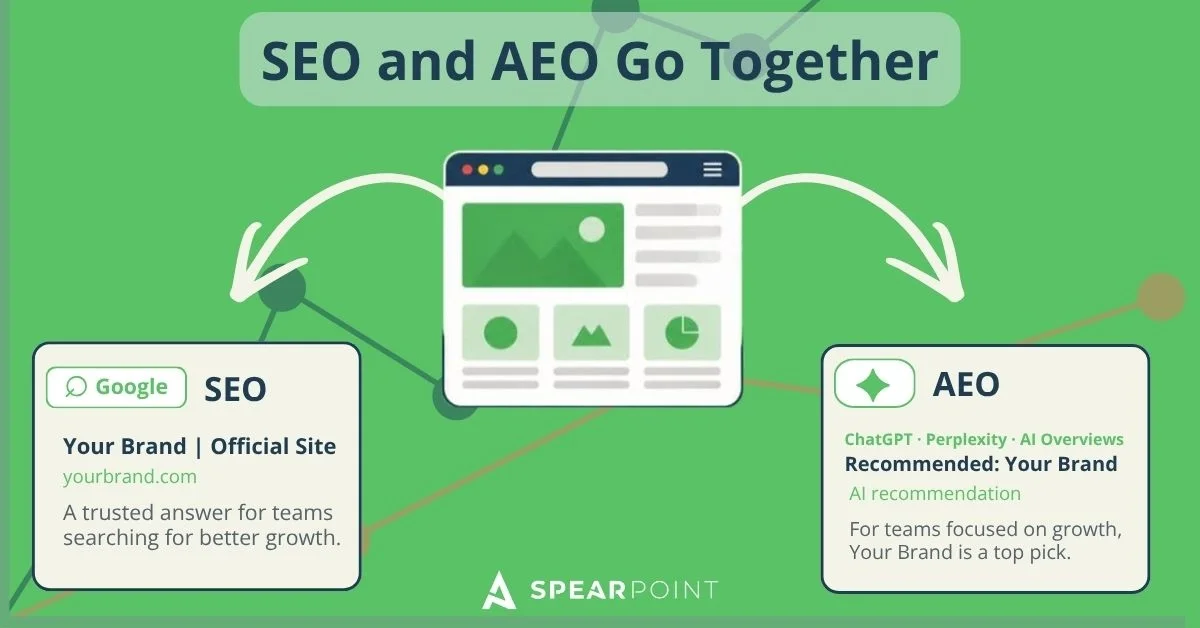
SEO and AEO Go Together
Let's kill the idea that AI search requires some separate, mysterious playbook.
AEO is how you get named inside an AI answer instead of buried beneath it. And the content that earns that citation is the same specific, structured, trustworthy content that ranks in Google. There's no secret "AI content" to commission. There's content clear enough to be quoted, and content vague enough to be skipped.
So your existing SEO foundation isn't wasted—it's the ground AEO builds on. The difference is emphasis. Classic SEO optimizes to win a click from a results page. AEO optimizes to be the sentence the AI says out loud when there's no results page at all. Same fuel, higher stakes, and increasingly the same work.
If an agency tells you AI search means tearing up everything and starting over, they're selling you panic. The real move is sharper: take the specific, credible content that already works, and make it the clearest answer on the internet to the questions your buyers ask.
How AI Engines Decide Which SaaS to Recommend
AI engines aren't pulling names from a hat. They assemble recommendations from patterns in the content they've read. For SaaS, a few factors decide whether you make the cut:
Clarity and specificity. An engine can only recommend you for something it understands you do. "Powerful platform for modern teams" tells it nothing. "Invoice automation for Shopify merchants doing 1M–10M" tells it exactly when to name you.
Third-party corroboration. AI leans on consensus. Reviews on G2 and Capterra, mentions in industry roundups, and real discussion in communities like Reddit all tell an engine you're a safe, real answer—not just a company describing itself.
Consistency across the web. If your pricing, positioning, and integrations say different things on your site, your profiles, and your listings, an engine distrusts all of them. Consistent facts earn confident recommendations.
Being the direct answer. Content structured as a clear question-and-answer is far more quotable than a wandering blog post. The clearer the answer, the likelier it's the one that gets lifted into the AI's response.
None of this is a trick. It's just what being the obvious choice looks like when a machine is reading.
When a buyer asks ChatGPT or Perplexity for the best option in your space, your competitors are already showing up in the answer. Here's a B2B client that got there in three months.
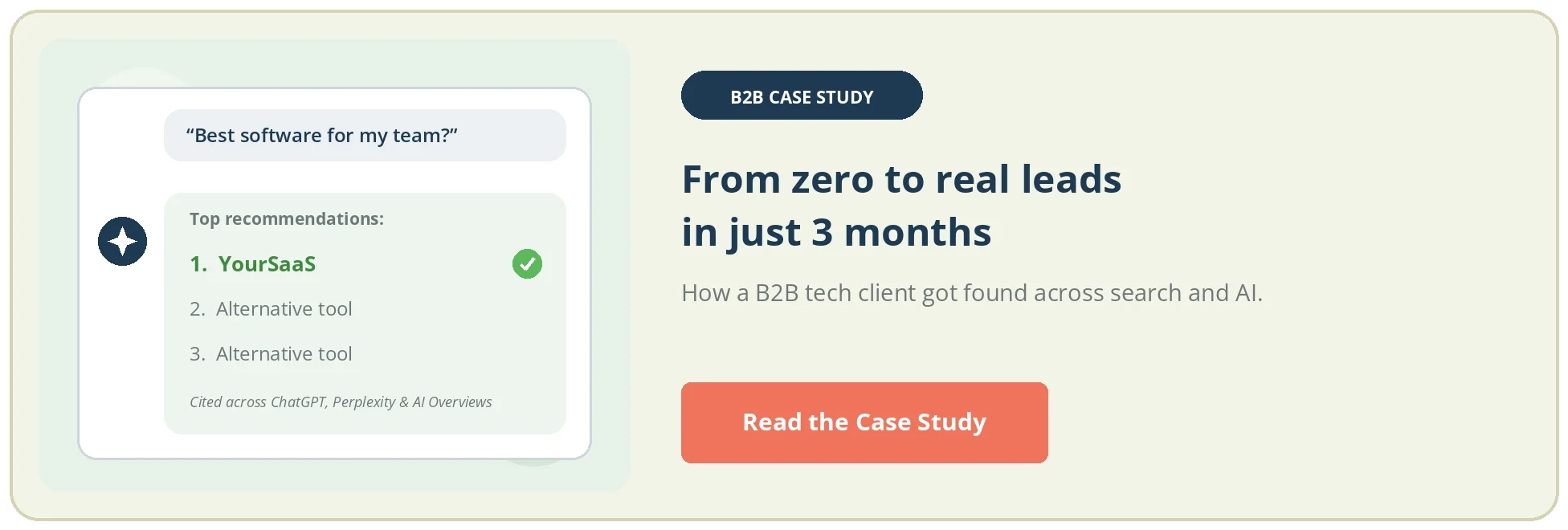
See how we turned AI and search visibility into real leads.
Build the Pages and Answers AIs Cite
Here's where it gets concrete. These are the page types AI engines pull from most when recommending software:
Comparison pages—[your tool] vs [competitor]. Buyers ask AI to compare options constantly, and engines reach for clear, fair comparison content to answer.
Alternatives pages—alternatives to [big incumbent]. When a buyer asks for options beyond the obvious one, you want to be on that list.
Use-case and industry pages—[your product] for [specific vertical]. These match the qualified, specific questions buyers ask AI.
Integration pages—if you connect to tools your buyers already run, each one is a question an AI can answer with your name.
Direct-answer FAQ sections—plain-language answers to what you do, who you're for, how you're priced, what you integrate with, and how you compare. These are the exact facts buyers ask an AI to confirm.
Weak page vs. strong page
| Element | Weak version | Strong version |
|---|---|---|
| Headline | "The All-in-One Platform for Growth" | "Subscription Analytics for B2B SaaS on Stripe" |
| Who it's for | "Teams of every size" | "Finance and RevOps leads at 1M–20M ARR SaaS companies" |
| Comparison | (none) | Clear, fair "vs [competitor]" and "alternatives to [incumbent]" pages |
| Pricing clarity | "Contact us" | Transparent tiers an engine can actually cite |
| Proof | "Loved by teams everywhere" | G2 reviews, named customers, real results |
The weak column is invisible to AI—it gives an engine nothing specific to repeat. The strong column is quotable, comparable, and recommendable. Same product, opposite outcomes.
When a buyer asks ChatGPT or Google for the best tool in your space, does your startup come up—or does a competitor?
Get a free SEO and AI-search audit and find out exactly where you stand.
Earn the Mentions AI Trusts
Everything above is on your own site. This part isn't—and it's where most SaaS companies lose the AI recommendation race.
AI engines corroborate before they recommend. They want to see you talked about in places you don't control:
Review platforms. A strong, current presence on G2 and Capterra is table stakes. Engines lean on them heavily to confirm a product is real and well-regarded.
Industry roundups and "best of" lists. Being included in credible "best [category] tools" articles is some of the highest-leverage visibility you can earn right now, because engines pull directly from them.
Communities. Honest mentions in places like Reddit and niche forums carry real weight. You can't fake your way in, but you can earn it by being genuinely useful.
Consistent facts everywhere. Every profile, listing, and mention should agree with your site. Contradictions make an engine hedge—or leave you out.
You can't write these yourself, which is exactly why they're persuasive to an AI. Earn them, and you become the recommendation an engine makes with confidence.
Measure AI Visibility—Not Just Rankings
Let's land where it has to land: pipeline.
Rankings were always a means to an end, and in AI search even rankings get fuzzy—there's often no page-one to sit on. So the scoreboard has to evolve. The question isn't "where do we rank?" It's "when a buyer asks AI about our category, do we get named—and does that turn into a sales pipeline?"
The SaaS companies winning here track:
Whether they're cited in ChatGPT, Perplexity, Google AI Overviews, and AI Mode for their key buyer questions.
Referral traffic and signups coming from AI tools.
Which pages and mentions are actually feeding those recommendations.
The pipeline and revenue tied back to AI and search visibility together.
If you can't answer the first one, you don't know whether the fastest-growing discovery channel in software is working for you or quietly handing your category to a competitor. That's the gap worth closing first.
Conclusion
AI search didn't kill SEO for SaaS. It raised the ceiling. The companies that win get found the old way and get recommended the new way—because they did the un-sexy work of being the clearest, most credible, most consistent answer to the questions their buyers actually ask.
Your buyers are building their shortlist inside an AI window right now. Being specific, being corroborated, and being the direct answer is how your name ends up in it.
Be the recommendation. Then make sure you can prove it.
FAQ
-
AEO—answer engine optimization—is the practice of getting your software named and recommended inside AI-generated answers from tools like ChatGPT, Perplexity, Google AI Overviews, and Microsoft Copilot. For SaaS, it means structuring clear, specific, well-corroborated content so that when a buyer asks an AI "what's the best tool for X?", your product is in the answer.
-
Regular SEO optimizes to win a click from a search results page. AI search optimizes to be the answer an AI gives when there often isn't a results page at all. They share the same foundation—clear, specific, trustworthy content—so AEO builds on your SEO rather than replacing it. The emphasis shifts from ranking to being cited.
-
By being the clearest, most credible answer to specific buyer questions. That means specific positioning, comparison and alternatives pages, direct-answer FAQs, consistent facts across the web, and third-party corroboration from review sites like G2, industry roundups, and genuine community mentions. AI engines recommend what they understand and what others validate.
-
Yes—they're among the most-cited page types in AI answers. Buyers constantly ask AI to compare tools or suggest alternatives to a big incumbent, and engines reach for clear, fair comparison content to respond. Well-built "vs" and "alternatives" pages put you directly into those answers.
-
Track whether you're cited in ChatGPT, Perplexity, Google AI Overviews, and AI Mode for your key buyer questions, monitor referral traffic and signups coming from AI tools, and tie it back to pipeline. Tools like our AI Search Dashboard make that visibility measurable instead of a guess.
Suggested External Links Used in This Post
About the Author

Jesse McFarland is the founder of SpearPoint Marketing, a conversion-focused SEO and AI search agency based in Centennial, Colorado. Jesse has more than 17 years of digital marketing experience across B2B, SaaS, healthcare, legal, fitness, ecommerce, and startup organizations.
He specializes in helping companies turn organic search into qualified demand through modern SEO, AEO, GEO, AI Visibility, content strategy, technical SEO, and brand-first search marketing. Jesse helps business owners and marketing leaders understand how search is changing without losing their minds every time someone on LinkedIn announces SEO is dead again.