You've got a product that works. You've got customers who are genuinely glad they found you. What you don't have is a steady stream of new ones finding you the same way.
That's the founder's trap. You spent your runway building something good, and somewhere along the way you assumed that if the product was strong enough, the leads would follow. They don't. The market doesn't reward the best solution. It rewards the one buyers can find at the exact moment they're looking.
That's the whole job, and it's doable even when you're a founder-led, bootstrapped team with no brand recognition and no marketing department. In some ways, that lean setup is an advantage. Let's talk about how to use it—across both classic search and the AI tools your buyers now trust.
TL;DR

Buyers finish most of their research before they contact you, so your website and AI-search presence do the selling your small team can't.
Skip the vanity content. For a startup, high-intent pages—service, "vs," alternatives, use-case, and integration pages—produce pipeline; generic "thought leadership" mostly produces nothing.
SEO and AEO are one system. The same clear, specific content that ranks in Google is what gets your startup recommended by ChatGPT, Perplexity, and Google AI Overviews.
Your founder's expertise and your real customer stories are unfair advantages. Put them to work—most competitors won't.
Measure pipeline, demos, and closed revenue, not pageviews. The runway is too short to optimize for traffic you can't convert.
Table of Contents Show
The Founder's Visibility Problem
Here's the homepage headline on roughly half of early-stage B2B sites:
"We help businesses grow."
Grow how? For whom? Doing what, exactly? That sentence describes a bank, a consultancy, a protein powder, and your startup equally well—which means it describes nothing. Generic positioning is the single most expensive mistake a founder makes, because it makes you invisible to search engines and AI tools at the same time.
Specificity is your way out. "We help Series A fintech teams automate SOC 2 evidence collection" tells a buyer, Google, and ChatGPT exactly who you're for and what you do. One of those headlines gets found. The other gets scrolled past.
And no, SEO isn't dead—the "SEO is dead" takes are mostly written by people who were bad at it. What's dead is lazy, me-too content that sounds like every other startup's seed-round blog. The opportunity for a sharp, specific founder has arguably never been bigger.
How B2B Buyers Actually Find You Now
If you still think the sale starts with a demo request, the data has news for you.
B2B buyers spend only 17% of their purchase journey meeting with potential suppliers—and 27% of it researching independently online.
— Gartner, The B2B Buying Journey
Gartner also found that 75% of B2B buyers now prefer a rep-free buying experience. Your buyers are forming their shortlist quietly, on their own, long before they fill out a form—and your scrappy three-person team isn't in the room for any of it.
Your content is. That's the leverage. For a startup, great search content is a salesperson who works the 83% of the journey you can't staff.
Then there's the newer channel most founders haven't fully clocked:
94% of B2B buyers now use large language models during their buying process.
— 6sense, 2025 B2B Buyer Experience Report
When a buyer asks ChatGPT or Perplexity "what are the best tools for [your category]?", a shortlist gets built in seconds—and you're either on it, or you aren't. The good news for a startup: AI engines don't care how old your domain is. They care whether your content clearly and credibly answers the question. That's a race you can actually win.
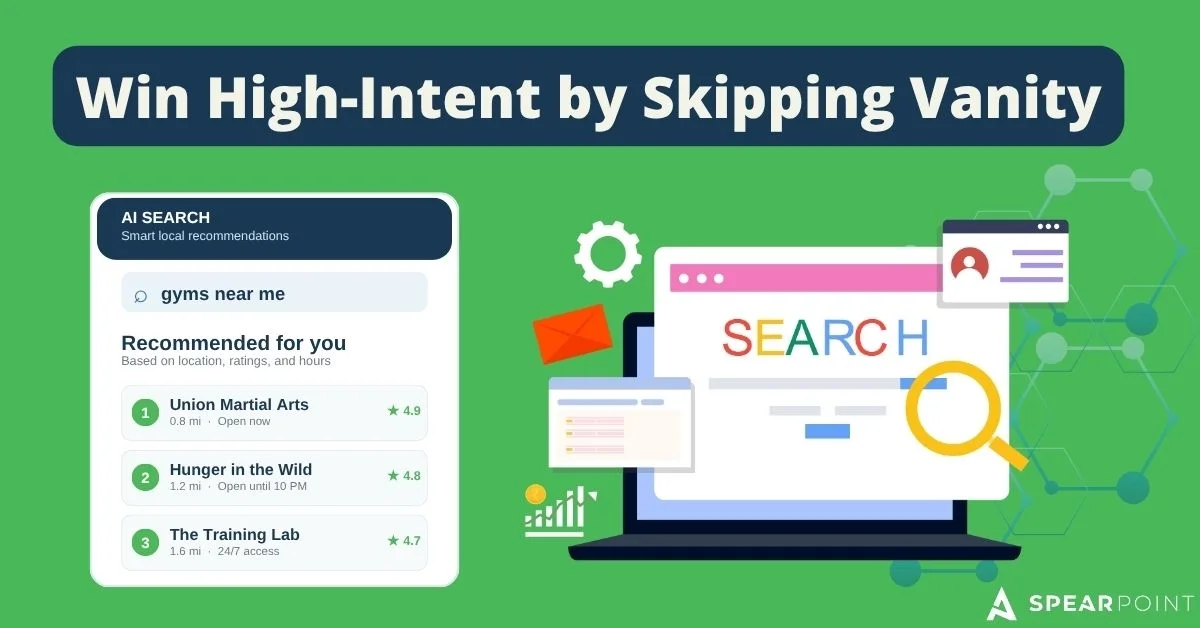
SEO for B2B Startups: Win High-Intent by Skipping Vanity
Most founders, told to "do SEO," go write a blog post titled "5 Trends Shaping [Industry] in 2026." It gets twelve views, eleven of them from the founder. Meanwhile, the pages that would actually pull demos never get built.
With limited runway, you optimize for intent, not volume. Build the pages buyers hit when they're close to deciding:
Service and solution pages—one sharp page per core problem you solve, in the buyer's language.
"[Your tool] vs [competitor]" pages—buyers comparing options are near the finish line. Win the comparison, and you win the deal.
"Alternatives to [big incumbent]" pages—people already shopping your category, handed to you.
Use-case and industry pages—[your product] for [specific vertical] catches buyers who want to know you're built for them.
Integration pages—if you connect to tools your buyers already use, each integration is a search entry point competitors usually ignore.
Weak page vs. strong page
| Element | Weak version | Strong version |
|---|---|---|
| Headline | "Powerful Software for Modern Teams" | "SOC 2 Compliance Automation for Series A Fintechs" |
| Who it's for | "Businesses of all sizes" | "Engineering and security leads at 20–200-person startups" |
| Proof | "Trusted by innovative companies" | "Cut audit prep from 6 weeks to 5 days—[named customer]" |
| Next step | "Learn more" | "Book a 20-minute demo" |
Same startup. One version is invisible and forgettable; the other ranks, gets cited by AI, and ends with an action a ready buyer will take.
AEO for B2B Startups: Get Recommended by ChatGPT, Perplexity & Google AI Overviews
Here's where SEO and AEO stop being two projects and become one.
AEO—answer engine optimization—is how you get named inside an AI answer instead of buried under it. And the content that earns that citation is the same specific, structured content that ranks in Google. There's no separate "AI content" to write. There's content clear enough to be quoted, or vague enough to be skipped.
To get your startup recommended by AI engines:
Answer real buyer questions directly. Add FAQ-style sections that state, in plain language, what you do, who you're for, what you integrate with, and how you're priced—the exact things buyers ask an AI to confirm.
Structure everything cleanly. Clear headings and schema markup help machines read you without guessing.
Earn third-party mentions. AI engines corroborate. Reviews on G2, mentions in industry roundups, and real customer stories make you a safer recommendation.
Keep your facts consistent everywhere. Conflicting claims across your site, your profiles, and your listings make an engine distrust all of them.
For a startup with no domain authority, this is the most level playing field in search. Be the clearest, most credible answer to a specific question, and you can get recommended right alongside companies ten times your size.
Want to see what high-intent SEO and AI visibility actually produce for a B2B company?
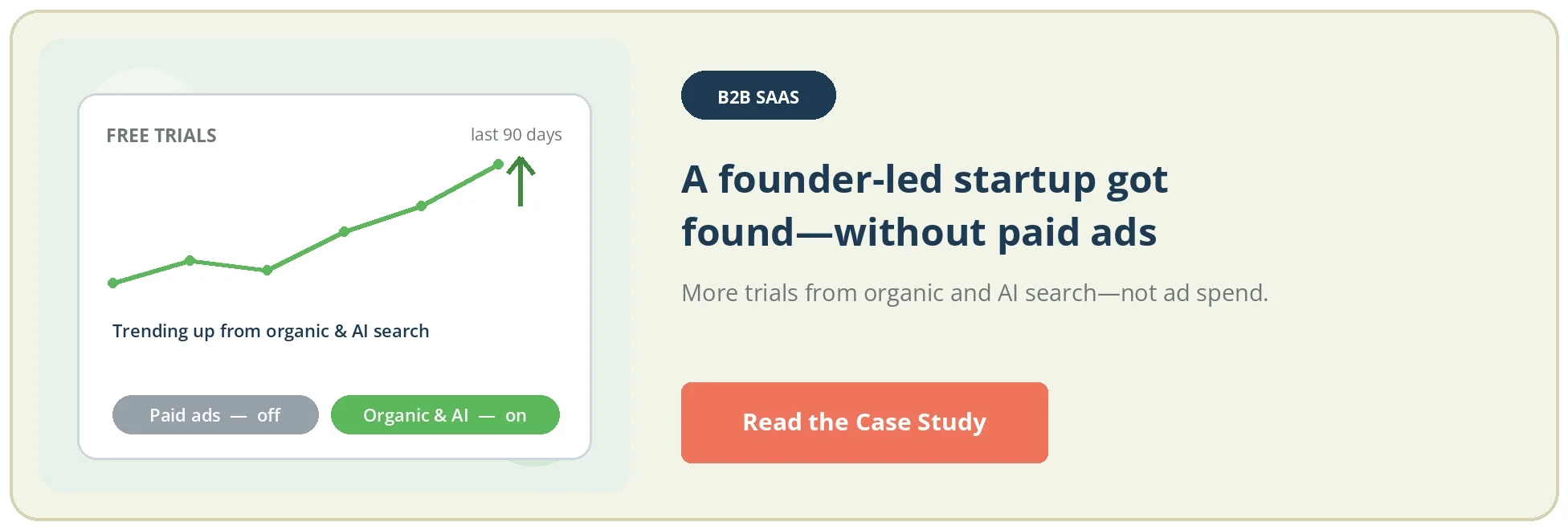
See how we turned search into booked pipeline for a real B2B client!
Use Your Unfair Advantages
Big competitors have brand and budget. You have things they lost years ago—and most startups leave them on the table.
The founder's voice. You know this problem better than any marketer they'll hire. Put your actual expertise into your content. A founder-written comparison beats a ghostwritten listicle every time, and AI engines reward genuine depth.
Real customer stories. You have early customers who are thrilled. That testimonial up top? It's doing more work than a month of blog posts. Build pages, case studies, and quotes around proof like it—don't let it sit on one homepage.
Speed. You can publish a sharp page this week. Your enterprise competitor needs three approvals and a legal review. Use that.
Focus. You don't have to be found for everything. Own one specific, high-intent niche completely, then expand.
The B2B Startup SEO & AEO Action Plan
Nail your positioning. Replace every "we help businesses grow" with a sentence naming exactly who you serve and what you do.
Build high-intent pages first. Service, "vs," alternatives, use-case, and integration pages before a single trend post.
Add the facts AI needs. Direct-answer FAQ sections, clean structure, and schema across your key pages.
Weaponize your proof. Turn happy customers into case studies, quotes, and named results throughout the site.
Get mentioned elsewhere. Reviews, roundups, and partner pages build the third-party credibility AI engines look for.
Put the founder on the page. Your expertise is content. Use it.
Track pipeline, not pageviews. Tie every page and query back to demos and revenue.
Measure Pipeline, Not Pageviews
Let's land where it matters: runway.
A traffic graph that's up and to the right feels like progress right up until you check the pipeline and it's flat. Rankings and traffic are means. Demos, pipeline, and closed revenue are the point. When you're burning runway, optimizing for pageviews you can't convert is a luxury you can't afford.
The founders who win with search don't ask "how much traffic did we get?" They ask:
How many demos and qualified leads came from search and AI referrals this month?
Which pages and queries actually produced them?
What's our cost to acquire a lead this way, and is it trending down?
Is this channel something we can forecast and scale?
Answer those, and SEO stops being a hopeful expense and becomes a pipeline channel you can bank on. For a startup, that's the difference between marketing that burns runway and marketing that extends it.
Conclusion
SEO for B2B startups isn't dead, and it isn't a luxury for later. It's the salesperson you can't yet afford to hire, working every hour across both Google and the AI tools your buyers now trust.
You don't need a big brand or a big budget to win. You need to be specific, be the clearest answer to a real buyer question, and put your founder's expertise and your customers' proof to work where people are actually looking.
You already built the hard part. Now make sure the buyers who need it can find it.
Get that right, and your phone starts ringing again, too.
Not sure whether buyers can find your startup in Google or AI search?
Get a free B2B startup SEO & AI-visibility audit—we'll show you exactly where your buyers are finding competitors instead of you.
FAQ
-
SEO (search engine optimization) gets your startup ranking in Google's results when buyers search. AEO (answer engine optimization) gets your startup named and recommended inside AI answers from ChatGPT, Perplexity, and Google AI Overviews. They run on the same fuel—clear, specific, credible content—so for a startup they're one strategy, not two budgets.
-
Yes, if you dial it in. High-intent pages that catch buyers near a decision can produce demos within months, and the content compounds over time instead of disappearing like paid ads. Startups waste money on broad, top-of-funnel content with no path to pipeline. Start at the bottom of the funnel and work up.
-
Expect early movement in three to six months and stronger, compounding results past six to twelve. High-intent "vs," alternatives, and service pages often convert faster than broad content because they catch buyers already comparing options.
-
Early on, a founder who knows the space can write better high-intent and comparison content than most agencies—your expertise is the moat. Bringing in help makes sense once you want to scale output, handle technical SEO and AEO properly, and free your time for product and sales. Either way, insist on pipeline reporting, not traffic reports.
-
For broad head terms, not quickly. But for specific, high-intent queries—comparisons, niche use cases, integrations—you can absolutely win, because incumbents often neglect them. And AI search is even more forgiving of a new domain: be the clearest answer to a precise question, and you can get recommended alongside far bigger names.
Suggested External Links Used in This Post
About the Author

Jesse McFarland is the founder of SpearPoint Marketing, a conversion-focused SEO and AI search agency based in Centennial, Colorado. Jesse has more than 17 years of digital marketing experience across B2B, SaaS, healthcare, legal, fitness, ecommerce, and startup organizations.
He specializes in helping companies turn organic search into qualified demand through modern SEO, AEO, GEO, AI Visibility, content strategy, technical SEO, and brand-first search marketing. Jesse helps business owners and marketing leaders understand how search is changing without losing their minds every time someone on LinkedIn announces SEO is dead again.