How to Win Buyer-Intent Search, Get Cited in AI Answers, and Turn Rankings Into Qualified Pipeline
Most B2B SaaS SEO is built to produce a traffic chart.
The chart goes up and to the right, everyone nods in the marketing meeting, and then the sales team asks where the demos are. Silence.
Here's the uncomfortable truth about SaaS SEO in 2026: your buyer has already made most of the decision before they ever fill out a form. Gartner found that 67% of B2B buyers now prefer a sales-rep-free experience, and 70% prefer a fully digital, self-service buying process. They're researching your category in Google, in ChatGPT, and on comparison pages while your sales team sits waiting for a lead that already picked a shortlist.
So the strategy question isn't "How do we get more traffic?"
It's this: when a buyer researches your category, does your product show up as an obvious, credible option at the exact moment they're deciding? That's a very different game, and it's the one worth playing.
TL;DR for the Founder Who Wants Pipeline, Not a Traffic Report

Architect SEO backward from the demo. Start with the searches a buyer makes right before they buy, then build out. Top-of-funnel volume is the last thing to chase, not the first.
Buyer-intent pages are where the money is. Comparison, "vs," alternatives, and integration pages convert because the person reading them already has their credit card halfway out.
Map content to your ICP's jobs, not to keyword volume. A page that solves a real use case for a real buyer beats ten thin posts chasing traffic.
AI answers are a channel now. ChatGPT, Perplexity, Gemini, Google AI Overviews, Microsoft Copilot, and Claude all recommend software, and getting cited is the new page-one.
Fix the technical foundation SaaS sites keep breaking. JavaScript rendering, programmatic pages, and indexation bloat quietly cap your ceiling.
Measure pipeline, not sessions. If you can't tie SEO to demos, qualified leads, and revenue, you're measuring the wrong thing.
Table of Contents Show
What "SEO for SaaS" Means When the Goal Is Demos
Let's define the thing before we optimize it. For a B2B SaaS company, SEO isn't a traffic exercise. It's the work of being present, credible, and easy to choose at every point where a buyer researches a solution to their problem.
That research now spans Google, AI answer engines, comparison sites, and communities, often in a single afternoon. Buyers spend only about 17% of their entire purchase journey meeting with any potential supplier, which means the other 83% is spent forming opinions without you in the room. Your content is the only sales rep in that room.
The best SaaS SEO strategies work backward from that reality. They start with the highest-intent moments, the ones closest to a demo, and build outward toward awareness. Most teams do the opposite: they publish a mountain of top-of-funnel blog posts, generate traffic that never converts, and wonder why the pipeline stayed flat.
Good SEO for SaaS earns qualified demos. Everything else is a means to that end.
Why Traffic-First SaaS SEO Stalls Your Pipeline
The traffic-first approach fails for a simple reason: not all traffic is created equal, and most of it never intended to buy.
A post ranking for "what is workflow automation" pulls in students, competitors, and curious tire-kickers. A page ranking for "[competitor] alternative for mid-market teams" pulls in a buyer who's actively shopping and unhappy with what they have. Same discipline, wildly different revenue outcomes.
There's a measurement trap underneath this. Sessions, impressions, and keyword counts feel like progress because they're easy to grow and easy to screenshot. They're also nearly disconnected from pipeline. Organic search for B2B SaaS delivers a cost-per-lead of roughly $147 to $164, compared with $250 to $310 for paid search, according to First Page Sage's 2026 analysis — but only when the traffic is the right traffic. Rank for the wrong terms and your cost-per-qualified-lead climbs toward infinity, because none of them convert.
The zero-click reality makes this worse for the volume-chasers. SparkToro's research puts roughly 60% of Google searches at zero-click, meaning informational queries increasingly get answered on the results page without anyone visiting your site. If your entire SEO strategy is built on informational traffic, a growing share of it now evaporates before it reaches you.
High-intent pages don't have that problem. Nobody resolves "HubSpot vs Salesforce for a 200-person sales team" from a snippet. They click, they compare, and they convert.
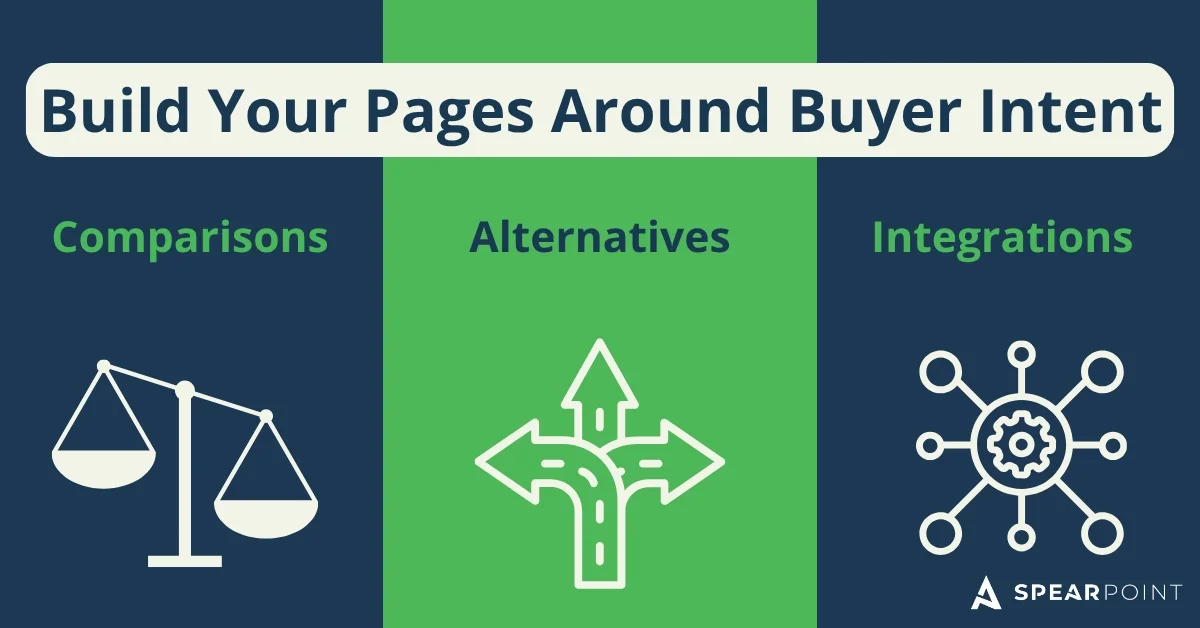
Build Around Buyer Intent: Comparison, "vs," Alternatives, and Integration Pages
If you do one thing from this post, do this: build the pages that capture buyers at the moment of decision. For B2B SaaS, four page types carry most of the weight.
1. Comparison and "vs" pages
"[You] vs [competitor]" is one of the highest-intent searches in existence. The person running it has narrowed the field to a shortlist and is deciding between finalists. A weak version ducks the competitor and reads like a brochure. A strong version is honest about where each tool wins, which builds the trust that closes the deal, and steers the fit-right buyer toward a demo.
2. Alternatives pages
"[Competitor] alternatives" captures buyers who've already decided to switch. They're not asking whether to buy; they're asking who to buy from instead. Own that page, and you enter every one of those evaluations.
3. Integrations pages
SaaS buyers care whether you plug into their stack. A page for "[your product] + Salesforce integration" catches a qualified buyer with a specific, solvable objection, and answers it before sales ever has to.
4. Use-case and solution pages
These sit one notch earlier than the rest and connect your product to a specific job the buyer needs done.
The common thread: every one of these targets a search made by someone close to a purchase. Build these first. The B2B keyword research that surfaces them is the highest-leverage hour you'll spend on SaaS SEO.
Use-Case and Jobs-to-Be-Done Pages That Map to Your ICP
Here's where most SaaS content strategies quietly go wrong: they're organized around keyword volume instead of around the buyer.
Your ideal customer profile doesn't search for your feature list. They search for the job they're trying to get done. A revenue operations leader doesn't wake up wanting "lead routing software." They wake up wanting to stop losing inbound leads to slow follow-ups. The page that names that problem in their language and shows how your product solves it is the page that earns the demo.
So map content to jobs, mapped to your ICP:
Take each core segment you sell to and list the specific jobs they want software to do.
Write a page for each job that leads with the problem, then the outcome, then your product as the mechanism.
Use the words your buyers actually use, pulled from sales calls and support tickets, rather than internal feature names.
This is also what separates content that ranks from content that sits idle. A single page that genuinely solves one buyer's problem will out-earn ten thin posts chasing broad terms every single time. If you want the full DIY version of this system, we broke it down in the SaaS SEO playbook for Google and AI search.
Theory is cheap. Here's what buyer-intent SaaS SEO did for a real B2B software company.
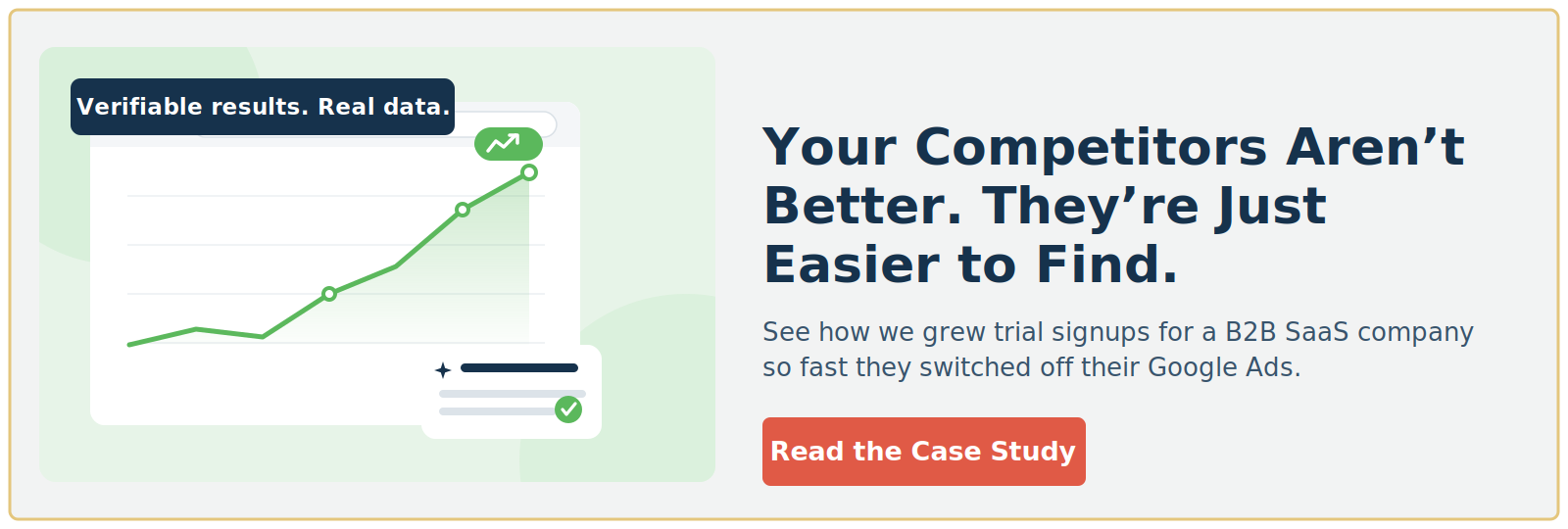
That kind of growth starts with being findable where buyers research. Which now includes the machines.
Getting Cited in AI Overviews, ChatGPT, and Perplexity
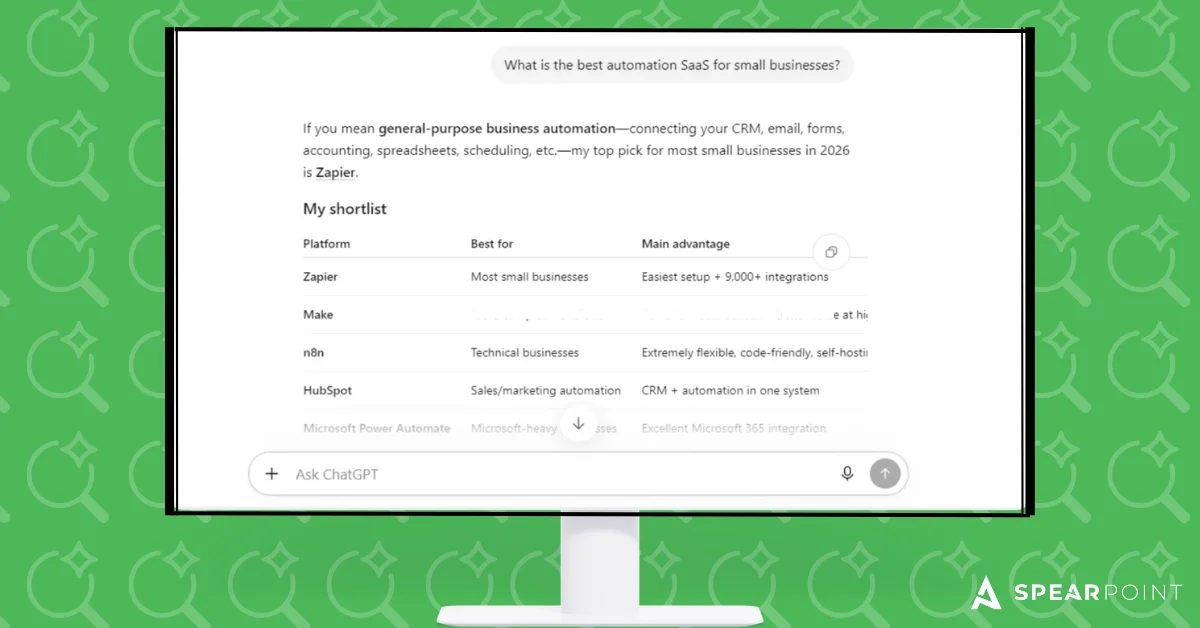
Your buyers are asking AI to build their shortlist. "Best CRM for a B2B SaaS startup," typed into ChatGPT, now returns three named products and a rationale. If yours isn't one of the three, you're not in the evaluation, and you'll never know it happened.
That’s why we treat SEO and Answer Engine Optimization as one system, not two disciplines. The same signals that earn rankings (clear content, real authority, and consistent entity information) are what make you eligible to be named by ChatGPT, Perplexity, Gemini, Google AI Overviews, Microsoft Copilot, and Claude. Optimize once, correctly, and you’ll show up in both places.
A few things move the needle specifically for AI citation:
Answer the question directly and early. AI engines extract clean, self-contained answers. Bury the point under 400 words of throat-clearing, and you won't get pulled.
Structure for extraction. Clear headings, concise definitions, comparison tables, and FAQ blocks give an engine something clean to lift.
Build entity clarity and third-party corroboration. AI recommendations lean on consensus across sources: reviews, mentions, and consistent descriptions of what you do and who you serve.
The mechanics run deeper than one section can hold. For the full breakdown, see how brands get found in AI search and the AEO playbook for B2B marketers.
The good news: the fundamentals that win AI answers are the same ones that win Google. You don't need a separate budget. You need a program that treats both as one visibility system.
The Technical Foundations SaaS Sites Often Get Wrong
You can have the best content strategy in your category and still lose if Google can't crawl, render, and index your site. SaaS sites break the technical basics in a few predictable ways.
JavaScript rendering
Many SaaS sites are built on frameworks that render content client-side. If your key content only appears after JavaScript runs, you're betting on the crawler executing it correctly, which Google's own documentation warns is slower and less reliable than server-rendered HTML. Server-side rendering or prerendering for critical pages removes the gamble.
Programmatic pages done badly
Programmatic SEO, generating pages at scale for integrations, use cases, or locations, is powerful for SaaS. Done carelessly, it spawns thousands of thin, near-duplicate pages that dilute your site's quality signals. Each programmatic page needs a genuine reason to exist and unique value.
Indexation bloat
Faceted filters, staging URLs, and orphaned pages balloon the number of URLs Google wastes crawl budget on. A lean, intentional index concentrates authority on the pages that earn the demos.
None of this is glamorous, but all of it drops your ceiling if you skip it.
Measure SEO by Pipeline, Not Sessions
Here's the metric shift that changes everything: stop reporting traffic to your leadership team and start reporting pipeline.
Tie your SEO program to the numbers a CFO respects: SEO-sourced demos booked, qualified leads generated, opportunities created, and revenue influenced. When you measure this way, two things happen. Your reporting starts to matter in the room where budget decisions get made, and your strategy self-corrects toward the pages that actually produce pipeline.
The return justifies the reframe. First Page Sage's 2026 research found a three-year ROI of 702% for B2B SaaS companies investing in SEO, with an average breakeven around month seven. Organic also compounds in a way paid never does: turn off your ads and the leads stop that day, while a ranking comparison page keeps booking demos for years.
Budget for the timeline honestly. Meaningful pipeline from SaaS SEO typically shows up in six to nine months and compounds from there, with the strongest results in years two and three. Anyone promising a flood of qualified demos in 90 days is selling you a traffic report, not a pipeline.
This conversion-first lens is the whole point of how we approach search. If you want to see what it looks like applied end to end, that's what our B2B SaaS SEO work and our conversion-based SEO program are built to do.
Want to know which buyer-intent searches your competitors are winning and you're not?
We'll show you where the qualified demand is hiding, and where AI is recommending someone else.
FAQ
-
The best strategies start at the bottom of the funnel and build outward. Prioritize buyer-intent pages, comparison, "vs," alternatives, and integration pages, then use-case pages mapped to your ICP's real jobs, then supporting content. Treat SEO and AEO as one system so you show up in both Google and AI answers, keep the technical foundation clean, and measure the program by demos and pipeline rather than traffic.
-
By being present at the exact moments a buyer is deciding. Rank and get cited for high-intent searches like comparisons and alternatives, answer the specific questions a buyer has before a demo, and make the next step obvious on every page. Because most of the buying journey now happens before a buyer contacts sales, the pages that answer those research questions are what generate qualified demos.
-
Expect meaningful pipeline in six to nine months, with results compounding in years two and three. Buyer-intent pages can move faster than broad informational content because there's less competition for the exact decision-stage query. Anyone guaranteeing results in 90 days on competitive terms is overpromising.
-
More worth it, not less. Buyers now research in AI tools like ChatGPT, Perplexity, Gemini, Google AI Overviews, Microsoft Copilot, and Claude, and those engines recommend software from the same signals that power SEO. Cut search, and you go invisible on both surfaces at once, right when your buyers are building their shortlist.
-
Either can work, but SaaS SEO in 2026 spans content strategy, technical SEO, buyer-intent research, and AEO, which is a lot for one hire to cover. Many SaaS teams run a hybrid: one internal owner who holds strategy and product context, paired with a team that brings the specialist depth and execution.
Suggested External Links Used in This Post
Gartner, 2026 B2B buyer behavior survey (rep-free and self-service preferences): https://www.gartner.com/en/newsroom/press-releases/2026-05-20-gartner-survey-finds-sixty-nine-percent-of-b-two-b-buyers-turn-to-sales-reps-to-validate-ai-generated-insights
First Page Sage, SEO ROI Statistics 2026: https://firstpagesage.com/
SparkToro, zero-click search research: https://sparktoro.com/
Google Search Central, JavaScript SEO basics: https://developers.google.com/search/docs/crawling-indexing/javascript/javascript-seo-basics
About the Author

Jesse McFarland is the founder of SpearPoint Marketing, a conversion-focused SEO and AI search agency based in Centennial, Colorado. Jesse has more than 17 years of digital marketing experience across B2B, SaaS, healthcare, legal, fitness, ecommerce, and startup organizations.
He specializes in helping companies turn organic search into qualified demand through modern SEO, AEO, GEO, AI Visibility, content strategy, technical SEO, and brand-first search marketing. Jesse helps business owners and marketing leaders understand how search is changing without losing their minds every time someone on LinkedIn announces SEO is dead again.