You're the best salesperson your company has. You're also the marketing department, which is the problem.
Founder-led marketing works beautifully right up to the point where it doesn't. You know the product better than any writer you could hire. You know the objections because you've heard all of them. And you have maybe four hours a week, usually the wrong four, usually after something else slipped.
So the question stops being whether to get help and becomes which kind. An agency, a fractional CMO, or your first marketing hire. They solve different problems, and picking the wrong one costs you a year.
TL;DR

Diagnose the bottleneck before you buy a solution. Missing strategy, missing execution, and missing ownership are three different problems, and each has a different answer.
An agency buys execution. Best when you know roughly what to do and have nobody to do it. Weakest when your positioning is still unsettled.
A fractional CMO buys judgment. Best when you need someone to decide what matters, build the plan, and tell you which hire to make next. They will not execute it.
An in-house hire buys ownership. Highest long-term leverage, slowest to pay off, and the easiest to get wrong if you hire before you know what the role is.
Whichever you pick, the buyer is doing the work without you. 6sense found 94% of buying groups rank their preferred vendor before contacting anyone, and that vendor wins 80% of the time. Your content either shows up in that research or you do not.
Table of Contents Show
The Founder Marketing Trap
Here's what the trap actually looks like, and it's rarely a lack of effort:
"We know what we should be doing. We just never get to it."
Marketing becomes the thing that happens when nothing is on fire, which in a growing company is never. You publish three posts in a good quarter and none in a bad one. The website still describes the product you sold two years ago. Nobody owns it, so it moves when you push and stops when you stop.
Meanwhile, your competitors with a full-time marketer aren't necessarily smarter. They're just consistent, and consistency compounds in search the way it doesn't in sales.
The founder's instinct is to hire a generalist and hope. The better move is to work out which of three things you're actually missing first.
What Founder-Led Marketing Is Actually Costing You
If you're waiting for a quiet quarter to fix this, the math has news for you.
B2B buying cycles now run roughly ten to eleven months, and 6sense found that buyers spend about 60% of that researching independently before they ever speak to a seller. Every month you're invisible is a month of that research happening without you in it.
It gets worse at the end. The same research found 94% of buying groups had already ranked their preferred vendors before first contact, and the preferred vendor won 80% of deals. By the time your sales skills matter, most of the decision is made.
Your content is the only thing doing that work. Which is awkward, because your content is the thing you do on Sunday nights.
And there's a newer wrinkle most founders haven't priced in:
Forrester found 94% of business buyers now use AI in their buying process, and that generative AI and conversational search have overtaken vendor websites and sales reps as their most meaningful information source. G2 puts half of B2B software buyers starting in an AI chatbot rather than Google.
That means being absent isn't neutral anymore. When a buyer asks ChatGPT or Perplexity who the serious vendors are in your category, something gets named. Right now it probably isn't you.
The Three Options, and What Each One Actually Buys
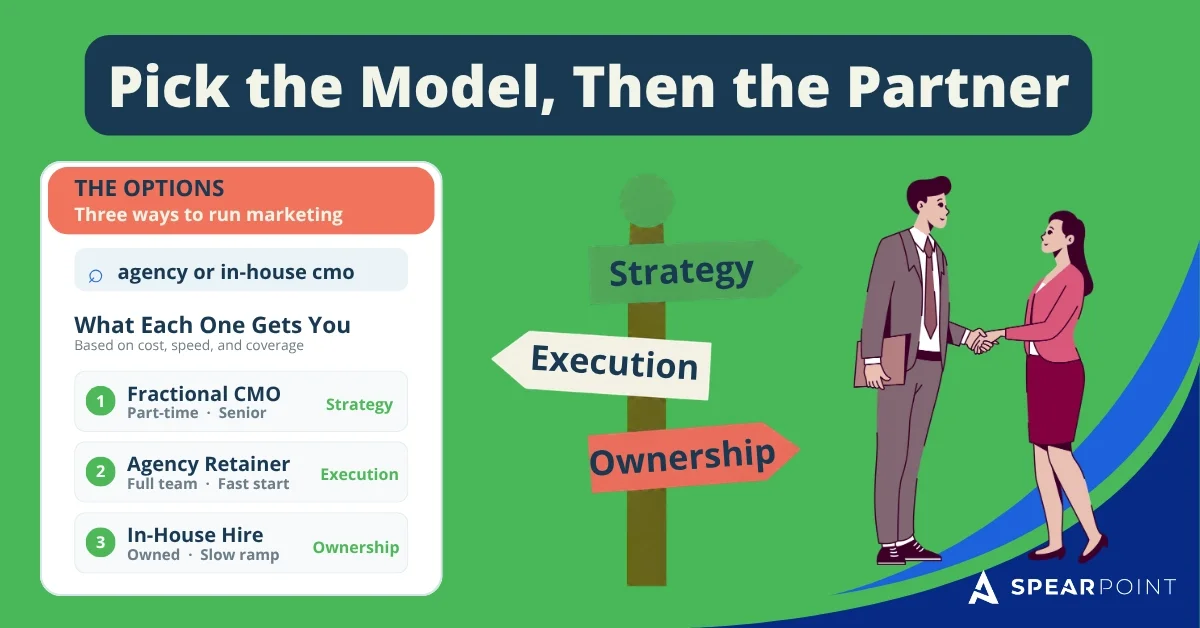
These get discussed as if they're three price points for the same thing. They aren't. They solve different bottlenecks, and the most expensive mistake is buying execution when what you lacked was a decision.
Start by naming which of these sentences sounds like you:
"I know what to do, I just can't get it done." That's an execution gap. Hire an agency. You already have the strategy in your head, and what you need is a team that ships pages, content, and technical work on a schedule you don't have to enforce.
"I'm not sure what we should be doing at all." That's a strategy gap. Hire a fractional CMO. Paying an agency to execute a plan nobody has written produces expensive, well-made activity pointed in no particular direction.
"We have a plan and an agency, and it still drifts." That's an ownership gap. You need someone internal whose job it is to care on Monday morning. That's your first hire, and it might be a marketing manager rather than a senior leader.
"We need all three and can afford one." Common, and survivable. Most founder-led companies start with an agency for execution, add fractional leadership when the channel count grows, and hire in-house once there's enough work to justify a salary.
"We want to keep it in-house with AI tools." Sometimes right. A founder who knows the space writes better comparison pages than an outside writer will. We wrote the honest version of that tradeoff in in-house SEO versus an agency.
Agency vs. Fractional CMO: A Straight Comparison
| What you're buying | Agency | Fractional CMO |
|---|---|---|
| Best when | You know the direction and need it executed | You need the direction decided first |
| Ramp time | Two to four weeks to first output | Immediate, but part-time attention |
| What usually breaks | Strategy drifts with no internal owner | A good plan nobody has capacity to run |
| What you should measure | Pipeline, opportunities, and revenue | Clarity of plan and quality of hires made |
The honest answer for most founder-led B2B companies is an agency first, because execution is usually the real gap and strategy without shipping is just a document.
How to Not Waste the First Six Months
Whichever you choose, the failure mode is identical: you buy help, feel relieved, disengage, and discover nine months later that a lot of work happened and no pipeline did.
Avoiding that is mostly about what you insist on in the first month, not what you buy.
Four things to require from day one:
Agree what counts as working, in writing. Not rankings or sessions. Demos, qualified leads, opportunities, and closed revenue. If nobody will put a pipeline number on it, you're buying activity.
Give them your voice, not just your login. Two hours of founder interview is worth more than a month of outside research. You know the objections. Nobody else does yet.
Start with high-intent pages, not top-of-funnel. Service pages, comparison pages, alternatives pages, and use-case pages. The trend piece can wait. The buyer comparing you to a competitor right now can't.
Check AI visibility monthly. Ask what ChatGPT, Perplexity, and Google AI Overviews say about your category today, and whether you appear. If your provider can't answer that, they're measuring a shrinking channel.
None of that requires you to run marketing. It requires about an hour a month of you staying the decision-maker, which is the part that actually can't be outsourced.
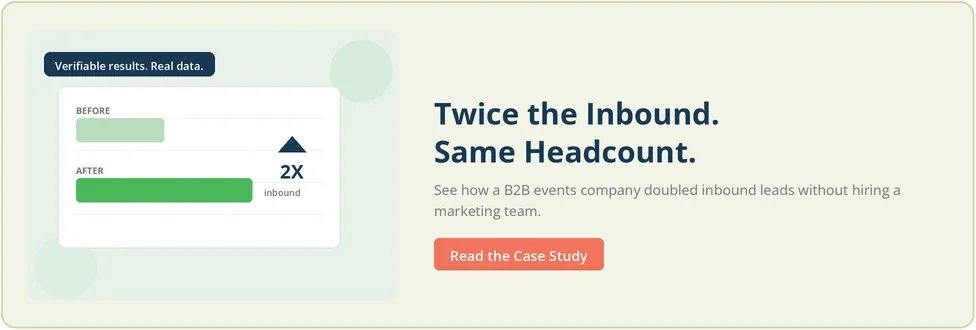
Wondering whether you need an agency, a fractional CMO, or a hire? See how we turned search into booked pipeline for a real B2B client
Your Unfair Advantages as a Founder
Big competitors have brand and budget. You have four things they lost years ago, and all four are content assets:
Your own expertise. You've had the objection conversation four hundred times. Write it down once and it outranks anything a content agency will produce from a brief.
Real customer stories with names attached. Your early customers are usually thrilled and usually willing to say so. Named proof beats a logo wall and is the thing AI engines actually cite.
Speed. You can publish a sharp comparison page this week. Your enterprise competitor needs legal, brand, and two committees to change a headline.
Focus. You don't have to be found for everything. Own one specific, high-intent category completely and you'll beat a much larger company that's spread thin.
The Founder's 90-Day Plan
Fix your positioning sentence first. Replace anything resembling "we help businesses grow" with who you serve, what you solve, and what changes. Everything downstream depends on this one line.
Build high-intent pages before blog posts. Service, comparison, alternatives, and use-case pages catch buyers near a decision.
Record two hours of yourself talking. Objections, war stories, why customers switch. That becomes months of content in your actual voice.
Turn three happy customers into named case studies. With numbers if they'll let you.
Add the facts AI engines need. Direct-answer sections, clean structure, schema, and consistent claims everywhere you appear.
Decide who owns this on Monday mornings. An agency, a fractional CMO, or you. Written down, not assumed.
Report on pipeline from month one. Not traffic. If the first report is a traffic chart, correct it before it becomes the habit.
What to Expect in the First 90 Days
Let's land where it matters: what you should actually see, and when.
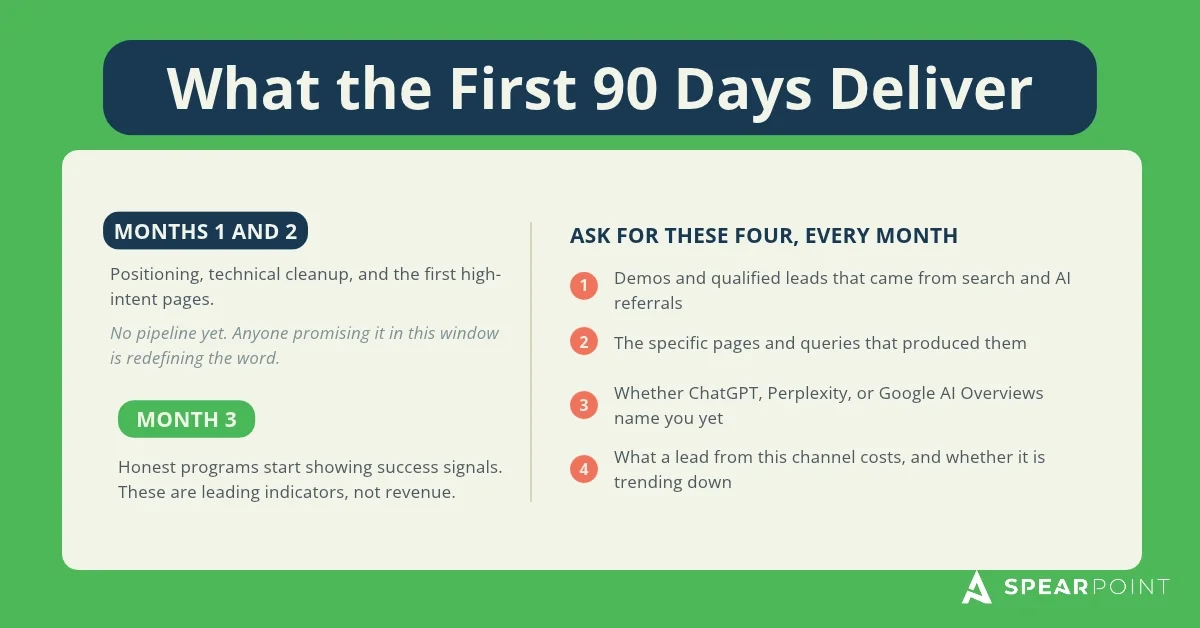
Months one and two are unglamorous. Positioning, technical cleanup, and the first high-intent pages. If someone promises pipeline in this window, they're redefining pipeline.
Month three is where honest programs start showing signal. Not revenue yet, but the leading indicators that predict it. Ask for these four, every month:
How many demos and qualified leads came from search and AI referrals?
Which specific pages and queries produced them?
Are we being named by ChatGPT, Perplexity, or Google AI Overviews yet, and for what?
What does a lead from this channel cost, and is that number trending down?
Answer those four and marketing stops being a hopeful expense. It becomes a channel you can forecast, which is the only version worth paying for.
Not sure whether buyers can find you in Google or AI search? Get a free B2B SEO & AI-visibility audit, and we'll show you exactly where buyers are finding your competitors instead of you.
FAQ
-
Depends which is missing. If you know what to do and can't get it done, an agency. If you can't confidently say what the plan should be, a fractional CMO, because an agency executing an unwritten strategy produces expensive motion. Most founder-led B2B companies have an execution gap, so the agency answer is right more often.
-
When there's enough recurring work to fill a role and you know what the role is. Hiring a generalist to figure out marketing for you usually fails, because they inherit no strategy and no systems. An agency or fractional CMO first often makes the eventual hire far more successful.
-
For writing in your own voice, yes, and often better than outsourcing it. What tends to break is technical work, consistency, and measurement. See in-house SEO versus an agency for where the line usually falls.
-
It varies enormously by scope, so treat any single number with suspicion. We published the ranges and what each tier actually buys in what B2B SEO should cost, and our own pricing is public. The useful question isn't the retainer, it's the cost per qualified lead six months in.
-
Expect leading indicators in three to six months and pipeline impact past six to twelve. That's slow next to paid, and it's also why it compounds. B2B cycles run ten to eleven months themselves, so the first closed deal attributed to search is often a year out.
Conclusion
The founder-led stage ends whether you plan for it or not. Either you choose what comes next or the calendar chooses for you, usually badly, usually in a quarter when something else is on fire.
Diagnose the gap first. Execution means an agency. Strategy means a fractional CMO. Ownership means a hire. Buying the wrong one is how founders lose a year and conclude that marketing doesn't work for them.
And whatever you pick, hold it to pipeline from the first report. You already built the hard part. The job now is making sure the people deciding in month eight of an eleven-month cycle can find you.
Get that right and you go back to being the best salesperson in the company, instead of the marketing department.
Suggested External Links

Jesse McFarland, MBA, has spent 17+ years helping businesses turn search visibility into real revenue, with a focus on conversion-driven SEO and AI search. He founded SpearPoint Marketing to do B2B SEO the way it should be done: tied to pipeline and revenue, not vanity traffic. Connect with Jesse on LinkedIn.