In-House SEO vs Agency: Can AI Tools Replace an SEO Agency?
Yes, you can do more SEO in-house than ever before.
You can use ChatGPT to brainstorm topics, Claude to edit content, Semrush or Ahrefs to pull keyword data, Screaming Frog to crawl your website, Google Search Console to see what's actually getting impressions, and GA4 to remind yourself that marketing attribution was apparently designed by someone who enjoys watching people suffer.
So the question is fair:
Can I do SEO in-house with AI tools instead of hiring an SEO agency?
The honest answer is yes, you can do some of it in-house.
The more useful answer is that AI tools can help you do SEO tasks, but they don't replace SEO strategy. They don't understand your business model unless you teach them. They don't know which customers are actually profitable. They don't know which leads waste your sales team’s time. They don't know when your website is technically holding you back. They don't magically understand your industry, your competitors, your positioning, your sales cycle, or why one keyword produces garbage leads while another keyword produces revenue.
AI makes SEO more accessible.
It doesn’t make SEO easy.
Very annoying, I know.
TL;DR for the Founders Who Bill by the Hour and Read by the Second

Yes, you can use AI tools to bring parts of SEO in-house.
AI tools are useful for research, content outlines, brainstorming, content refreshes, reporting summaries, and basic optimization support.
AI can help you move faster, but it doesn’t replace SEO strategy, technical expertise, industry knowledge, or accountability.
In-house teams usually understand the business better, but they often lack the time and execution capacity to keep SEO moving consistently.
SEO agencies understand the search landscape, competitive patterns, technical issues, content strategy, and what actually drives qualified leads.
An industry-specific SEO agency can usually move faster because they already understand the buyer, market, competitors, and common SEO mistakes in that space.
The best setup is often a hybrid: internal business expertise, agency strategy, and AI tools helping everyone move faster.
Using ChatGPT to write a blog post isn’t the same thing as building an SEO strategy.
The real question isn’t, “Can we do SEO in-house?”
The real question is, “Do we have the strategy, time, expertise, and execution capacity to do it well?”
Table of Contents Show
Why This Question Is Coming Up More Often
This question is showing up more because the tools have gotten better.
A business owner can now open ChatGPT or Claude and ask for keyword ideas, title tags, blog outlines, FAQs, schema suggestions, internal linking recommendations, and content briefs. SEO platforms can show rankings, backlinks, competitors, traffic estimates, keyword gaps, and technical issues. Google Search Console gives you real performance data straight from Google. Google’s own SEO Starter Guide says best practices help search engines crawl, index, and understand your content, which is still the foundation of search visibility.
So yes, the barrier to entry is lower.
That's a good thing.
But lower barrier to entry doesn’t mean lower complexity. It just means more people can now create content, run tools, and produce reports without necessarily knowing what matters. Which is basically how we ended up with 47 blog posts on every website called “5 Tips for Business Growth.”
Thank you, internet. Very helpful.
The real issue isn’t whether AI tools can help with SEO. They can. The real issue is whether your company can turn those tools into a strategy that creates qualified demand.
That's where things get harder.
What AI Tools Are Actually Good At
AI tools are very useful for SEO when they are used correctly. They can save time, speed up research, help organize ideas, and make content production easier. For a small business or internal marketing team, this can be a huge advantage.
AI tools can help with:
Keyword brainstorming
Blog topic ideation
Content outlines
FAQ generation
Title tag and meta description ideas
Content refresh recommendations
Basic competitor research
Internal linking ideas
Schema suggestions
First drafts of content
Editing and rewriting
Repurposing content for LinkedIn, email, and sales enablement
Summarizing Google Search Console or GA4 data
Creating prompt lists for AI search visibility testing
That's all useful.
But notice what most of those are.
They are tasks.
They aren't strategy.
AI can help you draft a service page. It cannot automatically know whether that service page should exist, whether the offer is positioned correctly, whether the keyword has the right intent, whether the page matches how your buyers make decisions, or whether the page will attract the type of leads your sales team actually wants.
That's the gap.
AI can help you produce SEO assets faster. It cannot decide what your business should be known for.
Where In-House SEO Usually Breaks Down
Most companies don't fail at SEO because they lack tools.
They fail because they lack focus.
They chase keywords that look good in a spreadsheet but don't drive qualified leads. They publish blogs because a tool said the keyword has volume. They optimize pages that should probably be rewritten from scratch. They track rankings but ignore conversions. They create content for broad informational searches and then wonder why none of it turns into pipeline.
Classic.
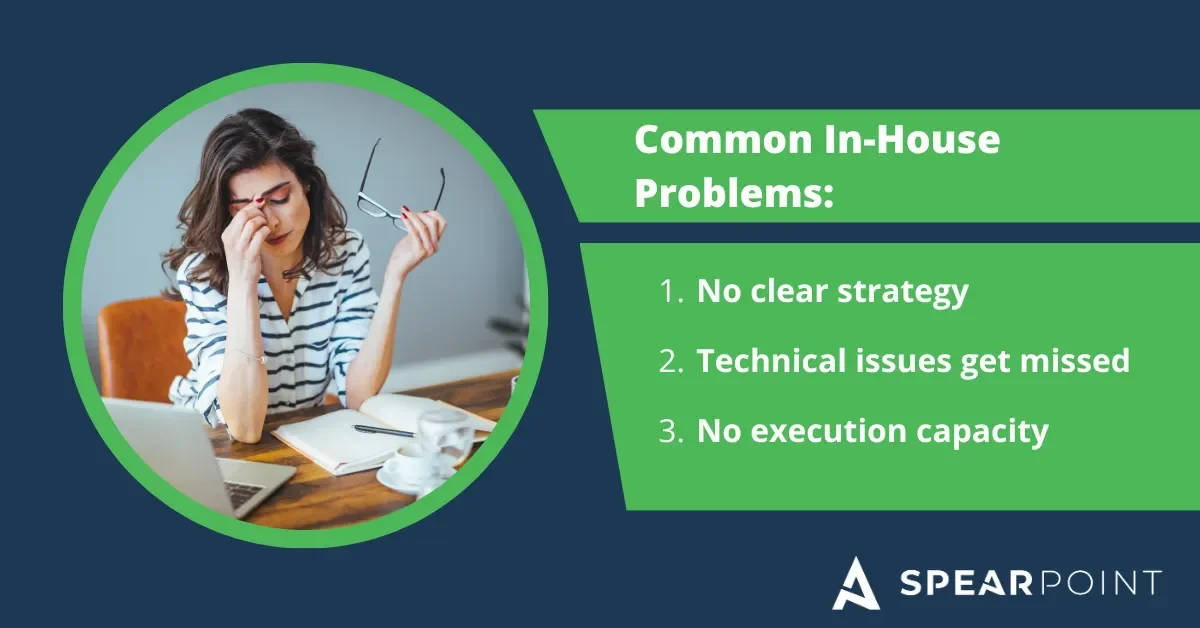
In-house SEO usually breaks down in a few predictable places:
No clear strategy: The team creates content, but there is no clear connection to revenue, sales priorities, or positioning.
Wrong keyword intent: The company targets broad terms that attract researchers, students, DIYers, or unqualified leads instead of actual buyers.
Technical issues get missed: Crawlability, indexation, site speed, duplicate content, JavaScript issues, schema, redirects, and internal linking problems often sit untouched.
Content sounds generic: AI-assisted content starts to sound like every other article on the internet. Which is unfortunate because the internet isn’t suffering from a shortage of generic content.
No conversion focus: Traffic grows, but leads don't. Or leads grow, but quality drops. Everyone celebrates impressions while the sales team quietly loses faith in marketing.
No third-party proof: The company focuses only on its website while competitors show up in reviews, directories, podcasts, PR mentions, comparison pages, and AI search citations.
No execution capacity: The team knows what needs to happen, but SEO gets pushed behind sales requests, website updates, internal meetings, paid campaigns, reporting, and the 47 other things that somehow became urgent by lunch.
Reporting is activity-based: The report says “we published four blogs,” but nobody can explain how those blogs support revenue.
That last one is the killer.
SEO activity isn’t the same thing as SEO progress.
This is why we think about SEO through a conversion-based SEO lens. Rankings are nice. Traffic is nice. But the point is to turn visibility into qualified demand, leads, members, customers, demos, calls, sales opportunities, or whatever actually matters to the business.
Radical concept.

The Part Everyone Overlooks: Actually Executing the Work
This is the part that almost always gets overlooked when companies talk about bringing SEO in-house with AI tools.
Execution.
Not ideas. Not strategy docs. Not a list of keywords. Not a beautiful content calendar that makes everyone feel productive for 12 minutes.
Actual execution.
SEO requires a lot of unsexy follow-through:
Updating title tags
Improving service pages
Building internal links
Fixing technical issues
Publishing and editing content
Refreshing old pages
Reviewing Google Search Console data
Tracking conversions
Building citations
Improving Google Business Profile listings
Creating comparison pages
Following up on content approvals
Reviewing rankings and traffic quality
Making sure the work actually gets done
This is where in-house SEO often runs into reality.
Your internal team may be smart. They may understand the business better than any outside agency ever will. They may even know what needs to happen.
But do they have the time?
Can they actually execute consistently?
That's a completely different question.
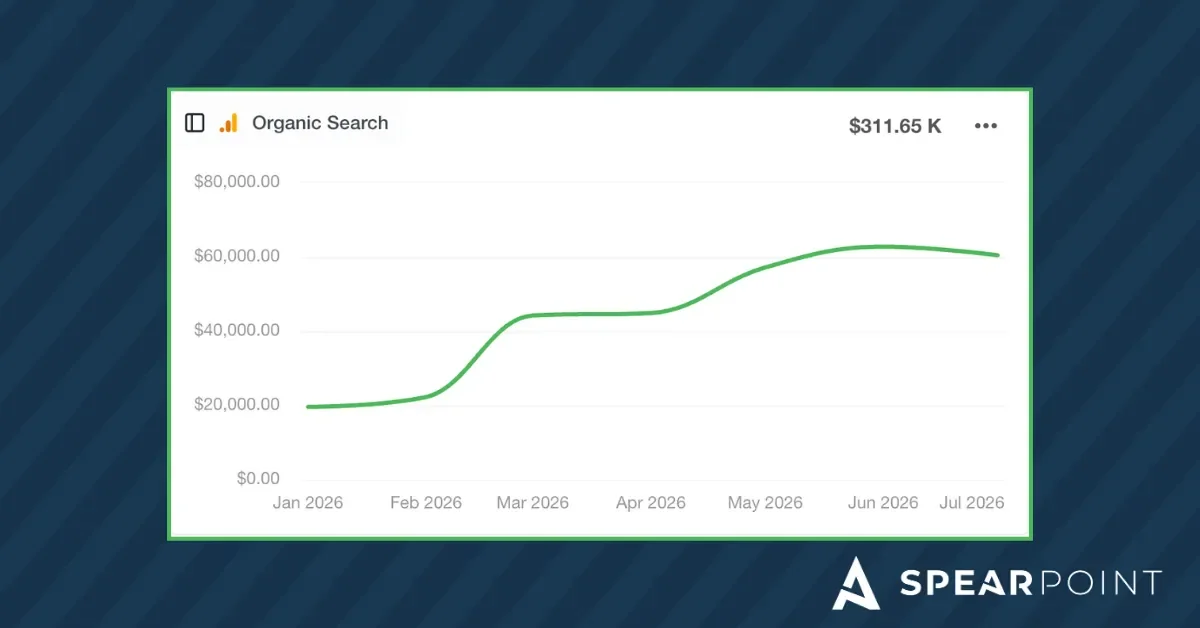
I wrote about this on LinkedIn because it's one of the most underrated advantages of hiring an agency:
When someone at an agency goes on vacation, your SEO shouldn't go on vacation too. When one person gets busy, the work should not disappear into the “we’ll get to it next week” graveyard. When AI Search suddenly becomes priority number one, and then priority number seven three days later, someone still needs to keep the work moving.
That's hard to do in-house when SEO is one person’s side responsibility, or worse, one of 47 priorities sitting on a marketer’s already very unreasonable to-do list.
This isn’t because in-house teams are lazy. They are usually the opposite.
They’re buried.
That's the point.
AI tools can make SEO tasks faster. But they don't create more hours in the week. They don't chase approvals. They don't fix your internal bottlenecks. They don't keep the campaign moving when the person responsible for SEO gets pulled into sales materials, a website emergency, an event, paid ads, email campaigns, reporting, and whatever “quick request” leadership just dropped into Slack.
Very quick. Always quick. But somehow, never quick.
This is why execution and continuity matter.
A good agency should bring a team, a process, and accountability. Someone owns the work. Someone keeps the strategy moving. Someone makes sure SEO and AI Search don't stall every time internal priorities shift.
SEO doesn't usually fail because nobody had ideas.
It fails because nobody had the time, ownership, or consistency to execute them.
Why an SEO Agency Still Matters
A good SEO agency should not just “do SEO tasks.”
That's not enough anymore.
A good SEO agency should help connect search visibility to business outcomes. That means understanding your customers, positioning, offers, sales process, competitors, conversion paths, and where your website helps or hurts the buyer journey.
An industry-specific SEO agency should bring pattern recognition that's hard to build internally.
They should know:
Which keywords usually drive good leads
Which keywords look impressive but waste everyone’s time
What competitors are doing well
Where content gaps usually exist
What technical issues commonly hurt sites in your industry
What pages need to exist to support buyer decisions
What proof buyers need before they inquire
How to connect SEO with AI search visibility
How to build content that supports both rankings and conversions
That's the difference between using SEO tools and having an SEO strategy.
The tool can show you a keyword.
The agency should help you decide whether that keyword matters.
Big difference.
If you're evaluating agencies, specialization also matters. A generalist agency may understand SEO basics, but a B2B SEO agency, fitness SEO agency, or ecommerce SEO partner should understand the buying behavior, search intent, proof points, and conversion paths inside that specific market.
AI Search Makes This Even More Important
AI search adds another layer to this conversation.
Buyers aren't only using Google. They are asking ChatGPT, Perplexity, Gemini, Copilot, and Google AI results for recommendations, comparisons, summaries, and vendor shortlists. That means your SEO strategy can no longer be limited to “rank the page and get the click.”
You also need to think about whether your brand is being mentioned, cited, and accurately described in AI-generated answers. That's why AEO and AI Search Optimization are becoming part of modern SEO strategy, especially for companies that need to show up before the buyer ever fills out a form.
Google has said that its generative AI search features still rely on core search quality and ranking systems, and that SEO fundamentals like crawlability, helpful content, technical accessibility, and unique value continue to matter. Google also says no magic AI-specific markup is required to appear in AI features, which is inconvenient for anyone trying to sell “secret AI SEO hacks” out of a Google Doc. You can read Google’s official guide to optimizing for generative AI features on Search.
AI search visibility depends on more than your website.
It can be influenced by:
Your service pages
Your blog content
Your reviews
Your directory listings
Your LinkedIn presence
Your podcast appearances
Your YouTube content
Your PR mentions
Your comparison pages
Your third-party citations
How consistently the internet explains your brand
This is where in-house AI-only SEO gets risky.
If your team is just using AI to create more content, you may be missing the bigger picture. AI search rewards brands that are clear, credible, crawlable, and validated across the web. Tools like ChatGPT Search and Perplexity can surface answers with sources or citations, which means the quality and consistency of your broader digital footprint matters.
More content isn’t the answer if the brand is unclear.
More blogs aren't the answer if buyers need proof.
More AI-generated FAQs aren't the answer if your competitors are the ones being cited.
In-House SEO vs Agency: The Real Difference
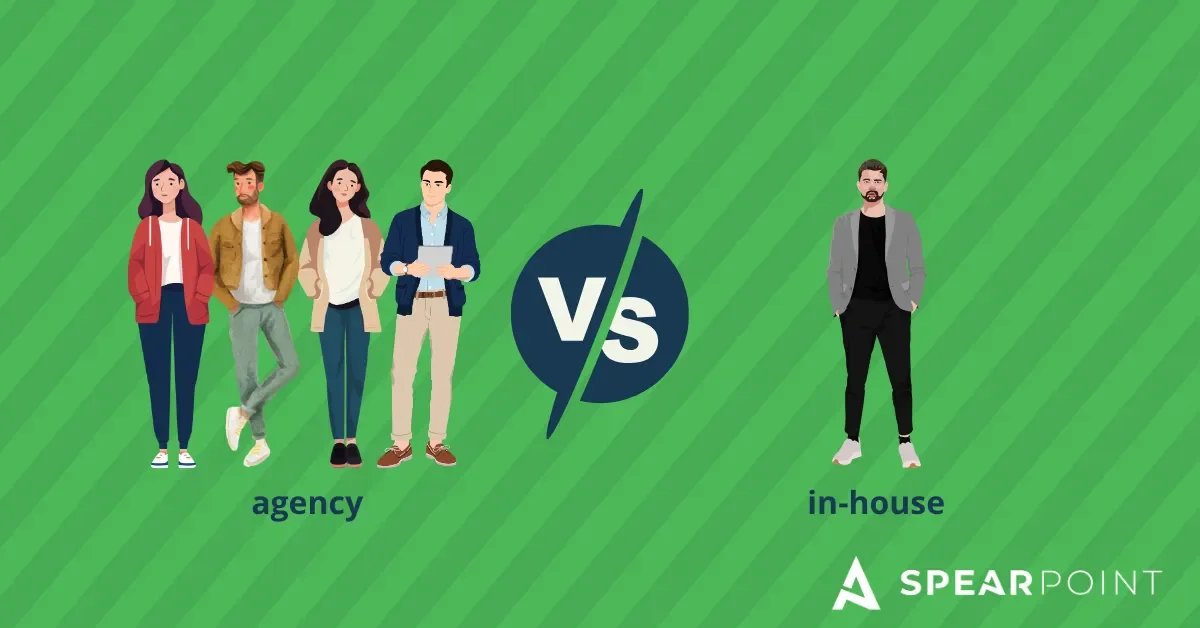
Here’s the simplest comparison.
| Area | In-House SEO With AI Tools | SEO Agency |
|---|---|---|
| Business knowledge | Usually stronger internally | Must be learned during onboarding |
| SEO expertise | Depends on team experience | Should already exist |
| Industry pattern recognition | Limited unless the team has done it before | Stronger if the agency specializes |
| Content production | Faster with AI support | Stronger with strategy, editing, and SEO direction |
| Technical SEO | Often missed or under-prioritized | Should be part of the process |
| Accountability | Can get buried under other priorities | Should be tied to deliverables and outcomes |
| AI search visibility | Easy to misunderstand | Stronger if the agency understands AEO/GEO/AI visibility |
| Cost | Can be cheaper upfront, unless hiring a person for this, then way more expensive | Usually more expensive but more complete |
| Speed to strategy | Slower without experience | Faster if the agency knows the market |
| Best fit | Companies with strong internal marketers | Companies that need strategy, execution, and expertise |
This isn’t about whether in-house is good or bad.
In-house can work.
Agency can work.
Both can also fail spectacularly without a strategy.
The question isn’t, “Which one is cheaper?”
The better question is, “Which one gives us the best chance to turn search into qualified demand?”
Example 1: A B2B Company That Needs SEO
Let’s say you're a B2B SaaS company or a professional services company selling to a niche audience. Your buyers aren't impulse-buying your offer after reading one blog post called “What Is Workflow Automation?” They are comparing vendors, reading reviews, checking credibility, asking peers, searching for alternatives, and trying to figure out who they can trust.
You can use AI tools in-house to create content outlines, summarize customer pain points, draft service pages, and build comparison content. That's useful.
But the hard part is knowing what to prioritize.
Should you create educational content? Comparison pages? Alternatives pages? Industry pages? Use-case pages? Case studies? Technical documentation? Partner pages? AI search prompt pages? Review profile optimization? LinkedIn thought leadership?
The answer depends on your sales cycle, buyer awareness, competitive landscape, and revenue goals.
For a B2B company, an agency that understands your industry can help identify:
Which keywords have buyer intent
Which pages support sales conversations
Which competitors are owning the category
Which content gaps matter
Which third-party sources influence trust
Which AI prompts your brand should appear for
Which pages need stronger positioning and conversion paths
This matters because B2B SEO isn’t about getting everyone to your website. It's about getting the right people to trust you before they ever talk to sales.
A B2B company using AI tools without strategy may publish a lot of content and still fail to generate qualified leads. An agency should help connect the content to the actual buying process.
You know. The part that pays the bills.
Example 2: A Gym or Local Business That Needs SEO
Now let’s say you run a gym, training facility, med spa, dental office, law firm, contractor business, or another local business.
AI tools can help you write Google Business Profile posts, service page content, FAQs, blog ideas, and social posts. They can help you describe services, create location pages, and summarize reviews. That's all helpful.
But local SEO isn’t just writing words on a page.
A local business needs to show up when nearby buyers search for something specific and are ready to act. For a gym, that might be:
“strength training gym near me”
“personal training in [city]”
“HYROX gym in [city]”
“fitness classes for athletes”
“small group training near me”
“best gym for strength and conditioning”
The challenge isn’t just ranking. The challenge is making sure the business looks credible enough to contact.
That means local SEO needs:
Google Business Profile optimization
Review strategy
Local citations
Service pages
Location pages
Internal linking
Photos and trust signals
Conversion-focused calls to action
Tracking for calls, forms, bookings, and trials
Local competitor analysis
AI search visibility for local recommendations
This is where a local SEO agency can make a big difference.
A gym owner might use AI to write a page about personal training. But an experienced agency should know how to position the offer, structure the page, optimize the Google Business Profile, build local relevance, improve reviews, and track whether the campaign is producing real leads.
For fitness businesses specifically, gym and fitness SEO has to account for Google Maps, reviews, local service searches, website conversions, and now AI-powered discovery. It's also why gym owners need to understand which gym keywords actually convert, not just which ones look nice in a keyword tool.
Because “we got more impressions” is cute.
But did the phone ring?
Did people book trials?
Did members sign up?
Did the business grow?
That's the point.
Example 3: An Ecommerce Business That Needs SEO
Ecommerce SEO is where the “I’ll just use AI tools” idea can get dangerous quickly.
AI can absolutely help with ecommerce. It can write product descriptions, category descriptions, FAQs, buying guides, comparison content, and email copy. It can help scale content production in a way that would have been painful a few years ago.
But ecommerce SEO isn’t just content.
An ecommerce business has to deal with technical and structural issues that AI tools may identify but not fix correctly.
Things like:
Collection page optimization
Product page optimization
Duplicate content
Variant and SKU issues
Faceted navigation
Canonical tags
Internal linking
Crawl budget
Schema markup
Product feed quality
Out-of-stock products
Redirects
Site speed
Reviews
Category architecture
Blog-to-product internal linking
Conversion rate optimization
AI can help write a better product description.
Great.
But if your collection pages are weak, your filters are creating indexation chaos, your internal linking is a mess, and your best products are buried six clicks deep, AI-written product copy won't save you.
Sorry.
For ecommerce, an SEO agency should help connect technical SEO, content strategy, category growth, product visibility, and conversion optimization. Google even points ecommerce site owners toward the importance of site structure in its SEO Starter Guide, because larger sites can get complicated quickly.
AI tools can help you move faster, but they shouldn't drive the strategy from the passenger seat while everyone pretends the car is fine.
When In-House SEO With AI Tools Makes Sense
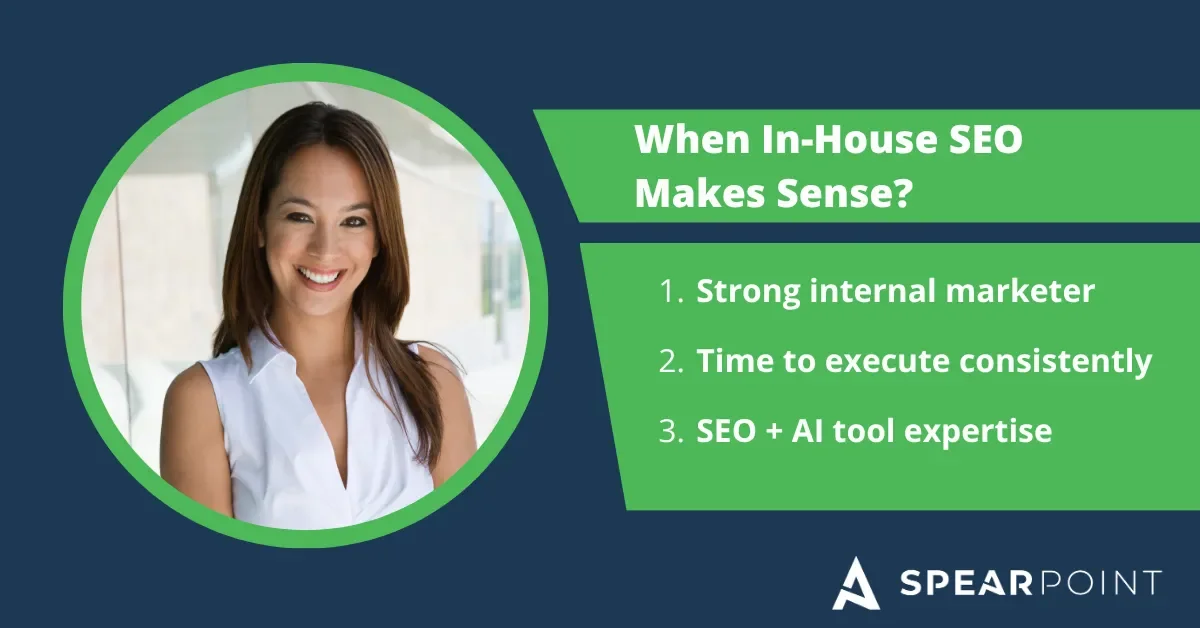
There are situations where doing SEO in-house with AI tools can make sense.
It can work if:
You already have a strong internal marketer
You understand your customers deeply
Your website is technically simple
Your competition isn’t too aggressive
You have time to learn SEO properly
You can consistently execute
You know how to evaluate AI output
You're comfortable using tools like Google Search Console, GA4, Semrush, Ahrefs, Screaming Frog, or similar platforms
You have someone responsible for SEO outcomes, not just SEO tasks
This is usually more realistic for a company with a marketing leader, content manager, or founder willing to be deeply involved.
AI tools can help that person move faster.
But again, faster is only helpful if you're moving in the right direction.
Running confidently toward the wrong keywords is still running toward the wrong keywords.
Just with better formatting.
When Hiring an SEO Agency Makes More Sense
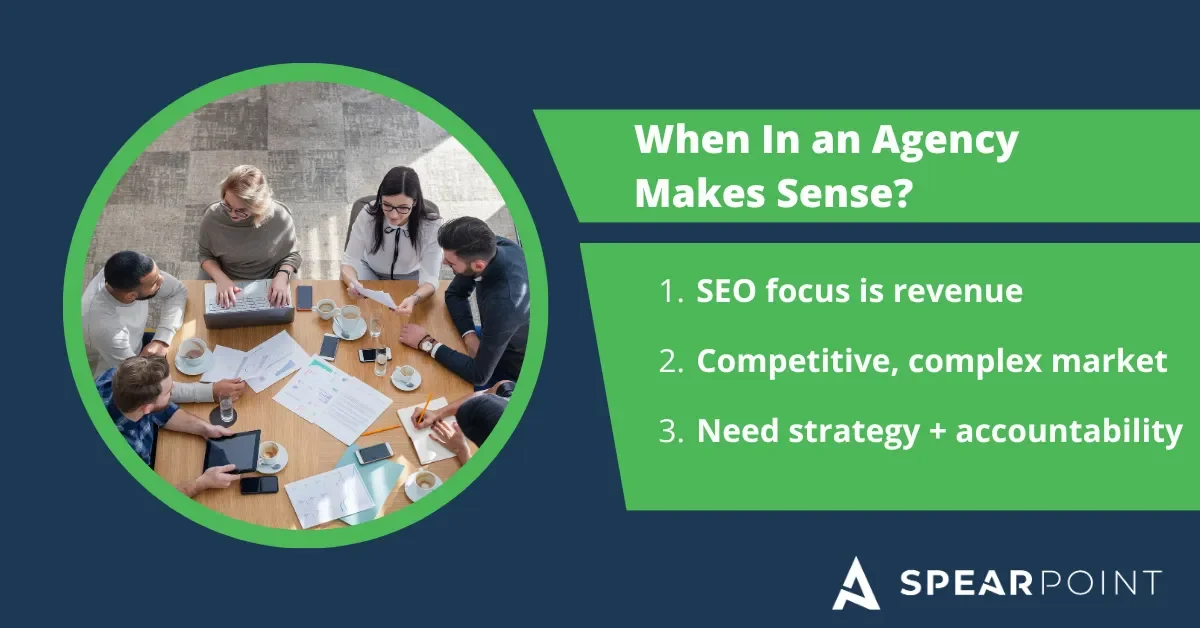
Hiring an SEO agency usually makes more sense when SEO needs to produce real business outcomes and not just “activity.”
An agency is likely the better option if:
SEO is important to revenue
You're in a competitive industry
Your internal team is already stretched
You aren't sure which keywords actually matter
Your website has technical issues
You need content strategy, not just content production
You need better conversion tracking
You need help with local SEO, ecommerce SEO, or B2B SEO strategy
You want to improve AI visibility
You need third-party proof, citations, and stronger brand signals
You want someone accountable for progress
The best agencies should not replace your business expertise.
They should extract it, organize it, and turn it into search strategy.
That's a big distinction.
A good SEO agency needs your input. They need to understand your best customers, your sales process, your most profitable services, your differentiators, your competitors, and what a qualified lead actually looks like.
If they don't ask those questions, that's a red flag.
And if their entire strategy starts and ends with keyword volume, that's another red flag.
Possibly a parade of red flags.
The Best Option Is Often Hybrid
For many companies, the best answer isn’t “in-house or agency.”
It's both.
Your internal team knows the business. Your agency should know SEO, AI search, technical strategy, content strategy, and what's working across similar companies.
That combination can be powerful.
A good hybrid model might look like this:
The internal team provides customer insights, sales feedback, subject-matter expertise, and approvals.
The agency provides strategy, keyword research, technical SEO, content briefs, optimization, reporting, and AI search visibility guidance.
AI tools help both sides move faster with research, outlines, drafts, summaries, and repurposing.
Human experts review, refine, and connect everything back to business goals.
This is how AI should be used.
Not as a replacement for expertise.
As a multiplier for expertise.
Because AI plus no strategy is still no strategy.
It just produces more words.
So, Can You Do SEO In-House With AI Tools?
Yes.
But that doesn’t mean you should do it all in-house.
If your goal is to publish a few articles, clean up some title tags, write FAQs, and learn the basics, AI tools can help. You may be able to make progress without an agency, especially if your competition is light and your website is simple.
But if your goal is to turn search into qualified leads, compete in a crowded market, improve AI search visibility, strengthen your brand authority, fix technical issues, and connect SEO to revenue, then hiring an SEO agency that understands your industry is still usually the better move.
The question isn’t whether AI can help.
It can.
The question is whether you have the strategy, expertise, time, and accountability to turn that help into results.
That's where many companies find out the hard way that tools aren't the same as experience.
FAQ
-
Yes, you can do parts of SEO yourself with AI tools. AI can help with keyword brainstorming, content outlines, FAQs, title tags, meta descriptions, content refreshes, and basic SEO recommendations. But AI tools still need human strategy, business context, technical review, and industry expertise to be effective.
-
Not automatically. Google’s guidance says the focus should be on helpful, reliable, people-first content, not simply whether content was created with AI or by a human. AI-assisted content still needs original value, accuracy, expertise, and a clear purpose. Google’s helpful content guidance and guidance on generative AI content are both worth reading before anyone turns AI content production into a content factory with Wi-Fi.
-
Usually, yes, upfront. But cheaper doesn’t always mean better. In-house SEO can become expensive if the team targets the wrong keywords, publishes low-value content, misses technical issues, or spends months working on activities that don't produce qualified leads.
-
Consider hiring an SEO agency if SEO matters to revenue, your industry is competitive, your website has technical issues, your team lacks SEO experience, or you need a strategy tied to leads and sales. An agency is especially helpful when you need industry-specific SEO, local SEO, ecommerce SEO, B2B SEO, or AI search visibility support.
-
No. ChatGPT can help with SEO tasks, but it doesn’t replace an SEO agency. It can generate ideas, outlines, drafts, and recommendations, but it doesn’t automatically know your business priorities, lead quality, technical issues, competitive landscape, or conversion strategy.
-
It depends on your team, goals, competition, and internal expertise. In-house SEO can work if you have a strong marketer and a simple site. An agency is usually better if SEO needs to drive measurable business growth, technical improvements, content strategy, AI visibility, and qualified leads.
-
AI search changes SEO because buyers may get answers, recommendations, and vendor shortlists before they ever click a website. That means brands need to focus not only on rankings and traffic, but also on AI visibility, brand mentions, citations, third-party proof, and whether AI tools accurately understand and recommend the company.
For more on this, read SpearPoint’s AEO and AI Search Services page or this guide on why SEO is still worth it even as search keeps changing.
See if an SEO Agency is Right For You
We’ll audit your brand’s search presence and create a clear action plan you can use yourself or with an agency.
About the Author

Jesse McFarland is the founder of SpearPoint Marketing, a conversion-focused SEO and AI search agency based in Centennial, Colorado. Jesse has more than 17 years of digital marketing experience across B2B, SaaS, healthcare, legal, fitness, ecommerce, and startup organizations.
He specializes in helping companies turn organic search into qualified demand through modern SEO, AEO, GEO, AI Visibility, content strategy, technical SEO, and brand-first search marketing. Jesse helps business owners and marketing leaders understand how search is changing without losing their minds every time someone on LinkedIn announces SEO is dead again.