An AI search agency can help your B2B company get found when buyers ask ChatGPT, Perplexity, Gemini, or Google for recommendations. At least, that’s the pitch. Open enough agency websites and you’ll find a lot of talk about prompts, citations, and visibility. Then you get to the part about qualified leads and the room gets strangely quiet.
I own an agency, so yes, I have a dog in this fight. But if you’re hiring an AI search or AEO agency, I want you to ask harder questions, including of us. Start with what the work will actually change, how it connects to your AI Search and AEO strategy, and who will be responsible for turning that visibility into business opportunities.
Quick answer: To hire an AI search agency for B2B, look for a partner that understands your buyers, can show a clear SEO and AI visibility baseline, and will improve your buyer-facing pages and credibility. Ask who does the work, how they measure results, and how the plan supports qualified leads and pipeline. Nobody can guarantee a ChatGPT recommendation.
TL;DR

An AI search agency should help your B2B company become easier to find, understand, trust, and contact across search experiences.
That includes your website, buyer-focused content, technical SEO, credible mentions, and conversion paths. Prompt tracking helps you see what’s happening, but it’s only one signal.
Before hiring an AEO agency, ask for a specific plan, a realistic reporting method, clear ownership, and evidence that the team understands how your buyers become customers.
Table of Contents Show
5 Key Takeaways
An AI search agency should be able to explain how its work supports qualified leads and pipeline, not only brand mentions.
B2B AI search strategy should focus on the questions buyers ask while comparing problems, solutions, vendors, and costs.
A credible agency will measure AI visibility alongside search performance, website conversions, and sales feedback.
The proposal should name the pages, technical work, outside sources, people, and priorities involved.
No agency controls what ChatGPT or another AI system recommends for every prompt.
What an AI Search Agency Actually Does
An AI search agency improves how a business appears when people use AI-powered tools to find information, compare options, and choose providers. Depending on the agency, that work may include SEO, content, technical fixes, digital PR, analytics, and conversion rate optimization.
What is an AEO agency?
An AEO agency focuses on answer engine optimization: making your business and its content easier to understand, reference, and cite in answer-driven search experiences. Some agencies use AEO, GEO, and AI search almost interchangeably. I’d spend less time debating the acronym and more time asking what they’ll actually do.
Good work might include improving a vague service page, answering a question your sales team hears every week, publishing an honest comparison, or earning a credible mention on a site your buyers already trust. It should also include fixing the boring stuff. A page that search systems can’t access or a contact form that doesn’t work isn’t going to be rescued by clever prompt research.
Google’s guidance for AI features in Search says its existing SEO best practices still apply to AI Overviews and AI Mode. Google also says there's no special schema or extra technical requirement that magically gets you included. That’s a useful test for any agency pitching you a secret AI markup formula.
My view: AI search needs a plan built on real search fundamentals, with more attention to how buyers ask questions and how your brand shows up across the web. The label on the invoice is the least interesting part.
SEO Is the Foundation. Make the Agency Prove the AI Search Part.

You might get your name into a few AI answers while the rest of your website is a mess. I wouldn’t call that a growth strategy. If buyers can’t find, understand, or use your most important pages, a brand mention has nowhere useful to lead.
Why does SEO matter for AI Search?
Google says its existing SEO best practices apply to AI Overviews and AI Mode. A page also has to be indexed and eligible for a Search snippet to appear as a supporting link there. OpenAI’s publisher guidance says sites should allow its search crawler, OAI-SearchBot, if they want their content included in ChatGPT search summaries and snippets. These platforms work differently, but neither gives you a reason to ignore the basics.
That foundation includes accessible pages, clear site structure, internal links, useful service and comparison pages, accurate information, and a website that turns interest into inquiries. AI Search adds another job: understanding the questions buyers ask AI tools, checking how your brand appears in the answers, and strengthening the sources those answers may reference.
What kind of agency would I hire?
I’d hire an agency that does SEO well and can prove it knows AI Search too. Show me SEO work that improved the site and attracted the right buyers. Then show me AI Search research, the prompts and sources that mattered, the changes you made, and what you learned when you checked again. Adding “AEO” to a services page last week doesn’t count as proof.
I wouldn’t put the whole program in the hands of an AI Search-only agency or a PR firm that now sells AI Search. Either can contribute something useful. PR, for example, can help earn credible coverage and mentions. But someone still needs to own your technical SEO, high-intent pages, content, measurement, and conversion path. That’s the partner I’d want leading the work.
Why B2B Companies Need a Different Hiring Test
B2B buyers usually have bigger questions than “What’s the best software?” They’re comparing requirements, use cases, implementation, risk, price, and alternatives. More than one person may need to believe your company is the right choice before anyone fills out a form.
Imagine a SaaS company selling inventory software to distributors. One buyer asks an AI tool how to reduce stockouts. Another asks which systems integrate with the company’s ERP. Later, a decision maker compares three vendors, checks reviews, and visits their pricing pages. Those searches have different levels of intent, but they’re part of the same buying decision.
An agency that tracks only “best inventory software” may miss most of that journey. An agency that chases hundreds of informational prompts may give you a gorgeous chart and no sales conversations. I’ve seen enough marketing reports to know how easy it is to celebrate the chart.
Your agency should know your ideal customer, the questions behind each buying stage, and what buyers need to see once they reach your site. That’s also why our B2B SEO approach starts with high-intent traffic and conversions, not traffic for its own sake.
How to Hire an AI Search Agency for B2Bs
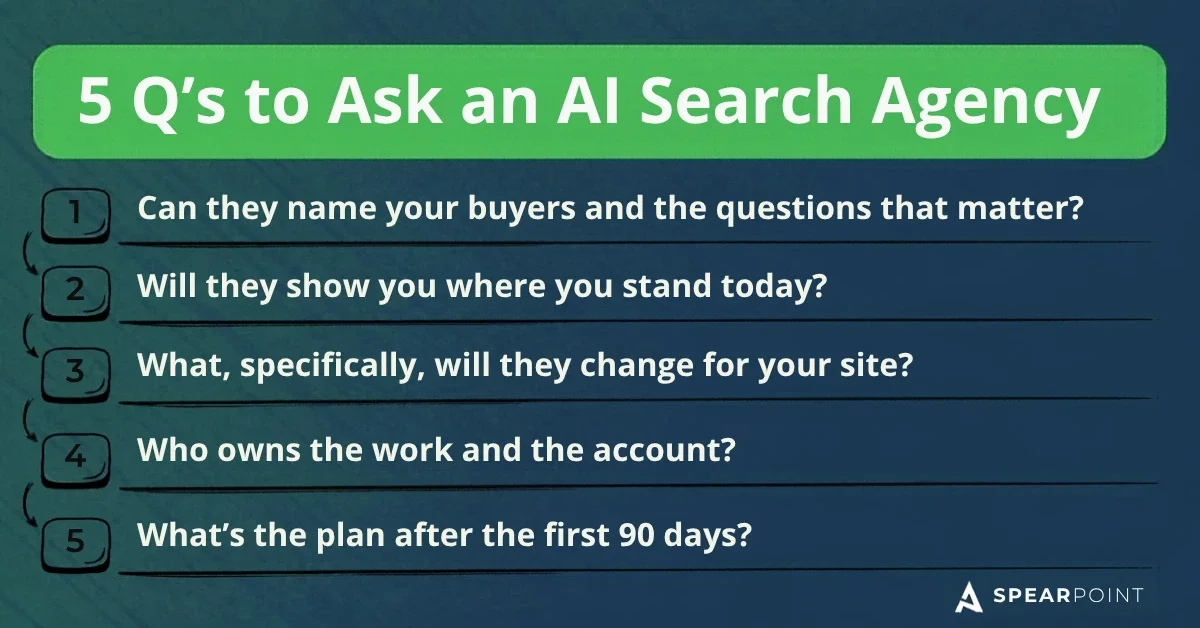
Ask each candidate to walk through your actual business. If every answer sounds like it could have been copied into a proposal for a dentist, a gym, and a cybersecurity firm, keep asking questions.
1. Can they name the buyers and questions that matter?
They should be able to identify your audience, how buyers describe the problem, and what a qualified opportunity looks like. They don’t need to memorize your industry before the first call. Relevant industry experience gives an agency a head start, but I still want to see it ask thoughtful questions about your business before promising a strategy.
Ask for examples across the journey: problem searches, solution searches, vendor comparisons, pricing questions, and objections. For a deeper look at why those stages matter, see our AEO guide for B2B marketers.
2. Will they show you where you stand today?
A useful baseline shows where your brand appears for a defined set of relevant prompts, where competitors appear, and which sources get cited. It should also review your existing search visibility, important pages, technical issues, and conversion tracking.
Ask how the prompts were chosen, which platforms were checked, and when the checks happened. AI answers can vary, so one screenshot of your name in ChatGPT is a nice moment. It isn’t a measurement strategy. We built our AI Search Dashboard to make prompt visibility and competitor comparisons useful for decisions. The human part is still deciding what to improve next.
3. What will they actually change for your site?
The agency should be able to name the work: which pages need a rewrite, what technical problems need attention, what questions need a better answer, and where your brand needs stronger outside validation. Ask what they will implement, what your team will implement, and what requires a subject matter expert’s review.
I’d be cautious if the entire plan is “publish 20 AI blogs a month.” B2B buyers often need a strong service page, an honest comparison, a useful case study, and a clear next step more than they need article number 347 about the history of their industry.
4. Who owns the work and the account?
Find out who will lead strategy, who writes and edits, who makes changes to your website, and who reports on results. Ask whether you retain access to the content, analytics, dashboards, and accounts. If your internal team handles publishing or subject matter review, put that in the plan.
I make a similar case in how to choose the right B2B SEO agency: define your goals, ask about experience, and expect transparency about the work and reporting. Ask to meet the person who will actually manage your account. Google’s advice on hiring an SEO also recommends asking for examples, expected results, measurement, communication, and explanations of proposed changes. Those questions still apply when an agency adds “AI search” to its pitch.
5. What happens after the first 90 days?
You should see a starting point, priorities, responsible people, and a way to review progress. The first month might focus on buyer research, analytics, site issues, and the pages closest to a sale. The next two months might focus on implementation, outside visibility, and improving pages based on what you learn.
That’s an example of a sensible sequence, not a promise that ChatGPT will recommend you on day 91. Ask what the agency will change if the original prompt set doesn’t produce useful signals or if visibility improves but leads don’t.

How to Measure Results Without Fooling Yourself
Here’s the part of the sales pitch where everyone wants one number. I’d love one too. It would make my life easier. But B2B buyers may see your name in an AI answer, search for you later on Google, visit your site from another device, and book a call a week after that. You won’t always be able to draw a straight line from the first mention to the deal.
Use a set of signals that moves from visibility toward business outcomes:
| What to watch | What it can tell you | What it can't prove by itself |
|---|---|---|
| Mentions and citations for relevant prompts | Whether your brand is appearing in the conversations you care about | That those mentions reached buyers or created leads |
| Search Console impressions and clicks | How your pages perform in Google Search | A separate, complete count of AI-driven discovery |
| AI referral sessions and on-site actions | What happens when a visitor arrives from a trackable AI source | Every way AI influenced the buyer |
| Qualified forms, calls, demos, and CRM notes | Whether more of the right people are raising their hands | That one channel deserves all the credit |
| Sales feedback | Whether prospects mention AI tools, recognize your brand, or bring better questions | A precise percentage of pipeline caused by AI search |
Google says AI Overviews and AI Mode activity shows up in overall Search Console web performance, rather than in a clean, separate AI-only report. OpenAI says ChatGPT search links can carry a utm_source=chatgpt.com parameter that helps with referral tracking. These are useful signals, but you still need to understand how your analytics records sources and ask prospects how they found you. See Google’s AI feature documentation and OpenAI’s publisher FAQ for the underlying platform guidance.
I like the ladder: visibility → relevant visits → conversions → qualified opportunities → revenue. Report what you can observe, explain what you can reasonably infer, and be honest about the gaps. If an agency claims it can prove every AI mention generated a deal, ask to see how.
Agency, Tool, or In-House Team?
You don’t automatically need another agency. The right setup depends on whether your team has the time and skills to turn what it learns into better pages, stronger visibility, and a working conversion path. As I wrote in in-house SEO vs. agency with AI tools, your team may know the business best. AI can speed up research and drafts. The hard part is choosing priorities and consistently getting the work done.
| Option | Usually makes sense when... | Your team still needs to own... |
|---|---|---|
| AI visibility tool | You already have strategists and people who can implement the work | Prompt selection, interpretation, prioritization, content, and follow-through |
| In-house team | You have ongoing SEO, content, technical, and analytics capacity | Specialized support when the team hits a gap |
| AI search or AEO agency | You need outside strategy, execution, or both | Product knowledge, sales feedback, approvals, and accountability for business goals |
| Hybrid agency + internal team | Your experts can supply insight and publish, but need a partner to direct the work | A clear handoff, shared priorities, and regular decisions |
I run an agency, and I’ll say it: if your team can do the work well, you may not need to outsource it. If your team can only buy a dashboard and then stare at it during a monthly meeting, you probably need help with execution. That’s where the cost question becomes useful. Compare the work you’re buying, who will do it, and how much internal time it will take.
Red Flags in an AEO Agency Proposal
You can learn a lot from what’s missing in a proposal. The issue isn’t whether an agency uses a new tool or a term you haven’t heard before. The issue is whether it can explain the work and the business reason behind it.
Guaranteed placement in ChatGPT. No outside agency controls every AI answer or can promise a recommendation for every buyer.
A wall of prompts with no buyer logic. Ask which ones reflect real research, comparison, and purchase decisions.
Reporting with no action. A dashboard should lead to a decision and an owner, not just another dashboard.
Content volume as the whole strategy. Ask how pages will be researched, checked by experts, edited, published, and improved.
No discussion of your website’s conversion path. Attention doesn’t become a lead if buyers can’t understand your offer or take the next step.
A proposal that could fit anyone. You should recognize your market, your competitors, and your sales process in it.
One more: be skeptical when someone claims a special technical trick guarantees inclusion in Google’s AI results. Google says its usual SEO fundamentals apply, and OpenAI’s publisher guidance focuses on whether its search crawler can access a site. Technical access matters. Magic switches don’t.
FAQ
-
Start with your ideal customers and the questions they ask before choosing a vendor. Then ask agencies for a baseline, a prioritized work plan, relevant examples, named owners, and reporting that connects AI visibility to search, leads, and sales feedback. Compare their answers against the same criteria.
-
Use the same hiring test. Ask the agency to define AEO in plain English and show how its work improves your pages, answers buyer questions, builds credible outside visibility, and supports conversions. The term on the proposal matters less than the scope, people, and measurement behind it.
-
Sometimes. An AI search agency may put more emphasis on AI answers, citations, conversational prompts, and brand mentions across platforms. Many of the underlying jobs overlap with SEO: accessible pages, useful content, clear site structure, and authority. Ask both types of agency what they will implement and how they will measure it.
-
No. An agency can improve the information buyers and search systems can find about you, then monitor relevant results and adjust the work. It can't control each answer an AI system produces. Treat guaranteed placement as a warning sign.
-
Costs depend on the market, website, competition, and scope. A reporting-only tool, a consulting engagement, and a program that includes technical fixes, content, PR, and CRO are different purchases. Ask what’s included each month, who implements it, what your team must supply, and when the priorities will be reviewed.
-
You can establish a baseline and start fixing problems early. Visibility and business results take longer and vary by platform, competition, and starting point. Ask for a plan with milestones the agency controls, such as completed work and established tracking, plus honest reviews of outcomes it can’t control.
Choose a Partner Who Owns the Outcome
If you’re hiring an AI search agency for B2B, you’re probably trying to solve a real problem: buyers are researching options in places you can’t fully see, and you want your company to be found, considered, and contacted. That deserves more than a new acronym and a slide full of green arrows.
Ask for a plan your team can understand. Ask who will execute it. Ask what a qualified lead means. And ask what happens when the data tells you the plan needs to change. More high-intent traffic. More leads. More opportunities. That’s the direction the work should move.
If you’d like a starting point, request a free SEO and website audit. We can look at your search foundation, AI visibility, and the path from discovery to inquiry, then tell you what we’d prioritize for your business. You can also contact SpearPoint with questions about your current plan.

Jesse McFarland, MBA, is the founder of SpearPoint Marketing, a Denver-area agency focused on SEO, conversion optimization, and AI Search. He has worked as both an agency strategist and an in-house marketing leader. Jesse helps B2B teams focus on high-intent visibility, better websites, qualified leads, and revenue. Connect with Jesse on LinkedIn.