How to Choose a Gym SEO Agency: Questions to Ask Before You Sign Anything

You've been burned before. Or you know someone who has.
A gym owner signs a twelve-month contract with an SEO agency, gets a glossy report every month full of green arrows and words like "impressions" and "keyword movement," and twelve months later has exactly the same number of members and a much lighter bank account. The rankings went up. The schedule stayed empty.
So when a studio owner asks us, “What should I look for when hiring an SEO agency for my gym or fitness studio?” The honest answer starts with what to look out for. Because the gap between an agency that grows your membership and one that just grows your invoice is enormous, and most of it is visible before you ever sign.
This is the buyer's guide we wish every gym owner had read before their last contract.
TL;DR

Hire for members, not rankings. If an agency measures success in impressions and keyword positions instead of trials, leads, and signups, they're selling you a trophy you can't deposit.
Ask how they'll measure success, what they'll do each month, and whether they can show results for local service businesses like yours. Vague answers are the answer.
Make sure they handle your Google Business Profile and reviews, and that they're optimizing for AI search—ChatGPT, Perplexity, and Google AI Overviews—not just classic Google.
Confirm you own everything if you part ways: your site, your content, and your Google Business Profile. Never let your visibility be held hostage.
Run from guaranteed #1 rankings, "proprietary secret methods," long lock-in contracts with no accountability, and anyone who won't report on leads.
Table of Contents Show
How Most Gyms Get Burned by SEO Agencies
Here's the dirty secret of the SEO industry: it's incredibly easy to look busy and incredibly hard to get caught.
An agency can send you a report showing your ranking for "best gym with squat racks and great vibes in [your suburb]" climbed from #8 to #2, and technically they've done something. Never mind that nobody on earth types that phrase, or that the three keywords actually driving trials went nowhere. The report is green. The retainer renews.
The problem was never SEO. The problem is lazy, unaccountable execution dressed up as a monthly deliverable. Local search absolutely works for gyms— 97% of consumers read reviews for local businesses, and 85% are more likely to use a business after reading positive reviews. People are out there actively looking for a gym like yours and deciding based on what they find. The question is whether your agency is capturing those people or just charting vowels.
The good news: the agencies that do this well give themselves away fast. So do the ones that don't.
Know What You're Actually Buying
Before you interview a single agency, get clear on the only metric that matters: members through the door.
Not traffic. Not rankings. Not "brand awareness." Those are means to an end, and the end is a full class schedule and a healthy monthly recurring revenue number. A good agency treats SEO and its newer sibling, AEO (answer engine optimization), as one connected system aimed squarely at that outcome:
SEO gets you found when someone searches "gyms near me," "CrossFit [your town]," or "best Pilates studio in [your area]" on Google.
AEO gets your gym recommended when someone asks ChatGPT, Perplexity, or Google's AI Overview, "What's a good beginner-friendly gym near me?"
That second one matters more every month. BrightLocal found 40% of consumers now trust AI platforms to recommend local businesses. If your agency has no plan for AI search, they're optimizing for half the internet and charging you for all of it.
Keep that outcome—members, measured—in your head for every conversation below. It's the lens that makes a good agency obvious.
Want to see what "measured by members, not rankings" actually looks like for a fitness business?
See how we turned search visibility into booked sessions for a real fitness client.
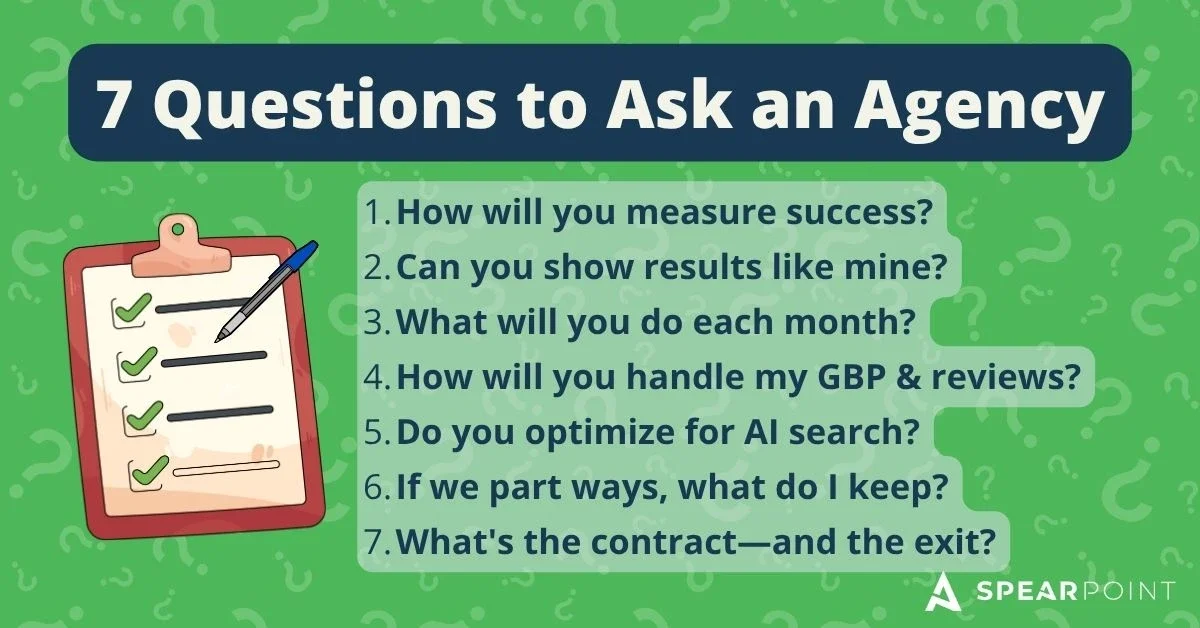
The Questions to Ask Before You Sign
This is the part to screenshot. Ask every one of these, and listen for the difference between a specific answer and a comfortable one.
"How will you measure success—and how will I see it?"
Good answer: Leads, trial signups, booked intro sessions, calls, form fills, and new members traced back to search. You get a dashboard that ties rankings to actual inquiries.
Bad answer: "We'll track keyword rankings, impressions, and organic traffic growth." Those are vanity metrics. They go up while your membership stays flat, and they exist mostly to make a report look productive.
"Can you show me results for businesses like mine?"
Good answer: Named local or service-business case studies with real before-and-after numbers—and references you can actually call.
Bad answer: A wall of logos, a vague "we've helped hundreds of businesses," and no specifics. Logos aren't results. Anyone can put a logo on a slide.
"What, specifically, will you do each month?"
Good answer: A concrete scope—on-page optimization, local landing pages, Google Business Profile work, content, technical fixes, review strategy—with deliverables you can point to.
Bad answer: "SEO services" and "ongoing optimization." That's a blank check written in your favor only in theory.
"How do you handle my Google Business Profile and reviews?"
Good answer: It's central to their plan. For a gym, your Google Business Profile is your storefront, and reviews are the deciding factor for most prospects. They'll have a clear strategy for both.
Bad answer: A shrug, or treating it as an afterthought. An agency that ignores your Google Business Profile doesn't understand local search for gyms.
"Are you optimizing for AI search too?"
Good answer: Yes—and they can explain, in plain English, how they get a gym cited by ChatGPT, Perplexity, and Google AI Overviews.
Bad answer: A blank stare, or "that's not really a thing yet." It's a thing. Your prospects are already using it.
"If we part ways, what do I keep?"
Good answer: Everything. Your website, your content, your Google Business Profile, your analytics—all yours, no drama.
Bad answer: Anything that sounds like your site lives on their platform, your profile is under their account, or leaving means starting from zero. That's not a contract, it's a hostage situation.
"What's the contract length, and how do I get out?"
Good answer: Month-to-month, or a clear term with a clean exit and performance you can hold them to.
Bad answer: A twelve-month lock-in with no accountability built in. SEO takes time, and a reasonable commitment is fair—but a long contract should buy you more accountability, not less.
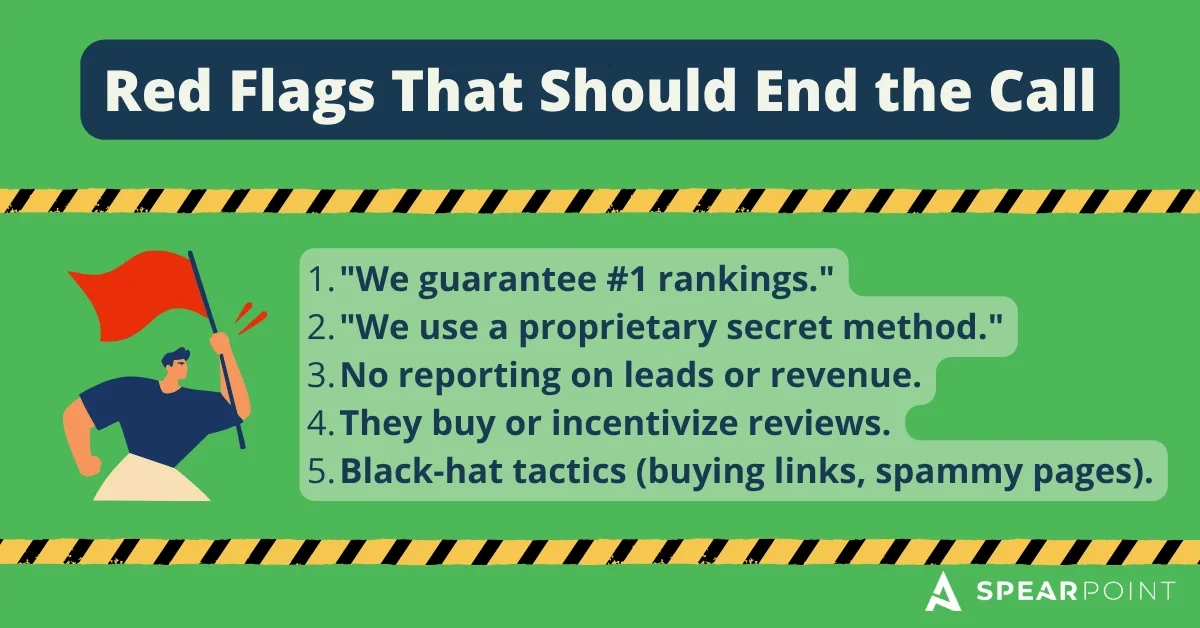
Red Flags That Should End the Call
Some answers aren't yellow flags to weigh. They're the exit.
"We guarantee #1 rankings on Google." Nobody controls Google's algorithm. This is either a lie or a sign they'll chase junk keywords they can rank to hit the promise.
"We use a proprietary secret method." Real SEO isn't a magic trick. Secrecy usually means either nothing's happening or something sketchy is.
No reporting on leads or revenue. If they only report traffic and rankings, they're hiding the one scoreboard that matters.
They buy or incentivize reviews. Fake reviews violate platform policies and can get your profile penalized or removed. For a gym that lives on trust, it's a catastrophic risk.
Black-hat tactics—link schemes, private blog networks, keyword-stuffed junk pages. Cheap and fast until Google notices, then your visibility disappears overnight.
Green Flags Worth Paying For
The flip side—the signals you've found a keeper:
They ask you about your membership goals, pricing, and best-fit clients before they talk tactics.
They lead with leads and revenue, not rankings.
They're transparent about exactly what they do and why.
They treat local SEO, your Google Business Profile, reviews, and AI search as one connected system.
You own everything, and they'll put it in writing.
They give you references without flinching.
Make the Decision: A Quick Scorecard
Interviewing two or three agencies? Score each one. The math gets honest fast.
| Criteria | Weak Agency | Strong Agency |
|---|---|---|
| Measures success by | Rankings, impressions, traffic | Leads, trials, new members |
| Proof offered | Logos and vague claims | Named results and references |
| Monthly scope | "SEO services" | Specific, listed deliverables |
| Google Business Profile & reviews | Afterthought | Core to the plan |
| AI search (AEO) | "Not a thing" | Clear, explained strategy |
| Ownership if you leave | Murky or hostage | 100% yours, in writing |
| Contract | Long lock-in, no accountability | Fair term, real accountability |
If an agency lands in the left column on measurement, ownership, or proof, the pitch doesn't matter. Keep looking.
Conclusion
Choosing a gym SEO agency isn't about finding whoever promises the most. It's about finding the one honest enough to promise the right thing—members, measured—and transparent enough to prove it.
The agencies that grow your gym give themselves away in the first conversation. They ask about your membership goals before your keywords. They talk leads before rankings. They'll hand you the questions above and answer every one without squirming.
Ask the questions. Watch for the flags. And don't sign anything until you're confident the person across the table is building your membership, not just their invoice.
Your schedule should be full because the right people found you. That's the whole job.
Not sure whether your current SEO is pulling members or just padding a report?
Get a free gym SEO & AI-visibility audit—we'll show you exactly where prospects are finding your competitors instead of you.
FAQ
-
Most reputable agencies charge somewhere between a few hundred and a few thousand dollars a month, depending on your market's competitiveness and how much they're doing. Be wary of the extremes: bargain-basement pricing usually means automated junk, and premium pricing is only worth it if it's tied to lead and revenue reporting you can verify.
-
Expect early movement in three to six months and stronger, compounding results past six to twelve. Local wins—an optimized Google Business Profile, local landing pages, and a steady flow of reviews—often produce trial signups faster than broad content does. Any agency promising instant #1 rankings is telling you what you want to hear, not the truth.
-
A strong Google Business Profile is essential, but it's one piece. You're still competing with every other gym's profile, and you don't control the local pack. Your website, local pages, review strategy, and AI-search visibility separate you from the studio down the street with an equally nice profile.
-
Yes. Prospects increasingly ask ChatGPT, Perplexity, and Google's AI Overviews for gym recommendations, and those answers are built from web content an agency can influence. If a prospective agency can't explain how they'll get you recommended in AI search, they're working with an outdated playbook.
-
Guaranteeing specific rankings. Nobody controls Google's algorithm, so the promise is either dishonest or a setup to chase worthless keywords they can actually rank. Right behind it: refusing to report on leads and revenue, and any contract that doesn't leave you owning your own website and Google Business Profile.
Suggested External Links Used in This Post
About the Author

Jesse McFarland is the founder of SpearPoint Marketing, a conversion-focused SEO and AI search agency based in Centennial, Colorado. Jesse has more than 17 years of digital marketing experience across B2B, SaaS, healthcare, legal, fitness, ecommerce, and startup organizations.
He specializes in helping companies turn organic search into qualified demand through modern SEO, AEO, GEO, AI Visibility, content strategy, technical SEO, and brand-first search marketing. Jesse helps business owners and marketing leaders understand how search is changing without losing their minds every time someone on LinkedIn announces SEO is dead again.